Your Guide to a Career in Sport Marketing
So you want a career in sport marketing? It's a field that pulls in thousands of people who dream of blending their love for the game with their professional life. But it's about much more than just snagging great seats; it's the strategic engine that fuels the entire sports industry, connecting teams, brands, and athletes with millions of die-hard fans across the globe.
This career path is where a passion for sports collides with sharp business savvy, creative thinking, and a healthy dose of data-driven decision-making.
What a Career in Sport Marketing Really Involves
Let's get one thing straight: working in sports isn't just about perks and free tickets. Sure, those things can happen, but the day-to-day reality of a modern sport marketing career is built on strategy, relentless hard work, and delivering results you can actually measure. It’s less about being a fan and more about figuring out what makes someone become a fan in the first place.
Think of a sports marketer as part storyteller, part business developer, and part community builder. Your main job is to forge and strengthen the emotional bond between a sports entity—whether that's a team, a league, or a single athlete—and its audience. That connection is the bedrock for everything else, from selling out stadiums to landing multi-million dollar sponsorship deals.
Beyond the Sidelines
A successful career in sport marketing demands a surprisingly diverse skill set that goes way beyond knowing player stats or the history of your favorite team. It's about taking solid business principles and applying them to the chaotic, high-energy world of sports.
Here’s a taste of what you’ll actually be doing:
- Fan Engagement: You'll be the brain behind the campaigns and experiences—both online and inside the venue—that keep fans buzzing with excitement and loyalty.
- Brand Partnerships: This involves identifying, negotiating, and bringing to life sponsorships with corporate brands that make sense for your team's image and values.
- Digital Content: You'll create powerful stories through social media, video, and websites to expand your team's presence and reach a wider audience.
- Data Analysis: Forget gut feelings. You'll use analytics to understand who the fans are, track how well your campaigns are performing, and make smarter strategic moves.
The core of sport marketing is translating passion into profit. It's the art and science of taking the raw emotion of a game-winning goal or a championship victory and turning it into a sustainable business model that benefits teams, sponsors, and fans alike.
The global sports market isn't just growing—it's exploding. Projections show it could rocket to $680 billion by 2028, growing at a compound annual rate of over 9.13%. This incredible expansion means there's a huge demand for skilled marketers who can keep up with new trends and technologies. If you want to dive deeper, you can explore statistics that define sports marketing and see the numbers for yourself.
Ultimately, a career in sport marketing puts you in the architect's chair for the entire fan experience. You're the one building the bridge between the on-field drama and the off-field excitement, ensuring the magic of the game thrives long after the final whistle blows.
To give you a clearer picture, let's break down the essential elements of a career in this dynamic field.
Key Facets of a Modern Sport Marketing Career
| Aspect | Description |
|---|---|
| Primary Goal | To build and monetize the emotional connection between a sports entity and its fans through strategic campaigns and partnerships. |
| Work Environment | Fast-paced and deadline-driven. Can range from corporate offices to live event venues, often requiring work on nights and weekends. |
| Core Skills | A blend of creativity (storytelling, content creation) and analytical ability (data analysis, market research, ROI measurement). |
| Key Relationships | Involves constant collaboration with sales teams, corporate sponsors, media partners, athletes, and fan communities. |
| Measures of Success | Tangible results like ticket sales, merchandise revenue, sponsorship value, audience growth, and fan engagement metrics. |
As you can see, the role is multifaceted, blending business acumen with a genuine understanding of what makes sports so captivating. It's a challenging but incredibly rewarding path for those ready to get in the game.
Mapping Your Path in the Sport Marketing World
A career in sport marketing isn’t a single, straight highway. It's more like a transit map full of interconnected lines, each leading to a different destination. You might find yourself working in-house with a pro team, diving into the fast-paced world of a specialized agency, or joining the corporate side with a major brand that sponsors sports. Each path offers a totally unique experience and its own set of challenges.
Where you decide to start really comes down to your career goals and what kind of work environment you prefer. Do you want to live and breathe a single team’s brand, shaping its story from the inside out? Or do you get a buzz from variety, juggling multiple clients and projects at once? Figuring that out is the first real step in plotting your course.
At its core, sport marketing boils down to a few key functions: high-level strategy, direct fan engagement, and crucial sponsorship management.
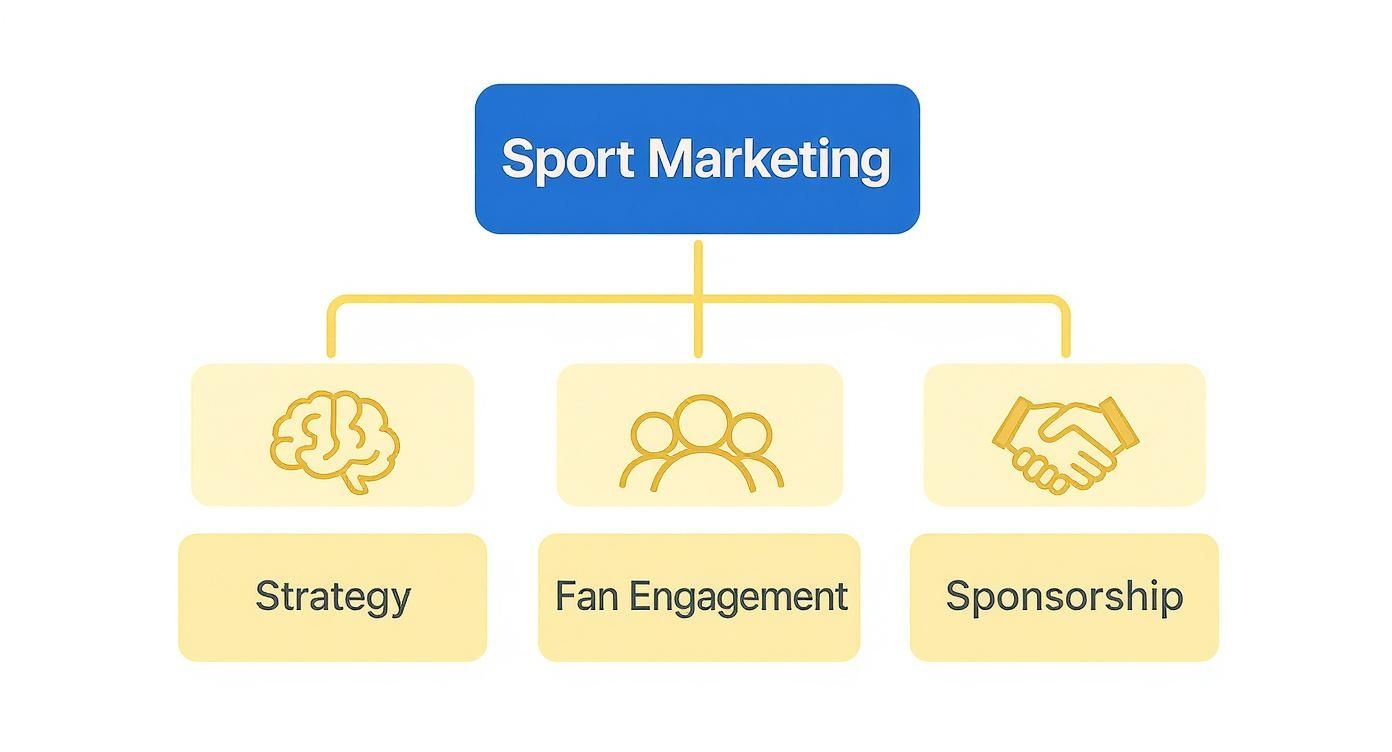
This simple breakdown shows that no matter which path you take, these three pillars are what hold the entire industry up.
Exploring the Main Career Arenas
To find your best fit, let’s unpack the three main settings where sport marketers build their careers. Each gives you a distinct perspective on the industry and helps you develop different professional muscles.
Working for a Team or League (The "In-House" Role): This is total immersion. Your focus is singular: grow the fanbase, sell tickets, and build a deep connection with the community for your club. Job titles here often look like Fan Engagement Coordinator, Social Media Manager, or Partnership Activation Specialist.
Working for an Agency: Agencies are the ultimate multi-taskers, serving a roster of clients from individual athletes to entire leagues and massive sporting events. Life here is project-based and incredibly varied. One month you might be launching a new ticketing campaign for a football club; the next, you’re managing PR for a major golf tournament.
Working for a Corporate Brand: Think about the big names you see on jerseys and stadium signs. Companies like beverage giants, car manufacturers, and tech firms have dedicated sport marketing teams. Their goal is to manage sponsorships and use the power of sport to reach their customers. A Brand Manager in this setting might decide which teams or athletes to partner with to get the biggest bang for their buck.
To get a clearer picture, let's compare these paths side-by-side.
Comparing Sport Marketing Career Paths
| Career Path | Primary Focus | Typical Roles | Pros | Cons |
|---|---|---|---|---|
| Team/League (In-House) | Building one specific brand, fan loyalty, and ticket/merch sales. | Social Media Manager, Fan Engagement Coordinator, Partnership Activation | Deep brand immersion, strong sense of team loyalty, seeing direct impact of your work. | Slower pace, can be creatively limiting, career growth may depend on team's success. |
| Agency | Serving multiple sports clients with campaign-based projects. | Account Executive, Digital Marketing Specialist, Sponsorship Consultant | Fast-paced, high variety, rapid skill development, broad industry network. | Long hours, high pressure, less ownership of a single brand's long-term success. |
| Corporate Brand | Using sports as a marketing platform to drive business goals. | Brand Manager, Sponsorship Manager, Experiential Marketing Lead | Strategic perspective, larger budgets, connects sports to broader business objectives. | Sports is a means to an end, not the core product; more corporate structure. |
As you can see, the path you choose really shapes your day-to-day experience. An in-house role is all about deep loyalty, agency life provides a whirlwind of experience, and the corporate side offers a unique view of how sports drive big business.
No matter which route you’re drawn to, setting clear objectives is a must for getting ahead. As you map out your journey, it’s a smart move to set actionable development goals to advance your career. This keeps you focused and helps you build the specific skills you'll need for that next big step.
A great way to see how these differences play out in the real world is to browse current sport marketing roles on GetSportJobs. Looking at how companies describe these positions will give you a much clearer idea of where your talents and interests fit best.
The Essential Skills Every Sport Marketer Needs
To make it in sport marketing, loving the game is just the entry ticket. Real success demands a specific mix of hard skills and soft skills—the kind that separates a true pro from a passionate fan. Think of it like a star athlete's toolkit. You need the raw power (your technical skills) and the game-day intelligence (your people skills) to actually win.
This blend is what lets you transform the raw, emotional energy of fandom into tangible business results. Great ideas are useless without the technical chops to bring them to life, and even the most brilliant data-driven strategy will fall flat if you can't inspire people to get behind it.

Core Hard Skills: The Technical Playbook
Hard skills are the measurable, teachable abilities that form the bedrock of your day-to-day work. These are the non-negotiables—the practical tools you'll use to launch campaigns, track performance, and ultimately, drive revenue.
- Data Analytics: This goes way beyond just looking at spreadsheets. It's about reading the story the numbers tell—decoding fan behaviour, proving the ROI on a sponsorship deal, and using tools like Google Analytics to make smart decisions, not just lucky guesses.
- Digital Marketing Mastery: You have to speak the language of the modern fan fluently. This means running social media platforms that actually engage people, using SEO to pull in new audiences, and writing email campaigns that don’t just get opened—they sell tickets.
- Content Creation: Whether you're scripting a viral TikTok video, writing a blog post that fans actually want to read, or designing a sharp graphic for Instagram, the power to create content that grabs attention is absolutely critical.
- Sponsorship Acumen: This is the art and science of partnerships. It involves knowing how to price sponsorship assets, building proposals that brands can't refuse, and managing those relationships so everyone comes out a winner.
It's also worth noting that as you build these skills, you're aligning with a broader shift in hiring, with the growing emphasis on skills over traditional degrees in various industries.
Crucial Soft Skills: Winning the People Game
Your technical skills might get you the interview, but it's your soft skills that will build your career. These are the interpersonal traits that dictate how you collaborate, solve problems, and keep up with the breakneck pace of the sports world.
Soft skills are the game-changers. They are the difference between managing a campaign and leading a movement, between closing a deal and building a lasting partnership.
You can't list them on a certificate, but a great marketer's soft skills are impossible to miss.
- Creative Vision: It’s that spark. It’s the ability to dream up a viral campaign out of thin air or spot a unique partnership angle that everyone else missed.
- Communication and Storytelling: Can you sell an idea to a skeptical executive? Can you write copy that gives fans goosebumps? You have to be a master storyteller, capable of making people feel the passion behind the brand.
- Negotiation: From getting a better rate from a vendor to hammering out the final details of a multi-million-dollar sponsorship, strong negotiation skills are essential to protecting your organisation's bottom line.
- Adaptability: The sports calendar is relentless and unpredictable. You have to be able to pivot when a campaign flops, embrace a new social media platform overnight, and stay cool under pressure. It's not a "nice to have"—it's a survival skill.
Your Playbook for Breaking Into the Industry
So, you've decided you want a career in sport marketing. That’s the easy part. The real game begins now: figuring out how to get your foot in the door of an industry that’s notoriously competitive. Landing a job here isn't about luck; it's about having a smart, actionable game plan that makes you stand out from every other passionate fan.
The goal is to stop being just a spectator and start being an active participant, even before you land that first official role. You need to build a foundation of tangible proof—a professional highlight reel, if you will—that shows you have the skills, drive, and understanding to contribute from day one.

Gain Hands-On Experience
Classroom theory is important, but experience is what gets you hired. The sports world values people who have already proven they can thrive in its fast-paced, high-pressure environment. It’s time to find opportunities that get you off the sidelines and into the action.
- Internships: They're the classic entry point for a reason. Securing an internship with a team, an agency, or a college athletic department gives you priceless, real-world training and, just as importantly, connections.
- Volunteering: Raise your hand to help at local sporting events, charity tournaments, or even youth leagues. It’s a fantastic way to show initiative and network with industry pros in a more natural, less formal setting.
- On-Campus Roles: If you're still a student, your university's athletic department is a goldmine. Look for any available roles in game-day operations, social media management, or marketing support.
Your goal is to collect stories and results you can talk about. Instead of just saying you're a hard worker, you'll be able to say, "During my internship, I helped increase student attendance at basketball games by 15% by launching a targeted social media campaign."
Build a Portfolio That Proves Your Skills
A resume lists your experiences; a portfolio shows them. This is your chance to give hiring managers a real taste of your creative and strategic thinking, especially if you don't have a ton of formal work on your C.V. yet. A simple website or even a polished PDF can work wonders.
Here are a few things you could create for it:
- A mock marketing plan for your favorite team's next season.
- Social media content you designed for a class project or a small local club.
- A blog post where you analyze a recent, successful sponsorship deal in the industry.
Taking this kind of initiative proves you can already do the work. It makes it much easier for a hiring manager to see you fitting right into their team. Remember, your resume might get you the interview, but it's your experience and portfolio that will help you land the job.
Understanding Salaries and Career Growth
Let's talk about the money and the long game. Passion might get you in the door, but knowing the financial reality and seeing a clear path forward is what builds a real career. In sports marketing, your salary isn't a simple number; it’s a mix of your role, where you live, and who you work for.
For example, an entry-level Marketing Coordinator for a minor league team might start around $40,000. But land that same job with a major league franchise in a big city like New York or LA, and you could be looking at $55,000 or more right out of the gate. As you rack up wins and experience, your earning potential grows—a lot.
Typical Salary Benchmarks
To give you a better idea of what to expect, here’s a rough breakdown of salary ranges at different career stages. Remember, these are just ballpark figures and can swing based on countless factors.
- Entry-Level (0-2 years): Think Social Media Coordinator or Partnership Activation Assistant. Here, you're focused on execution and learning the business from the ground up. Expect a salary in the $40,000 to $60,000 range.
- Mid-Level (3-7 years): Once you step into a Marketing Manager or Sponsorship Manager role, you’re not just doing the work—you’re starting to steer the ship. Salaries here often climb into the $65,000 to $95,000 bracket.
- Senior-Level (8+ years): At the Director or VP level, you're leading teams, setting the vision, and managing major budgets. These leadership roles can command salaries from $100,000 to $180,000+, especially at big-name leagues or global brands.
What’s driving this growth? The industry is incredibly healthy. The sports sponsorship market alone is projected to hit $115 billion by 2025, growing at a powerful 8.7% clip. That expansion means more high-value jobs are opening up, especially for people who understand data, fan engagement, and strategic partnerships. You can discover more about the sports industry's outlook to see just how big the opportunity is.
Your career trajectory is a ladder you build yourself. The first few rungs are about proving you can handle the day-to-day grind. Every step up from there demands more—more strategic thinking, more leadership, and a proven ability to drive revenue.
Charting Your Career Trajectory
Growth in a career in sport marketing is about more than a bigger paycheck; it's about making a bigger impact. Your path will be unique, but it often follows a familiar progression:
- Coordinator: You're in the trenches, executing the daily tasks that make campaigns happen.
- Manager: You start owning entire projects. You might manage a small team or a budget and are responsible for reporting on results.
- Director: You’re in charge of a whole department, like digital media or corporate partnerships. You’re setting the long-term strategy and managing a serious budget.
- Vice President/CMO: You’re at the executive table. The organization's entire marketing vision and its direct impact on the bottom line rests on your shoulders.
It's a clear path that shows how today's hard-working intern can become tomorrow's visionary leader, shaping how millions of fans connect with the games they love.
How to Find and Land Sport Marketing Jobs
Knowing you want a job in sports is one thing; actually finding and landing it is a whole different ball game. Your practical job hunt starts now, and success demands a smarter approach than just blasting your resume across massive, generic job sites. The key is knowing exactly where to look to cut through the noise.
Think about it: general job platforms can be overwhelming, burying the roles you actually want under thousands of completely unrelated listings. This is why specialized, sport-specific job boards are your most powerful tool. They're built for our industry, which means every single listing is relevant to your career goals.
Master Niche Job Boards
Platforms dedicated exclusively to the sports industry are your secret weapon. They’re the places where hiring managers from teams, leagues, and agencies go when they need to find talent like you.
For example, GetSportJobs pulls hundreds of current opportunities into one central hub. Instead of wading through a sea of irrelevance, you can filter directly for marketing, sales, or operations roles, making your search infinitely more efficient.
The screenshot above gives you a glimpse of how a specialized platform organizes jobs by category, letting you zero in on what matters. Using these tools means you spend less time sifting and more time perfecting the applications that count.
Perfect Your Application Tools
Once you’ve found the right opportunities, your resume and cover letter have to be flawless. Generic applications get ignored—it’s that simple. You need to tailor every single one to the specific job description, highlighting the exact skills and experiences that employer is asking for.
Think of your resume as your personal highlight reel. It needs to be concise, powerful, and customized for every single "game"—or job application—you enter.
Before you hit send, it's a good idea to run your documents through a tool that can spot weaknesses. You can get instant, targeted feedback and boost your chances by using a dedicated sport industry resume analyzer to make sure your application is ready for the big leagues.
Finally, treat LinkedIn as more than just a digital resume. Follow the companies you admire, genuinely engage with their posts, and start connecting with people who have the kinds of jobs you want. Building real connections can open doors that a cold application never could. This proactive strategy is what turns a passive job search into a winning one.
Common Questions About Sport Marketing Careers
Diving into a new career path always stirs up a few big questions. If you're setting your sights on sport marketing, you’re probably wondering about everything from what degree you need to where you should even start looking. Getting solid answers now helps you build a smarter game plan for landing your dream job.
Let's clear up some of the most common uncertainties we hear from aspiring pros. Think of this as your pre-game huddle to help you focus your energy where it matters most.
Do I Need a Specific Degree?
While a degree in Sport Management, Marketing, or Business can give you a great head start, it's definitely not the only way to get in the game. Plenty of successful marketers have broken into the industry with backgrounds in communications, public relations, and even data science.
What truly matters isn't the title on your degree, but the skills you can prove you have. A killer portfolio filled with class projects, volunteer experience, or even mock campaigns will often catch a hiring manager's eye more than a specific major.
At the end of the day, your passion for the game and the skills you've picked up from internships or personal projects are what count. Your ability to show what you can actually do is your biggest asset.
Agency or Team: Which Is a Better Start?
There’s no magic answer here—it really comes down to your personality and what you want out of your career. Both paths offer unique perks for kicking things off in sport marketing.
- Agency Life: Jumping in at an agency throws you into the deep end with a ton of different clients, sports, and projects. It's a fantastic way to learn fast, build a diverse skill set, and grow your professional network in a hurry.
- Team/League Life: Starting on the inside with a team lets you go all-in on a single brand. You get to live and breathe its culture, becoming an expert on its specific fanbase and market.
If you love variety and a fast-paced environment, an agency might be your perfect match. But if you're passionate about one specific team and want to shape its story from the ground up, an in-house role is the way to go. For more industry deep-dives, you can explore our sport marketing blog for tons of articles and advice.
How Important Is Networking?
Let's be blunt: in the sports world, networking isn't just important—it's everything. This industry is a surprisingly small, tight-knit community where a personal connection can open doors that a cold online application never will.
The key is to build genuine relationships, not just collect contacts. Show up at industry events, share your thoughts on LinkedIn, and reach out to professionals whose careers you admire. A strong, authentic network is your ultimate competitive edge.
Ready to find your spot on the roster? GetSportJobs is the leading job board for the sports industry, connecting talented people just like you with top-tier teams, leagues, and brands. Stop scrolling endlessly and start finding the best opportunities, all in one place. Explore open roles on GetSportJobs today!