Your Guide to Careers in College Athletics
A career in college sports isn't just about what happens on the field or court. It's a massive, vibrant industry humming with professionals who handle everything from marketing and media to keeping athletes healthy and ensuring the entire department plays by the rules. Think of it as the ultimate team behind the team, where a shared passion for sports fuels a wide range of exciting careers.
Why a Career in College Sports Is More Than Just Coaching
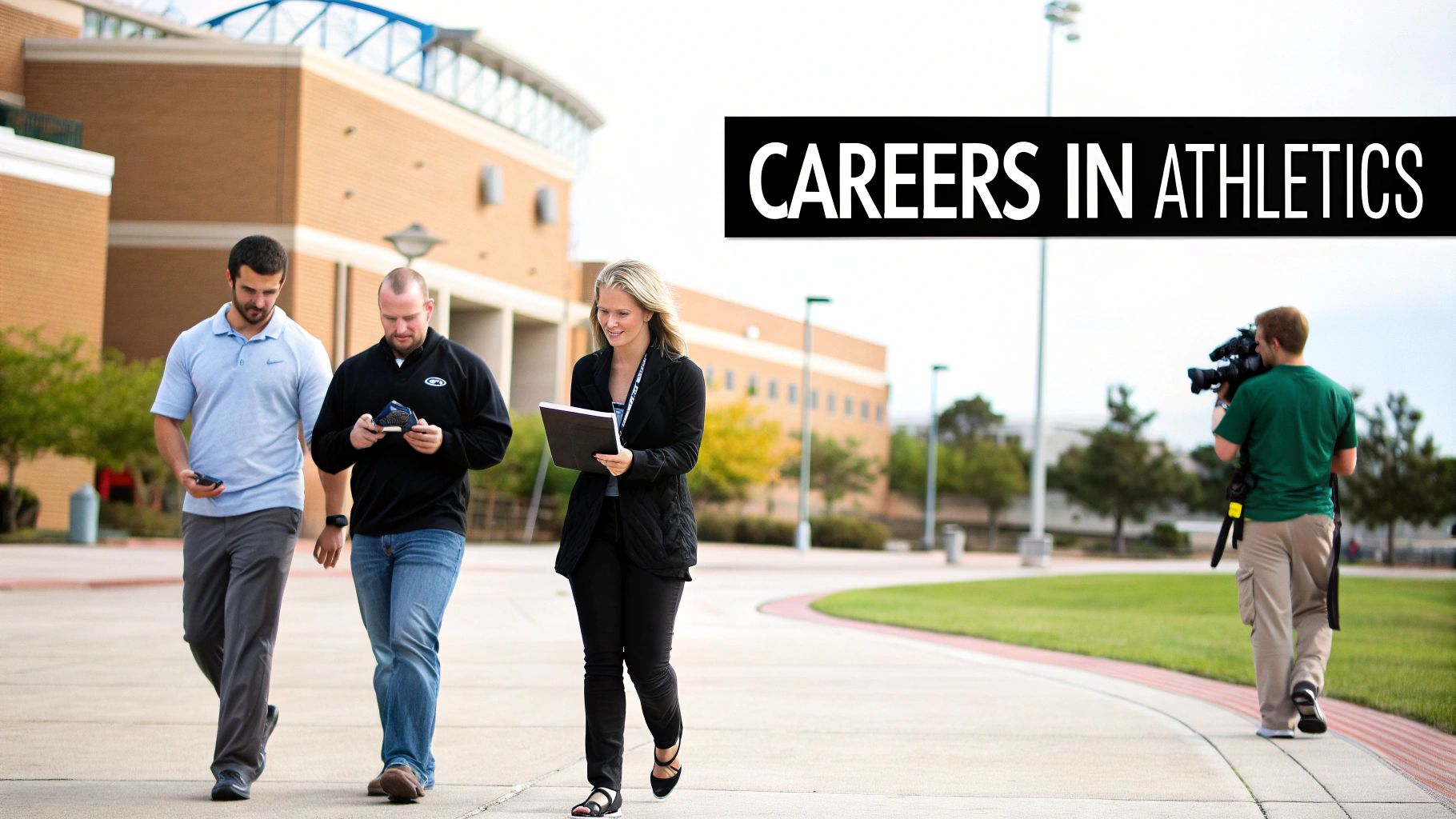
When you picture careers in college athletics, you probably imagine a head coach pacing the sidelines or an assistant coach drawing up plays on a whiteboard. While coaching is definitely a cornerstone of any athletic program, it’s just the tip of the iceberg.
The truth is, a successful athletic department operates like a dynamic, fast-paced business. You've got executives (the Athletic Director), a legal department (Compliance), health and wellness experts (Athletic Trainers, Strength & Conditioning Coaches), and a full-blown marketing and PR team (Sports Information, Marketing). Every single role is crucial, and they all work together to support student-athletes and create the unforgettable experiences that define college sports.
A Look Inside the Athletic Department
To really get a feel for where you might fit in, it helps to break down the key functions of a modern athletic department.
- Performance and Coaching: This is the most visible arm, focused directly on recruiting, training athletes, and winning games.
- Administration and Operations: These are the strategists and planners who manage budgets, oversee facilities, and guide the department's long-term vision.
- Student-Athlete Support: This group is dedicated to the well-being of the athletes, from their physical health and academic eligibility to their mental wellness.
- External Relations: This is the public-facing side of things, responsible for generating revenue, engaging with fans, and telling the department's story.
To give you a clearer picture, let's lay out the most common career paths. This table provides a quick snapshot of who does what and the skills you'll need to succeed. As you look through these roles, think about how your own passions and skills could translate.
And when you're ready to see what's out there, job boards like GetSportJobs are the perfect place to explore real-world openings and get a feel for the market.
Key Career Paths in College Athletics at a Glance
This table breaks down the major career categories, giving you a sense of their primary mission and the skills that are most valued.
| Career Path | Core Function | Essential Skills |
|---|---|---|
| Athletic Administration | Strategic oversight, budget management, and departmental leadership | Leadership, financial acumen, strategic planning |
| Coaching | Athlete development, recruitment, and game strategy | Tactical knowledge, communication, mentorship |
| Strength & Conditioning | Designing and implementing physical training programs | Exercise science, motivation, data analysis |
| Athletic Training | Injury prevention, treatment, and rehabilitation for athletes | Medical knowledge, quick decision-making, empathy |
| Compliance | Ensuring adherence to NCAA, conference, and institutional rules | Attention to detail, legal interpretation, ethics |
| Sports Information | Managing media relations, statistics, and brand storytelling | Writing, public relations, social media savvy |
Each of these paths offers a unique way to contribute to the success of student-athletes and the thrill of college competition. The key is finding the role that aligns best with your talents and long-term goals.
The Core Roles Powering Every Athletic Department
When you see the final score on the board, you're only seeing the tip of the iceberg. The real work in college athletics happens long before the first whistle blows. Behind every winning team and every successful student-athlete is a whole army of dedicated professionals, each playing a vital part. These are the people who power the entire department, turning passion into performance.
Think of an athletic department as a high-performance engine. The coaches and athletes might be the most visible parts, but a complex system of administrators, trainers, and communicators keeps that engine running smoothly, efficiently, and within the rules. Let's pull back the curtain on these core careers to see what they're really about day-to-day.
Athletic Administration: The Visionaries and Strategists
Sitting at the top of the food chain is Athletic Administration. These are the executives of the sports world, led by the Athletic Director (AD). Their job is all about the big picture—the long-term health, financial stability, and strategic direction of the entire department. They aren't just managing teams; they're building a sustainable brand and a multi-million dollar business.
An AD's day could swing from negotiating a massive media rights deal to approving plans for a new stadium, to hiring the next head football coach. They are the ultimate decision-makers, and their responsibilities cover everything from budget allocation to NCAA compliance. To thrive here, you need a sharp business mind, serious leadership skills, and a knack for fundraising and building relationships with people like alumni and donors.
Did you know? The sports job market is holding strong. Job growth across all sports-related industries has been expanding by more than 1.3 percent annually. On top of that, the U.S. Bureau of Labor Statistics projects that employment for postsecondary education administrators—which includes many sports administration roles—will grow 8 percent from 2020 to 2030. You can dig into more insights on the growing sports job market from research done by Emporia State University.
Coaching Staffs: The Architects of Victory
This is the job everyone thinks of first when you mention careers in college athletics, and for good reason. Coaches are the on-the-ground leaders who recruit, develop, and mentor student-athletes. But their world is so much bigger than just the X's and O's of game day.
A coach's day is a constant juggle. They're constantly shifting between different roles:
- Recruiting: This means hours spent watching film of high school prospects, traveling across the country for in-person evaluations, and building genuine relationships with potential student-athletes and their families.
- Player Development: They're on the field or court running practices, designing drills, and giving one-on-one instruction to help every athlete hit their peak potential.
- Game Planning: This involves deep-dive analysis of opponents, creating strategies, and getting the team mentally and physically ready for the next battle.
- Mentorship: They also wear the hat of a mentor, helping student-athletes navigate the intense pressures of college life, both in the classroom and out.
Success in coaching demands an encyclopedic knowledge of your sport, fantastic communication skills, and an almost supernatural ability to motivate and lead.
Strength and Conditioning: The Performance Engineers
While head coaches are designing the game plan, Strength and Conditioning (S&C) Coaches are busy building the athletes who can actually execute it. These are the experts in exercise science, the ones responsible for creating training programs that boost performance while keeping injuries at bay. They are, quite literally, the architects of speed, power, and endurance.
You'll find S&C coaches in the weight room and on the field, guiding athletes through workouts specifically tailored to their sport and position. They're obsessed with data and technology, using it to track progress and fine-tune programs to make sure athletes are at their absolute peak when it matters most.
To get into this field, a degree in Kinesiology or Exercise Science is pretty much standard. The real ticket, though, is the Certified Strength and Conditioning Specialist (CSCS) certification—it’s the gold standard that most employers won't hire without.
Athletic Training: The Health and Wellness Guardians
Injuries are an unfortunate, but unavoidable, part of sports. Athletic Trainers (ATs) are the healthcare professionals who serve as both first responders and long-term caretakers for student-athletes. They specialize in preventing, diagnosing, and treating muscle and bone injuries.
Their work is incredibly hands-on and often high-stakes. One minute, an AT is taping an ankle before practice; the next, they're sprinting onto the court to assess a serious injury mid-game. They also manage the entire rehab process, working tirelessly to get athletes back to playing safely. A bachelor's or master's degree in athletic training and certification from the Board of Certification (NATA-BOC) are non-negotiable requirements.
Compliance: The Rule Keepers
College athletics is governed by a mountain of rules from the NCAA, the conferences, and the universities themselves. The Compliance department is the team tasked with navigating this incredibly complex legal landscape. Their job is to make sure everyone—from coaches and student-athletes to boosters—is playing by the book.
A compliance officer's job is a mix of education, monitoring, and enforcement. They might spend a morning reviewing a recruit's academic transcripts to confirm eligibility, then spend the afternoon interpreting a dense new NCAA bylaw for the coaching staff. This role demands a meticulous eye for detail, a rock-solid ethical compass, and the ability to explain complicated rules in a way people can actually understand. A background in law or sports administration is a huge plus here.
Sports Communications: The Storytellers
Finally, there’s Sports Communications—a department often called Sports Information or Media Relations. These are the storytellers, the voice of the athletic department. They act as the bridge between the teams and the public, shaping the department's brand and controlling the narrative.
Their responsibilities are all over the map and move at a breakneck pace:
- Media Relations: They write press releases, set up interviews for coaches and athletes, and manage the chaos of a post-game press conference.
- Content Creation: They're the ones producing all the content for the official athletics website and social media, from game recaps to in-depth feature stories.
- Statistics Management: They keep the official stats during games and are the keepers of the program's history books and records.
To succeed here, you need to be a great writer, have a real knack for public relations, and live and breathe social media. They are the ones who shape how fans, the media, and potential recruits see the program, making their work absolutely essential to the department's public image.
How to Map Your Career Trajectory
Moving up in college athletics isn’t a sprint; it’s more like a chess match. You can’t just put your head down and hope for the best. It’s all about making calculated moves, getting the right kind of experience, and building a reputation that opens doors for you. A well-thought-out career plan is what separates those who stall out from those who eventually land their dream job.
You have to be intentional about your next step. The industry has well-worn, if sometimes unspoken, paths to leadership. If you understand how those pipelines work, you can position yourself for the roles you want down the road and turn that ambition into an actual plan.
From Assistant to Leader: The Traditional Climb
For many jobs in college athletics, the path forward is pretty straightforward. An assistant coach learns the ropes, gets good at recruiting and developing players, and eventually earns a shot as a head coach. It’s the same in athletic training, where a graduate assistant gets their hands dirty, earns certifications, and moves up to an assistant and then head athletic trainer role.
This kind of vertical climb is common in just about every department. The trick is to crush it at every level, always volunteering for more responsibility and showing you can deliver. Think of each job as a building block that gives you the skills—and the network—you need for the next one.
- Coaching Path: Assistant Coach → Associate Head Coach → Head Coach
- Athletic Training Path: Graduate Assistant → Assistant AT → Head AT
- Communications Path: Intern/Assistant SID → Associate SID → Director of Sports Information
This is the classic structure: administration provides the oversight and strategy, while coaching and training staff handle the day-to-day with the athletes.
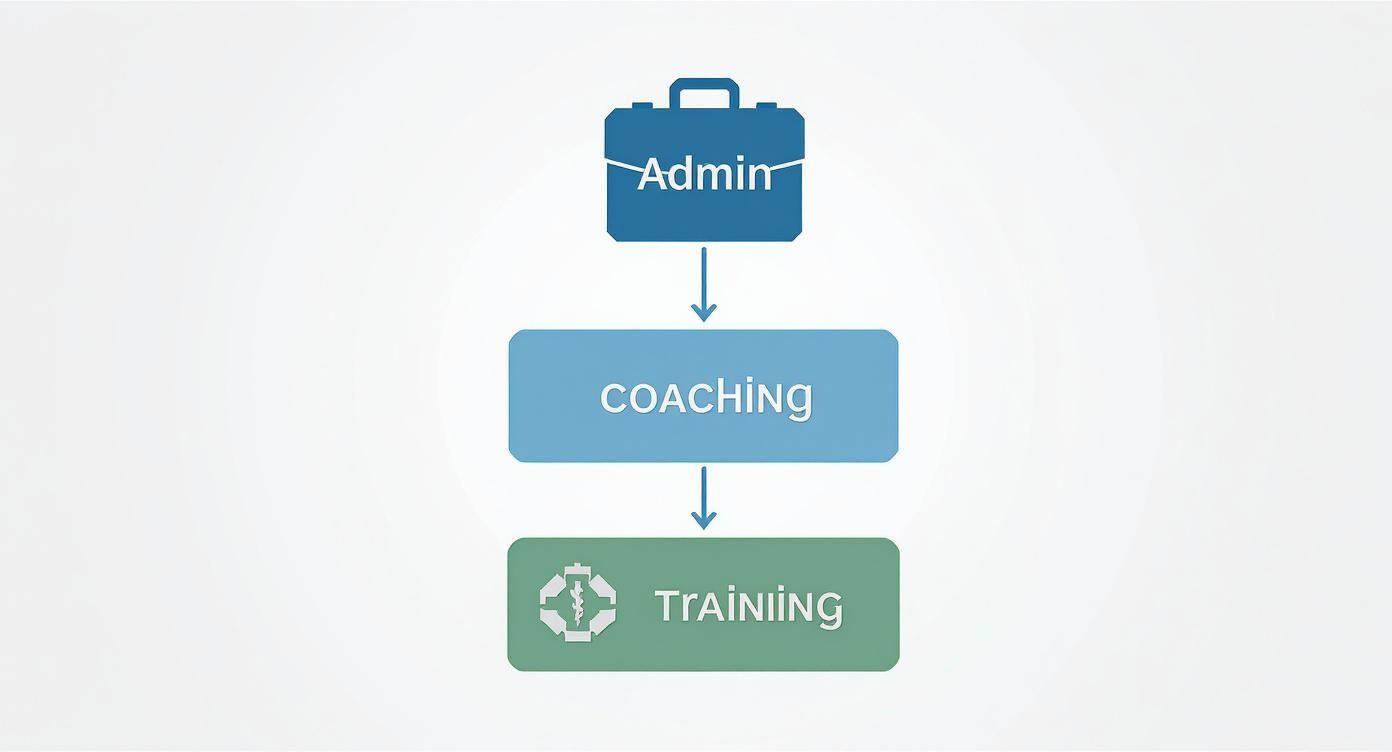
As you can see, while coaching and training are on the front lines, it's the administrative roles that steer the ship for the entire department.
The Proven Pipeline to the Athletic Director Chair
Nowhere is this idea of a clear career path more obvious than in the journey to becoming an Athletic Director (AD). The top job in a department is almost never handed to an outsider. It's earned by working your way through a few key senior administrative roles first. You simply can't leapfrog your way into the AD chair without that foundation.
The hiring data tells a pretty clear story here. Since 2020, three specific job titles have served as the launching pad for nearly 75% of all Division I Athletic Director hires. The most common stepping stone by far is the Deputy Athletic Director position, which produced 85 new ADs in five years. The next most common path was being a sitting AD who moved to a new school (71 hires), followed by Senior Associate ADs (30 hires). As HERO Sports' analysis of hiring trends shows, schools overwhelmingly prefer candidates who already have proven senior leadership experience.
Climbing the ladder to become an Athletic Director requires a deliberate strategy. Aspiring leaders must target roles like Deputy AD or Senior Associate AD to gain the specific experience in fundraising, budget management, and external relations that institutions demand.
Gaining Diverse Experience Across Divisions
One of the smartest things you can do to accelerate your career is to get experience in different NCAA divisions. If you work at a Division III school, for instance, you'll likely wear a ton of different hats. One day you're handling marketing, the next you're running game operations and answering compliance questions. That kind of broad exposure is invaluable.
That well-rounded skill set is incredibly attractive to bigger Division I and II schools. It shows them you get the entire athletic ecosystem, not just your one little corner of it.
Think about making these kinds of strategic moves:
- Start Broad: Begin at a D-III or a smaller D-II school where you can learn multiple facets of the business.
- Specialize Up: Take that wide-ranging experience and use it to land a more focused role at a larger D-II or a mid-major D-I program.
- Target the Top: Now, with a strong, diverse resume, you're a much more compelling candidate for the top-tier programs.
This approach proves you’re adaptable and have a deep understanding of how athletics works at every level. By intentionally mapping out these moves, you build a powerful career path that makes you stand out and truly prepares you for leadership.
Your Game Plan for Breaking into the Industry
Knowing the roles is one thing, but actually landing one? That's a whole different ballgame. Breaking into the hyper-competitive world of college athletics takes more than just a love of sports—it requires a smart, proactive game plan. You need to build a foundation of hands-on experience, cultivate a strong professional network, and create application materials that scream "I get it."
Think of this as your own personal recruiting process. You have to prove your value, showcase your skills, and convince hiring managers you’re ready to contribute to their team’s success from day one. Let's start building your playbook.
Secure Foundational Experience
In college athletics, experience isn’t just a nice-to-have; it’s the price of admission. Internships, volunteer roles, and graduate assistantships are the most valuable assets you can put on your resume. These are the roles where you learn the real-world rhythm of a department, make critical connections, and prove you have the grit to thrive.
These opportunities are your training ground. They let you put what you learned in the classroom into practice and show you’re serious about a career in this demanding field.
Here’s how to hunt down these vital roles:
- Start at Home: Your own university’s athletic department is the most logical place to begin. Reach out to staff in areas that interest you—operations, marketing, communications—and simply ask about volunteer or internship opportunities.
- Leverage Your Status: If you're a student, your school's career services office often has established relationships and direct listings for sports-related internships. Use them.
- Look Beyond the Big Names: Don't get tunnel vision for major Division I programs. Smaller D-II, D-III, and NAIA schools often provide more hands-on experience because their smaller staffs mean you get to wear multiple hats.
The goal of your first experiences is simple: get your foot in the door and start learning. Every task, from setting up for game day to drafting a social media post, is a piece of the puzzle that makes you a more valuable candidate.
Master the Art of Networking
You’ve heard the saying, "it's not what you know, it's who you know." In the tight-knit world of college sports, this is gospel. Networking isn't about awkwardly passing out business cards; it's about building genuine relationships with people who can offer guidance, mentorship, and eventually, a heads-up on job openings.
Your network is your professional support system. To get a leg up, it helps to understand how to apply for jobs and get hired faster by using proven strategies that prioritize relationship-building. Start connecting with intention by attending industry conferences, setting up informational interviews, and using platforms like LinkedIn to engage with leaders in the field.
Craft a Winning Resume and Cover Letter
Think of your resume and cover letter as your personal highlight reel. They need to do more than just list what you’ve done; they have to tell a compelling story about why you’re the right person for a career in college athletics. This means translating your experiences into the language of the industry.
Whether you were a student-athlete or not, you already have transferable skills. The key is to frame them effectively. This is especially true for the nearly 100,000 student-athletes from the 2025 graduating class getting ready to enter the job market. This group naturally brings incredible time management, discipline, and teamwork—all honed by balancing brutal athletic and academic schedules.
Here’s how to frame your experience for maximum impact:
- Quantify Your Achievements: Don't just say you "assisted with marketing." Instead, try: "Helped grow the team's Twitter following by 15% over the season." Numbers grab attention.
- Use Industry Keywords: Sprinkle in terms like "NCAA compliance," "game day operations," "donor relations," and "student-athlete welfare" to show you speak the language.
- Tailor Every Application: A generic, one-size-fits-all resume is a one-way ticket to the "no" pile. Research each school and department, then customize your application to spotlight the skills and experiences that matter most for that specific role.
Your application is the first impression you'll ever make. Make sure it clearly communicates your passion, your skills, and your understanding of what it really takes to succeed in the dynamic world of college sports.
Winning the Job Search and Interview
Landing a job in college athletics is more than just finding an opening—it's about proving you're the right person to help a program succeed. Getting that first interview is a huge step, but now the real work begins. This is where you transition from just another name on a resume to the candidate they can't afford to lose.
The job hunt starts with looking in the right places. Sure, you can scroll through massive, generic job boards, but the real gems are on industry-specific sites. These platforms are built for people like us, meaning you'll spend less time weeding out irrelevant posts and more time discovering opportunities that actually fit your career goals.
Finding and Tracking Opportunities
A smart job search is a focused one. Instead of casting a wide net and hoping for the best, you need to be strategic. The goal is to have the right roles come to you.

When you use a dedicated platform like GetSportJobs, you can dial in your search with filters for specific roles, divisions, and locations. It’s all about efficiency.
But before you hit "apply," get your resume in shape. Tools like a specialized resume analyzer for sports jobs are game-changers. They can scan your resume against actual job descriptions in the industry and show you where you’re hitting the mark and where you’re falling short. It's a quick way to make sure you’re highlighting the skills that hiring managers are actually looking for.
Preparing to Ace the Interview
Once an interview is on the calendar, it’s time to prepare. This is your moment to show you’re more than just a piece of paper—you’re a perfect fit for the department’s culture, vision, and team. That starts with solid research.
Go deep. Don’t just skim the athletics homepage. Dig into recent news articles, press releases, and social media. Know who the head coaches are, what the Athletic Director’s vision is, and what challenges or triumphs the department has faced lately.
Here’s what to look for:
- Recent Wins: Have any teams won a conference title? Did the department just unveil a new facility? Mentioning these shows you’re paying attention.
- Leadership’s Philosophy: Who is the AD and what do they value? Read their interviews or public statements to get a feel for their direction.
- The Vibe: Is this a D-I powerhouse where revenue and national rankings are everything? Or is it a D-III school with a deep focus on the holistic student-athlete experience? Your approach should match their reality.
This kind of detailed prep proves your interest is genuine and allows you to frame your answers in a way that resonates with their specific world.
Answering Industry-Specific Questions
In a college athletics interview, you’ll get hit with questions that go way beyond the typical, “Tell me about yourself.” They want to know you get it—the unique pressures, the odd hours, and the core mission of college sports.
You should be ready to talk about your philosophy on student-athlete well-being, how you’d handle a tricky compliance scenario, or what new ideas you have for engaging donors. Your answers need to show you’ve got both the practical chops and a real passion for what they do.
To really seal the deal, you need to articulate your value clearly. It’s critical to master communication skills for interviews so you can connect your past experiences directly to their future needs. That’s what separates the good candidates from the great ones.
Asking Insightful Questions
Remember, an interview isn’t an interrogation; it’s a conversation. The questions you ask are just as telling as the answers you give. They reveal how you think and what’s important to you.
Skip the generic questions about salary and benefits for now—that comes later. Instead, ask questions that show you’re already thinking like part of the team.
Examples of Strong Questions to Ask:
- “What are the department's biggest goals in the next couple of years, and how does this role fit into that picture?”
- “Beyond the day-to-day duties, how would you define real success for the person in this position after their first year?”
- “Could you tell me a bit about how the different teams here—like marketing, academic support, and compliance—work together on major initiatives?”
Thoughtful questions like these show you’re a serious professional looking to make a meaningful impact. It turns the interview into a collaborative discussion and leaves the hiring manager thinking, “This person is ready to get to work.”
Answering Your Questions About College Athletics Careers
Thinking about a career in college athletics? It’s a rewarding path, but it’s natural to have questions. Let's tackle some of the most common ones I hear from people trying to break into the industry.
This is your roadmap to understanding what it really takes to build a successful career in this unique world.
Do I Need a Master's Degree to Work in College Athletics?
The short answer is: not always for your first job, but you'll likely need one to move up. A master's degree is a huge advantage and often a non-negotiable for senior roles. If you're aiming for a top job like Athletic Director, Senior Associate AD, or Head Coach at a major program, a graduate degree in Sports Management or a related field is pretty much the standard.
You can definitely get your foot in the door with a bachelor's degree and some solid internship experience. But pursuing a master's shows you're serious. It also equips you with specialized knowledge in crucial areas like sports finance, NCAA law, and high-level marketing—things you need to know to lead a department.
Think of a master's degree as a career accelerator. It doesn't just help you land that first job; it unlocks the door to senior leadership roles down the line by giving you that strategic, big-picture understanding of the business of college sports.
What Is the Work-Life Balance Really Like?
Let's be direct: this is a lifestyle, not a 9-to-5 job. If you work in college athletics, you have to be passionate about it, because the hours are long. Nights and weekends are standard, especially when your sport is in season. Game days, recruiting trips, and team travel are all just part of the deal.
The entire rhythm of your year is dictated by the athletic and academic calendars, which means you'll often be working when others are on holiday. It’s incredibly rewarding work, but it demands serious dedication, flexibility, and a strong personal support system to handle the schedule. That commitment is a fundamental part of the culture in careers in college athletics.
How Important Is It to Have Played a College Sport?
Being a former college athlete is a great bonus. It gives you instant credibility and a real-world understanding of the student-athlete experience, which is a big help when you're trying to connect with players and appreciate the pressures they're under. But is it a deal-breaker? Absolutely not.
At the end of the day, what really matters are your skills, your passion, and your relevant experience.
Here’s what to keep in mind:
- Skills Trump Status: Hiring managers are looking for people who have tangible skills in communication, organization, and problem-solving.
- Diverse Backgrounds Welcome: Many of the most successful people in compliance, marketing, and administration never played a sport in college.
- Show Your Dedication: You can prove your commitment and understanding through high-quality internships, volunteering, and building genuine connections in the industry.
Ultimately, your ability to excel in the role will always matter more than whether you were on a college roster. Your performance is what will shape your career.
Ready to find your place on the team? GetSportJobs is the top job board for connecting talented people like you with the best opportunities in college and pro sports. Stop searching and start applying. Explore hundreds of openings in coaching, administration, marketing, and more at GetSportJobs today