Your Guide to Careers with Sports Teams
For so many of us, working in sports feels like the ultimate dream. It’s a chance to turn a lifelong passion into a career, where your work directly contributes to the game you love. While the athletes get all the glory on the field, there’s a massive army of dedicated professionals working behind the scenes to make every single game happen.
Exploring Careers Beyond The Sidelines
One of the biggest myths out there is that you have to be a former athlete to land a job in sports. That couldn't be further from the truth.
A modern sports team is a complex, multi-million-dollar business that needs top talent from just about every field imaginable. Your expertise in marketing, data science, healthcare, or logistics is just as critical as a perfect spiral or a 95-mph fastball. The best way to think about it is to see the team not just as a roster of players, but as a dynamic company with departments all pulling in the same direction: to win.
This structure opens up a world of opportunity. The industry's rapid growth backs this up, too. In the UK alone, employment in sports-related fields has seen a massive 20% surge since 2021. And this isn't just for old-school roles; we're seeing huge demand in areas like sports tech and health, proving there's a real need for diverse skills.
The Four Pillars of a Sports Organization
At its core, a professional sports team operates a lot like any other major corporation. It has specialized departments, each focused on a different part of the business or the on-field product. Getting a handle on these core areas is the first step to figuring out where you might fit in.
The chart below breaks down the four main pillars that support nearly every professional sports team.
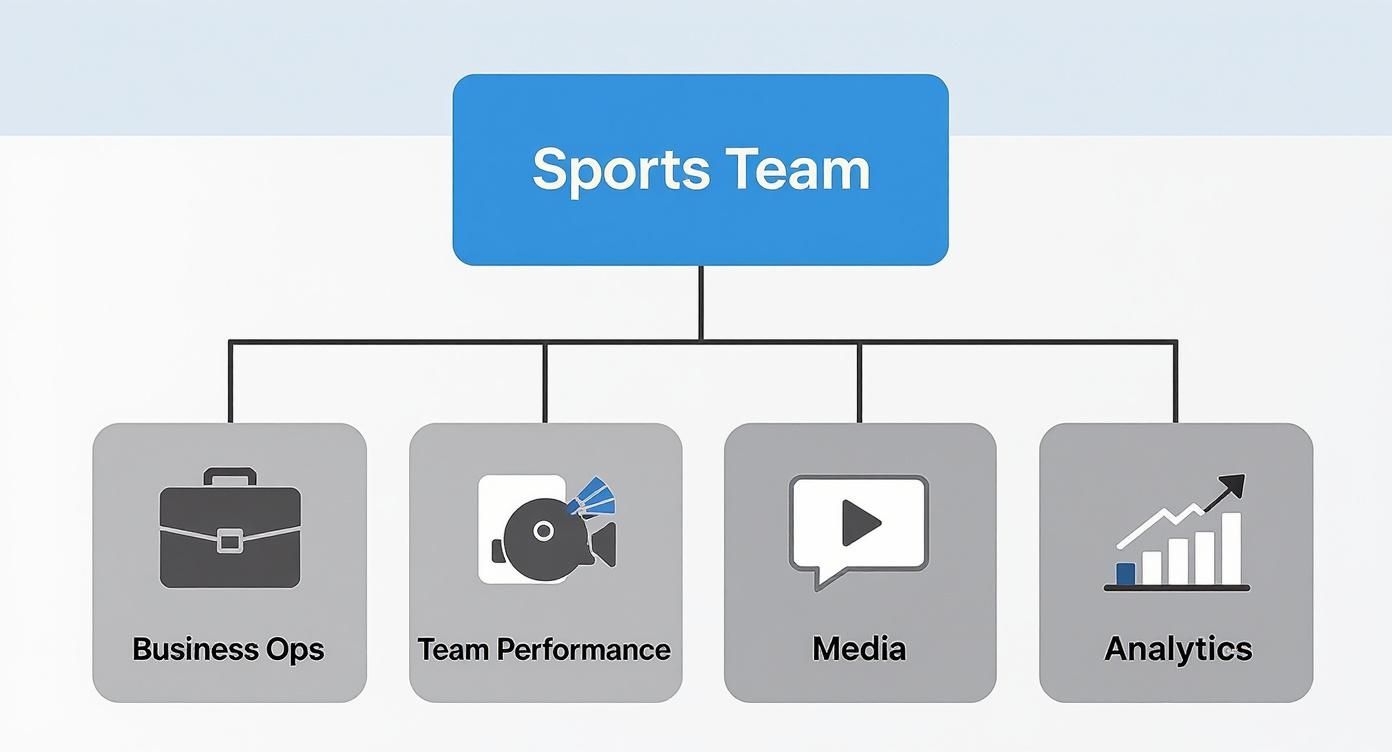
This visual really drives home how interconnected everything is. The success of the team relies on every single department—from the front office to the analytics gurus—working together seamlessly.
To give you a clearer idea of where different jobs fall, here's a quick breakdown of the major departments and the kinds of roles you'll find within them.
Overview of Career Departments in a Sports Team
| Department Category | Primary Function | Example Job Titles |
|---|---|---|
| Business Operations | Manages the financial, administrative, and commercial aspects of the organization. | Ticket Sales Rep, Partnership Manager, Accountant, HR Generalist, Stadium Operations Manager |
| Team Performance | Focuses on player development, coaching, health, and on-field success. | Head Coach, Strength & Conditioning Coach, Athletic Trainer, Team Doctor, Equipment Manager |
| Media & Communications | Creates and distributes content, manages brand image, and engages with fans. | Social Media Manager, Public Relations Coordinator, Content Creator, Broadcast Producer |
| Data & Analytics | Uses data to inform decisions in scouting, player performance, and business strategy. | Data Scientist, Video Analyst, Scouting Analyst, Business Intelligence Analyst |
Each of these pillars offers a unique career path. For example, if you have a finance degree, you’d be right at home in Business Operations. If you're a natural storyteller, the Media department is calling your name. You can get a better sense of the day-to-day grind by exploring some of the great articles on the GetSportJobs blog.
The key takeaway is that a successful sports franchise is a blend of on-field talent and off-field strategy. The front office's ability to sell tickets and secure sponsorships directly impacts the resources available to the coaching staff and players.
At the end of the day, it doesn’t matter if your skills are in building spreadsheets or building athletes—there’s a place for you in sports. In the sections that follow, we'll dive deeper into the specific jobs within each of these pillars to help you find the perfect role to kickstart your career.
Driving On-Field Performance and Success

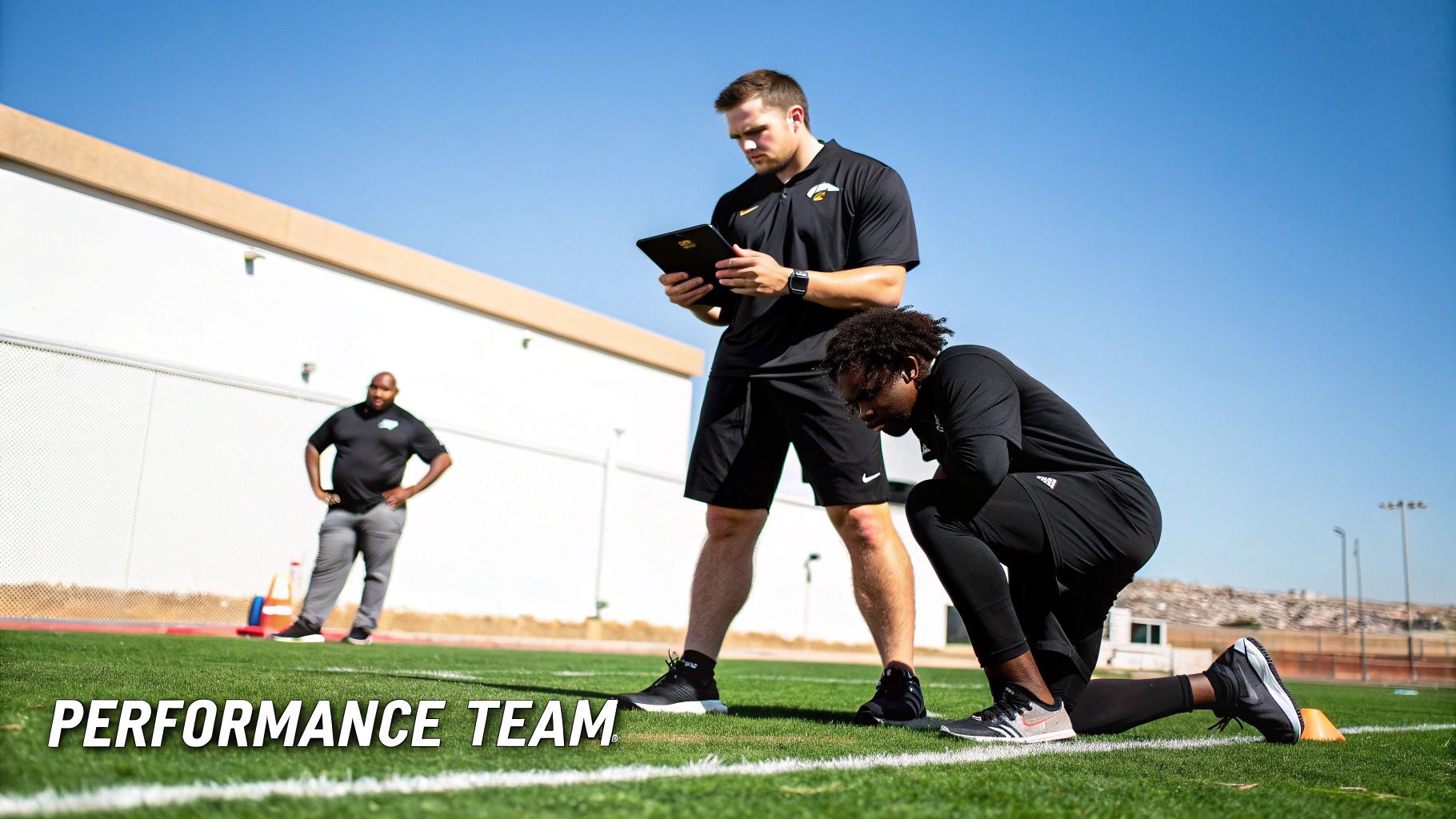
If the front office is the business brains of a sports team, the performance department is its heart and soul. These are the people right in the thick of it, working directly to unlock an athlete's full potential and execute the strategies that win championships. This is where a deep love of the game meets science, strategy, and some serious people skills.
Think of an elite team like a Formula 1 car. The athletes are the car itself—a machine full of raw power. The performance staff? They're the engineers, the pit crew, and the race strategist all rolled into one. Their job is to fine-tune every single component to make sure that car runs faster, harder, and more reliably than everyone else on the track.
These are incredibly hands-on careers. You're not just staring at spreadsheets or drawing up workout plans in a vacuum. You’re on the ground, working with world-class athletes, managing big personalities, and making high-stakes decisions under immense pressure.
The Coaching Staff: The Strategic Architects
When you think of on-field roles, the coaching staff is usually the first thing that comes to mind. They are the strategic leaders, the ones responsible for game plans, player development, and those crucial in-the-moment decisions. But it’s so much more than just the head coach shouting from the sidelines.
A modern coaching staff is a complex machine with highly specialized parts, all working together:
- Head Coach: The leader of the pack. They set the team's entire philosophy, shape the culture, and have the final say on strategy.
- Assistant Coaches: These are the specialists. Think of a quarterbacks coach in football or a hitting coach in baseball—they focus on a specific position or element of the game.
- Video Coordinators: The unsung heroes who spend hours breaking down game film. They analyze their own team and opponents to spot tactical advantages, weaknesses, and tendencies.
Today's teams are also leaning heavily on data to find a competitive edge. Digging into tools like the best predictive analytics software gives you a good idea of how numbers are directly influencing play calls and personnel decisions.
The Health and Performance Engine
Working in lockstep with the coaches is a dedicated team of medical and science experts. Their entire focus is on the physical and mental well-being of the athletes, making sure players are strong, healthy, and primed to perform.
Strength and Conditioning (S&C) Coaches are the architects of athleticism. They design year-round training programs to build speed, power, and endurance, all while working to minimize the risk of injury. It's a role that demands expertise in exercise physiology and biomechanics, along with the ability to motivate and push athletes to their limits.
Athletic Trainers and Team Physicians are the medical backbone of the team. Trainers are the first responders on the scene, providing immediate care, managing rehab programs, and handling preventative treatments. The team physicians oversee every aspect of player health, from routine physicals to making calls on major injuries and surgeries.
These roles are the true guardians of a team's most valuable asset: its players. Their ability to keep athletes on the field is just as important as any single play or strategic call.
Getting one of these jobs is fiercely competitive, much like becoming a pro athlete yourself. To put it in perspective, there are only about 14,000 professional athletes in the U.S. Just one out of every 3,000 high school athletes ever makes it to the pros. That level of selectivity applies to the most coveted roles surrounding the team, too.
Ultimately, a career on the performance side is for people obsessed with the process of improvement. It’s about taking incredible talent and meticulously shaping it into consistent, elite performance through a combination of smart strategy, sound science, and unwavering support.
Running The Business Behind The Game
While the action on the field grabs all the headlines, a powerful engine of business professionals keeps the entire organization running. These front-office careers are where strategy, creativity, and a love for the game collide to generate revenue, build the team’s brand, and create an unforgettable experience for fans.
Think of it like a blockbuster movie. The players and coaches are the on-screen stars, but behind the scenes, you have producers, marketers, and distributors who actually get the film made and into theatres worldwide. In the same way, the business team builds the financial foundation and community support that lets the on-field product shine.
This side of the industry offers some of the most diverse careers with sports teams, attracting pros from business, marketing, finance, and communications. You don't need to know how to break down game film; you need to know how to build a brand and drive results.
The Revenue Generators: Ticket Sales and Sponsorships
At the heart of every team's business operation are the departments that bring in the cash. These roles are fast-paced, laser-focused on results, and absolutely critical to the team's financial health.
Ticket Sales professionals are on the front lines, tasked with filling every seat in the stadium to create that electric game-day atmosphere. Their work covers everything from single-game tickets and season ticket packages to high-end luxury suites. To succeed here, you need to be a great communicator, persistent, and skilled at building real relationships with fans and corporate clients.
The Corporate Sponsorships and Partnerships team is responsible for landing the major deals you see on jerseys, stadium signs, and TV broadcasts. They hunt for potential partners whose brands align with the team and then craft compelling proposals to seal the deal. This is a highly strategic sales role that demands creativity, sharp negotiation skills, and a deep understanding of what makes a marketing partnership valuable.
A sold-out stadium and high-value sponsorships don't just happen. They are the direct result of a skilled business team executing a smart, aggressive strategy to maximize every possible revenue stream.
Crafting The Brand: Marketing and Communications
While sales teams are chasing direct revenue, the marketing and communications groups are busy building the team’s brand and telling its story. They are the voice of the organization, shaping how the public sees the team and forging a deep, lasting connection with the fanbase.
Marketing departments are the architects of the fan experience. Their work is broad and exciting, often including:
- Game Day Promotions: Planning the theme nights, giveaways, and in-game entertainment that make coming to the stadium a can't-miss event.
- Digital and Social Media: Running the team's online presence, creating killer content, and engaging with fans 24/7 across every platform.
- Advertising Campaigns: Developing and launching TV, radio, and digital ad campaigns to boost ticket sales and keep the team top-of-mind.
The Communications and Public Relations (PR) team acts as the gatekeeper for the team's official narrative. They handle all media requests, write press releases, and prep players and coaches for interviews. When a crisis hits, the PR team is on the front line, managing the message and protecting the organization's reputation.
Sample Job Spotlight: Sponsorship Manager
To give you a real-world feel for these jobs, let's break down a typical job description for a Sponsorship Manager. This role perfectly blends sales, marketing, and relationship management.
Position Title: Sponsorship Manager
Key Responsibilities:
- Identify, research, and secure new corporate partners for the team.
- Develop and present custom sponsorship packages tailored to a partner's marketing goals.
- Manage and grow relationships with current sponsors to ensure they renew and find new opportunities to invest.
- Work with the marketing team to deliver on all contractual promises, like stadium signage, digital campaigns, and VIP events.
- Track all sales activity and revenue, providing regular updates to team leadership.
Required Skills and Qualifications:
- Bachelor's degree in Business, Marketing, or a related field.
- A proven track record in sales, ideally within the sports or entertainment world.
- Exceptional skills in negotiation, communication, and presenting.
- The ability to build and maintain strong professional relationships.
- A creative and strategic mindset with a self-starter attitude.
This snapshot shows that teams are hunting for sharp business minds. Success in these careers with sports teams has less to do with your athletic past and everything to do with your drive to win in the marketplace.
6. Mastering Analytics and Team Operations
Behind every smooth game day and brilliant strategic move, you'll find a crew of operations and analytics experts. These are the unsung heroes, the people working behind the scenes who form the very backbone of a modern sports team. They keep the machine running while constantly hunting for that next competitive edge.
If the performance staff are the engineers fine-tuning the engine, think of the operations team as the air traffic controllers. They manage the mind-boggling logistics of getting a team from point A to point B, ensuring they arrive ready to perform at the highest level. This isn't just booking a few flights; it’s a massive logistical puzzle of schedules, transport, hotels, and equipment.
These pros are masters of planning and problem-solving. One tiny mistake—a delayed bus, a bag of missing gear, a hotel fiasco—can throw off a team's entire preparation and genuinely impact the outcome of a game. It's a high-stakes world that demands an incredible eye for detail.
The Logistical Backbone: Team Operations
A career in team operations puts you right in the middle of the action, even if you’re not on the field. You become the go-to problem solver for players and coaches, taking care of all their needs so they can focus on one thing: winning. It’s a demanding path, for sure, but incredibly rewarding for anyone who thrives under pressure and loves to organize.
Key responsibilities often include:
- Travel Coordination: Arranging flights, ground transportation, and hotels for the entire team, staff, and sometimes even their families.
- Equipment Management: Making sure every single piece of gear—from jerseys to training cones—is accounted for, maintained, and ready for every game and practice.
- Schedule Management: Building and handing out detailed itineraries for every trip and home stand, covering everything from meal times to media appearances.
- Facility Liaison: Working with stadium and practice facility staff to make sure everything is perfect for the team's arrival.
These careers with sports teams require a proactive mindset. You’re always thinking three steps ahead, anticipating what could go wrong and having a backup plan ready.
The Rise of The Data Gurus
While the operations team makes sure the team can function, the analytics department is figuring out how it can function better. Over the last decade, data has completely reshaped the sports world. Teams now have entire departments of analysts who act as the organization's strategic chess masters.
These professionals dig through data to find hidden advantages everywhere. They aren't just looking at the box score anymore. They build complex statistical models and use advanced algorithms to break down player performance, evaluate scouting reports, and inform in-game tactics. Their work directly influences some of the biggest decisions a team makes.
The modern front office no longer runs on gut instinct alone. Every major decision, from who to draft to how to set up a defense, is now heavily backed by rigorous data analysis.
Comparing Traditional Scouting and Modern Analytics Roles
This shift toward data has created a fascinating dynamic between old-school scouting and new-school analytics. Both roles share the same goal—find great players and win games—but their methods couldn't be more different.
The table below breaks down the key distinctions.
| Attribute | Traditional Scout | Data Analyst |
|---|---|---|
| Primary Tool | The "eye test," years of experience, and personal relationships. | Statistical models, video tracking data, and programming languages like Python or R. |
| Key Skill Set | Deep knowledge of the game, talent evaluation, strong communication skills. | Quantitative analysis, data visualization, statistical modeling, and coding. |
| Main Objective | Assess a player's intangible qualities, character, and raw physical tools. | Quantify performance, predict future success, and identify undervalued assets. |
So, who wins? The truth is, the most successful teams don't pick a side. They blend both approaches, valuing the scout's hard-won wisdom while using the analyst's data to challenge biases and uncover truths the human eye might miss.
This powerful synergy has created a massive demand for analytically-minded people. If you love finding trends and telling stories with numbers, you should explore the wide range of sports analytics jobs available today to see how these roles are shaping the future of sports. For anyone with a mind for numbers and a love of the game, analytics offers one of the most exciting careers with sports teams out there.
Your Playbook for Breaking Into The Industry

Let's be honest: landing a job with a sports team is a competitive game. The same passion that fuels sold-out stadiums also draws thousands of applicants for every open role. Just loving the game isn't enough; you need a smart, proactive strategy to turn that passion into a paycheck. This isn't about generic advice—it's about real, actionable steps to get you noticed.
Just how competitive is it? An upcoming 2025 report from iWorkinSport reveals that North American franchises have massive brand power, with 10 U.S. teams ranking among the world's top 20 most attractive sports employers. The survey, which polled over a thousand highly-educated professionals, proves just how sought-after these jobs are. For a deeper dive, check out this in-depth look at top sports employers.
When you're up against that level of competition, you have to be strategic right from the jump.
Gain Hands-On Experience Anywhere You Can
Before you can work for a major league team, you need some real-world reps. The good news? You don't have to start at the top. In fact, some of the best experience comes from smaller organizations where you can wear multiple hats and see your impact firsthand.
Think outside the big leagues and look for opportunities here:
- Collegiate Athletics: Your local college’s athletic department is a goldmine for internships in marketing, operations, and media relations.
- Minor League or Local Teams: These clubs often run on a lean staff, which means interns and volunteers get handed significant responsibilities.
- Youth Sports Organizations: Volunteering to manage a social media account, organize an event, or help with coaching shows genuine initiative and passion for the industry at its roots.
This kind of experience proves you’re committed and willing to put in the work, not just waiting for a dream job to land in your lap.
Network with Purpose, Not Just for Numbers
In the tight-knit world of sports, who you know is often just as important as what you know. But let's be clear: effective networking isn’t about mindlessly collecting LinkedIn connections. It's about building genuine relationships.
Focus on quality over quantity. Instead of asking for a job, ask for advice. See if someone will give you 15 minutes for an informational interview to learn about their career path. When you go to industry events, your goal should be to listen and learn, not just hand out business cards. People are far more likely to help someone who shows a real interest in their work. For those looking to navigate this landscape, it's worth exploring the benefits of using a recruiter to help make those crucial connections.
Tailor Your Resume and Build Your Portfolio
Your resume is your personal highlight reel. A generic, one-size-fits-all document is a fast track to the "no" pile. You need to tailor it for every single application, spotlighting the skills and experiences that line up perfectly with the job description.
Think like a scout. The hiring manager is searching for a player who can fill a specific need on their team. Your resume has to make it immediately obvious that you're the perfect fit for that role.
A strong resume is step one, but a portfolio is your proof of performance. This is non-negotiable for creative roles, but it's quickly becoming a difference-maker across all departments.
- For Marketing: Showcase successful campaigns you've managed, including social media analytics and content examples.
- For Analytics: Share projects where you used data to solve a problem or uncover a unique insight.
- For Operations: Detail an event you helped organize, outlining your specific responsibilities and the final outcome.
To make sure your application is firing on all cylinders, a specialized tool can be a game-changer. You can optimize your resume and cover letter with our free sports industry resume analyzer to truly stand out.
At the end of the day, persistence and a proactive approach are your most valuable assets in locking down one of the many rewarding careers with sports teams.
Common Questions About Sports Team Careers
Alright, you’ve seen the playbook and learned the strategies for breaking into the sports industry. But even with the best game plan, a few key questions can linger. Think of this as your final huddle before you take the field—a chance to tackle those common uncertainties head-on.
Let’s clear up the myths and get down to brass tacks. We're here to answer the practical, real-world questions that can make all the difference between staying on the sidelines and getting into the game.
Do I Need A Sports Management Degree To Work For A Team?
This is easily the question I hear most, and the answer is a resounding no. While a sports management degree provides a fantastic foundation and is absolutely valuable, it's not the only ticket to the show. Far from it.
Modern sports teams are sophisticated businesses. They are actively hunting for talent with degrees in marketing, finance, communications, business administration, and data science. What really moves the needle isn't your specific major, but your ability to show you have relevant, transferable skills and a genuine feel for the industry.
Honestly, practical experience from internships, volunteering, and a solid professional network will often carry more weight than the title on your diploma.
Focus on building a skill set that solves a real problem for a team. If you can walk in and show them how you can sell more tickets, create killer content, or uncover an analytical edge, you’ll be a top prospect no matter what your degree is in.
What Are Realistic Entry-Level Salary Expectations?
It’s incredibly important to walk into the sports world with your eyes wide open when it comes to salary. The passion and glamour that attract so many people to these jobs also create an intensely competitive market, which tends to keep starting pay lower than in other industries.
For many, the first few years are about "paying your dues." Entry-level roles, especially internships or jobs with minor league clubs, can be pretty modest. A starting gig as a ticket sales rep or a marketing coordinator might require some savvy budgeting. But don't mistake that starting point for the final destination.
The sports industry rewards hustle, performance, and loyalty. As you gain experience, deliver results, and climb the ladder—particularly at the major league level—the potential for significant salary growth is absolutely there. Think of that first job as a strategic investment in a long-term career you're passionate about.
How Important Is Networking In The Sports Industry?
Let me be blunt: networking is everything. You could argue it's the single most critical factor in landing a job in sports. The industry is a remarkably tight-knit, relationship-driven world where who you know truly matters.
Many of the best careers with sports teams are filled through referrals and word-of-mouth long before they ever hit a public job board. This means building a network of genuine, authentic relationships isn’t just helpful—it’s essential.
Here are a few tried-and-true ways to build those connections:
- Attend Industry Conferences: These events are built for networking. Go with a goal to learn from people, not just to hand out business cards.
- Use LinkedIn Smartly: Don't just send random connection requests. Find people in roles you admire and send a personalized note asking for a quick informational chat to hear about their journey.
- Volunteer at Sporting Events: This puts you right in the middle of the action, creating natural opportunities to meet industry insiders without any pressure.
Proactive, sincere networking is the key that will unlock doors you didn't even know were there.
What Is The Work-Life Balance Really Like?
Working for a sports team isn't a 9-to-5 job; it's a lifestyle. The team's schedule becomes your schedule, and the traditional idea of work-life balance often gets a major rewrite. Long hours aren't the exception—they're the norm.
Get ready for a calendar filled with nights, weekends, and holidays, especially if your job is tied to game days, like operations, media, or sales. The pace is relentless, demanding, and often unpredictable. A surprise trade or a tough losing streak can change the entire mood and workload of the office in an instant.
But here’s the trade-off: you are completely immersed in a high-energy, passionate, and thrilling environment. You’re part of the team's story, riding the incredible highs of a big win and grinding through the frustrating lows of a tough loss. It’s a demanding career, but for those who truly love the game, it's unbelievably rewarding.
Ready to find your spot on the roster? The perfect opportunity is out there. Start exploring hundreds of open roles today on GetSportJobs and take the first real step toward turning your passion into your profession. Find your next sports job now!