Your Guide to FIFA World Cup 2026 Jobs
The first jobs for the FIFA World Cup 2026 are already live, and this isn't just another hiring cycle. For professionals in sports, events, logistics, and countless other fields, this is a career-defining moment. We're talking about the largest single-sport event in history, and it's creating an absolutely unprecedented number of jobs across the United States, Canada, and Mexico.
The Sheer Scale of World Cup 2026 Employment
Forget thinking of the World Cup as just a month of soccer. It's a continent-sized economic engine. With the tournament spread across 16 host cities in three different countries, the workforce required to pull it off is staggering. This isn't just about what happens inside the stadiums; it's a massive operation that touches nearly every industry.
From the earliest planning stages to the final whistle of the championship match, every single detail depends on a skilled team. This includes people in operations, marketing, hospitality, transportation, media, and security. Because of the incredible scale, hiring isn't centralized. Instead, it’s spread across a huge network of different employers.
Who's Actually Doing the Hiring?
If you want to land a role, you first need to know where to look. The jobs market for the World Cup is built around three main groups, and each one hires differently and on its own timeline.
- FIFA: As the global governing body, FIFA manages the big picture. Think broadcast rights, top-level sponsorship, and setting the standards for the entire event. Their roles are often strategic and based in central operational hubs, like their Miami office for 2026.
- Host City Committees (LOCs): Each of the 16 host cities has its own Local Organizing Committee, or LOC. These are the teams responsible for making the event happen on the ground. They hire for roles that are specific to their city—everything from venue management and local transportation logistics to volunteer programs and city-wide marketing campaigns.
- Contractors and Vendors: This is where a massive volume of the hiring happens. An entire ecosystem of third-party companies is brought in to deliver specialized services like security, catering, ticketing tech, merchandise, and event production. These partners hire for thousands of both temporary and permanent positions.
Knowing this structure is key to a smart job search. For example, a logistics pro might focus on the Host City Committees, while a cybersecurity expert might find a perfect fit with a contracted tech vendor.
The World Cup 2026 brings together a vast array of industries. To give you a clearer picture, here's a breakdown of the major sectors and the kinds of organizations doing the hiring.
Key Employment Sectors for the FIFA World Cup 2026
| Employment Sector | Primary Hiring Organizations | Example Roles |
|---|---|---|
| Event Operations & Management | FIFA, Host City Committees (LOCs), Venue Operators | Venue Manager, Competition Coordinator, Operations Director |
| Hospitality & Guest Services | Official Hospitality Partners, Hotels, Catering Companies | VIP Host, Guest Relations Manager, Food & Beverage Supervisor |
| Logistics & Transportation | LOCs, Third-party Logistics Contractors | Fleet Manager, Accommodation Coordinator, Transport Planner |
| Marketing & Communications | FIFA, LOCs, Sponsoring Brands, Media Agencies | Social Media Manager, Public Relations Officer, Brand Ambassador |
| Security & Safety | Private Security Firms, Local Law Enforcement, LOCs | Security Officer, Crowd Control Specialist, Safety Manager |
| Media & Broadcast | FIFA, Host Broadcasters, News Agencies | Broadcast Engineer, Camera Operator, Media Relations Officer |
| Technology & IT | Ticketing Partners, IT Contractors, FIFA | IT Support Technician, Network Engineer, Accreditation Specialist |
| Volunteering | Host City Committees (LOCs) | Wayfinder, Fan Zone Assistant, Media Center Volunteer |
This table just scratches the surface, but it illustrates how roles are distributed across different types of employers. Whether your background is in tech or transportation, there's likely a place for you in this massive undertaking.
An Economic Engine for North America
This hiring boom is fueled by the incredible economic impact of the World Cup. The wave of tourists, media, and teams ignites local economies, creating demand for more services and, in turn, more jobs. It’s a historic workforce challenge.
In fact, some projections show the tournament could create nearly 824,000 full-time equivalent (FTE) jobs globally, with the vast majority concentrated in North America. You can dive deeper into the expected economic and employment figures in recent studies released by FIFA.
The 2026 event is so big it essentially becomes its own temporary industry. You're building entire operational teams from scratch in 16 different markets at the same time, which creates an intense and widespread demand for talented event professionals.
The variety of roles is staggering. This is about so much more than what happens on the pitch; it’s about creating the infrastructure to support a global spectacle. This is your chance to be part of history.
Where to Find Your World Cup 2026 Dream Job
Knowing where to look is half the battle. While you might stumble across a few listings on generic job boards, the real opportunities are found by going straight to the source. If you want to cut through the noise and land a role at the World Cup, you need a targeted search strategy.
Let’s be honest, the hiring process for an event this massive can feel overwhelming. The key is to start with the core organizations running the show. These are the epicenters of hiring, and keeping a close eye on them will put you miles ahead of the competition.
Start with the Official Organizers
The most direct route to a World Cup role is through the official career portals of the main organizing bodies. Think of these as the ground-zero for the most critical operational, strategic, and management positions.
- The FIFA Careers Portal: This is the mothership. It's the global hub for jobs directly with FIFA, often focused on the big picture—tournament governance, broadcast rights, global marketing, and high-level event strategy. You'll typically see roles based in major operational centers like Miami or Zurich.
- Host City Committee Websites: Each of the 16 host cities has its own Local Organizing Committee (LOC), like KC2026 or LA2026. These are the boots on the ground, handling everything within their specific city. Their career pages are goldmines for location-specific roles in venue management, local marketing, volunteer coordination, and transportation logistics.
A practical tip? Go set up alerts on these sites right now. Use specific keywords that match your skills—like "logistics," "media operations," or "fan engagement"—along with the city name. That way, you get an email the second a relevant job goes live.
Explore the Ecosystem of Contractors and Partners
A massive number of FIFA World Cup 2026 jobs won't come from FIFA or the LOCs directly, but from the huge network of third-party companies they hire to deliver specialized services. These are the vendors and suppliers responsible for much of the event-time staffing and operational muscle.
Think about all the moving parts of a global spectacle:
- Broadcasting: Major media networks will need everyone from production assistants and camera operators to broadcast engineers.
- Security: Private security firms will hire thousands for crowd management, venue security, and asset protection.
- Hospitality & Catering: Companies managing VIP experiences, concessions, and corporate hospitality will need an army of service pros.
- Technology & Ticketing: Partners providing accreditation, IT infrastructure, and ticketing systems will need on-site technical support.
Your job is to identify the major players in these fields and start checking their career pages. Many of these roles might not even have "World Cup" in the title, but will be project-based contracts timed perfectly for the tournament.
A common mistake I see people make is only searching for jobs with "World Cup" in the title. A contractor might just list a role as "Event Manager" or "Logistics Coordinator" on a fixed-term contract. It's up to you to connect the dots.
Leverage Professional Networks and Niche Job Boards
Beyond the official portals, your professional network and specialized job boards are your secret weapons. These platforms bring opportunities together and offer insights you just won't find anywhere else.
LinkedIn is a non-negotiable tool here. Sure, follow the official FIFA and Host City pages. But the real power move is to identify and follow the key executives and hiring managers at these organizations. Engaging with their posts can give you a heads-up on upcoming roles before they’re even posted.
Niche sports industry job boards are also essential. They do the hard work of consolidating relevant openings, saving you a ton of time. For instance, you can zero in on specific host cities to see what kinds of roles are popping up locally. For anyone targeting one of the major U.S. hubs, you can check for World Cup-related jobs in Los Angeles and other host cities as the event gets closer.
Platforms like this are built to connect you directly with the sports organizations hiring for the tournament. By combining direct monitoring of official sites with these targeted platforms, you build a comprehensive search strategy that covers all your bases.
Understanding the World Cup Hiring Timeline
When it comes to landing a role for the FIFA World Cup 2026, timing is everything. This isn't your standard corporate hiring cycle. A mega-event operates in distinct phases, and each one calls for different skills and brings a surge in specific types of jobs. Applying for a venue operations role three years out is like showing up for the final exam a month early—your timing is just off.
To get ahead, you have to sync your job search with the event's operational lifecycle. It's a marathon, not a sprint. Knowing when certain roles are likely to pop up is your biggest strategic advantage. You can think of it as three main hiring waves, starting years before the first whistle blows and running right through the tournament itself.
This visual gives you a great breakdown of the key hiring phases for FIFA, the Host Cities, and the huge network of contractors, helping you figure out the best time to make your move.
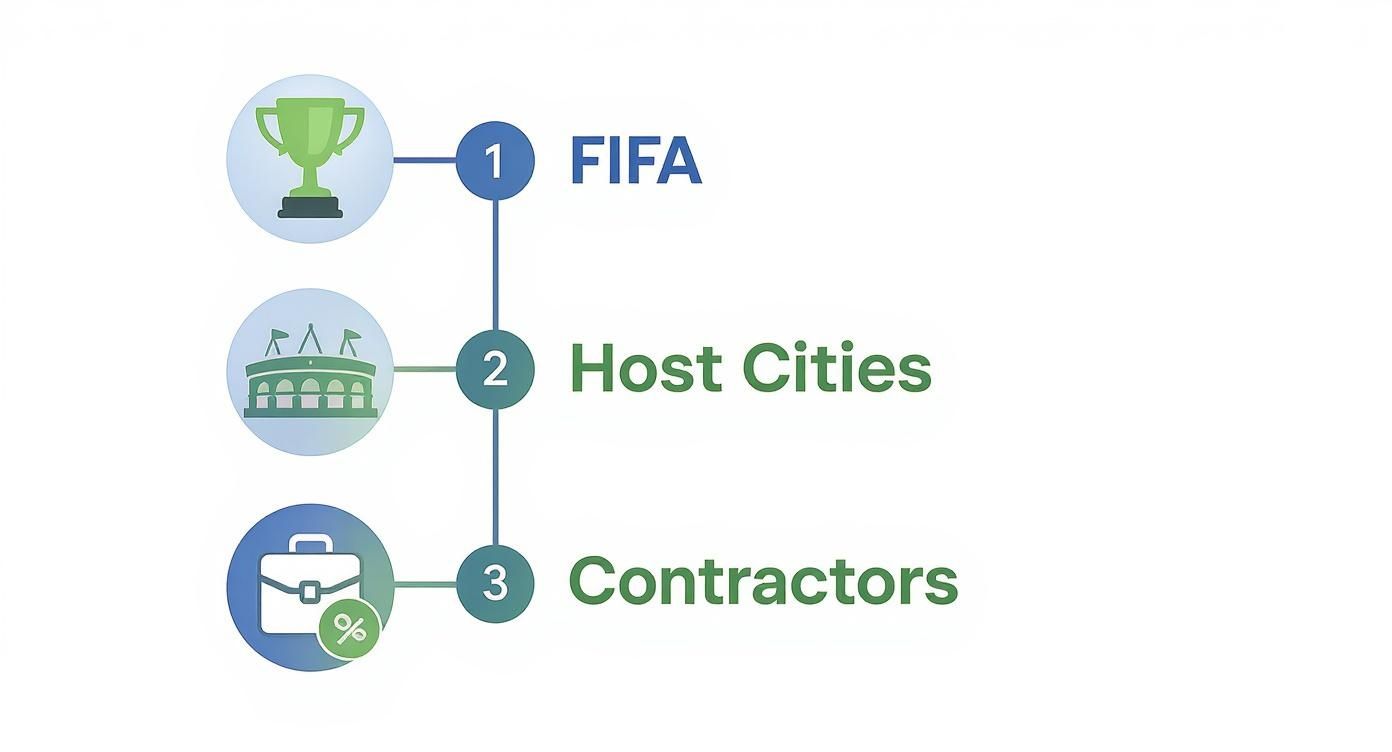
As the infographic shows, the most senior FIFA roles were filled a while back. But the major hiring waves for Host Cities and their partners are happening right now and will only get bigger as we get closer to 2026.
The Early Strategic Phase (4-5+ Years Out)
This first phase kicked off long before the tournament was even on most people’s radars. The hiring here was all about putting the foundational leadership and strategic framework in place. These were the senior-level roles filled by people making the big-picture decisions.
We're talking about positions like:
- Chief Operating Officers
- Directors of Marketing & Communications
- Heads of Security and Operations
These jobs went to seasoned executives, many with past Olympic or World Cup experience under their belts. While these top-tier roles are mostly filled, it's good to know who these leaders are—they’re the ones building out their departments now.
The Operational Build-Up Phase (1-3 Years Out)
This is where we are right now, and it’s the single largest wave of professional hiring. The core leadership team is set, and their focus has shifted to recruiting the managers and specialists who will build the operational machine. This is the period when the Local Organizing Committees (LOCs) in each of the 16 host cities really start to scale up.
You’ll see a massive spike in mid-level and senior manager roles across pretty much every functional area. For professionals with specialized skills, this is the prime time to get in the game.
The operational build-up is the sweet spot for most experienced candidates. Organizations need people who can not only plan complex projects but actually execute them. Functional departments like logistics, marketing, and volunteer management are being built from the ground up as we speak.
Roles in high demand during this phase include:
- Venue General Managers
- Logistics and Transport Managers
- Volunteer Program Managers
- Marketing and Fan Engagement Leads
- Ticketing and Accreditation Managers
If your background lines up with these kinds of roles, now is the time to be actively searching, networking, and polishing your CV.
The Event-Time Phase (12 Months and Less)
The final year before the tournament will bring the last major hiring push, which is all about event-time delivery. This wave is defined by a massive number of short-term, contract-based roles. These are the front-line positions that bring years of planning to life.
This is also when contractors and vendors do the bulk of their hiring. Security firms, catering companies, transport providers, and merchandise operators will be recruiting thousands of temporary staff to make it all happen.
Keep an eye out for openings like:
- Event Staff and Team Leaders
- Guest Services Representatives
- Security Officers
- Drivers and Fleet Coordinators
- Hospitality Hosts
Even though these roles are temporary, they offer an incredible, once-in-a-lifetime experience and an unbeatable entry on your resume. For students, recent grads, or anyone looking to break into the sports event industry, this phase is your golden ticket. Volunteer recruitment also hits its peak during this time, offering another fantastic way to be part of the action.
What Are the Most In-Demand World Cup Jobs?
To really get a feel for FIFA World Cup 2026 jobs, you need to look past the job titles and understand what makes the event actually happen. The range of roles is massive. Sure, there are the obvious ones, but positions in areas like sustainability and digital fan engagement are now just as critical for a modern mega-event.
So, what does a Venue Manager really do on match day? What kind of pressure is a Logistics Coordinator under when a shipment gets stuck in customs? Let's pull back the curtain on some of the most common and sought-after roles you’ll see posted as we get closer to 2026.
The Engine Room: Operations and Logistics Roles
Operations and logistics are the absolute backbone of the World Cup. These are the people who make sure stadiums are ready, teams get where they need to go, and millions of fans have a safe, seamless experience. If you thrive on details, stay calm under pressure, and love solving problems on the fly, this is where you belong.
Take the Venue General Manager, for example. Think of this person as the CEO of their assigned stadium for the entire tournament.
- What they do: They have the final say on-site, overseeing everything from security and staffing to guest services and crisis management. They're the central hub, coordinating dozens of different departments, vendors, and contractors.
- What it takes: You don't walk into this role. It requires years of senior-level experience running a major stadium, arena, or convention center.
- A day in the life: On a match day, their morning starts before sunrise with briefings for security, catering, and broadcast crews. They’re constantly walking the facility, troubleshooting a broken ticket scanner one minute and a VIP transport issue the next. They're the first to arrive and the last to leave.
Then you have the Logistics Coordinator. These are the master puzzle-solvers, managing the incredibly complex movement of equipment, goods, and people. One day they might be coordinating team bus schedules, the next they’re figuring out how to get broadcast equipment across three different international borders. Their entire job is about planning for what could go wrong.
The success of a World Cup is measured by how smoothly things run behind the scenes. Logistics pros are the unsung heroes who make it all look easy. When everything just works, it's because they've already thought through every possible problem.
The Spotlight: Fan and Media Engagement Roles
While the ops team keeps the machine running, the engagement folks are all about shaping the experience for a global audience. These jobs are perfect for creative, tech-savvy communicators who get a buzz from creating unforgettable moments.
A Media Operations Specialist is a perfect example. They live at the intersection of the tournament organizers and the thousands of journalists, broadcasters, and photographers descending on the event.
- What they do: They run the media centers, coordinate press conferences, and ensure every broadcaster has the technical support and access they need to do their job.
- What it takes: A background in sports PR, communications, or broadcast production is pretty standard. Being fluent in English, Spanish, or French is a massive advantage.
- A day in the life: They could be managing photographers' positions along the pitch, then rushing to organize post-match interviews with a star player, all while juggling the competing demands of different media outlets on a tight deadline.
Similarly, the Fan Engagement Lead is focused on everything happening outside the 90 minutes of the match. They’re the ones creating the festival atmosphere in the fan zones, organizing cultural events, and driving interaction on social media and the official app. It’s a role that demands marketing instincts, event planning chops, and a true passion for the game. If this path excites you, it's worth exploring the wider world of event management jobs in sports to see how the skills overlap.
A Wave of Opportunity Across North America
The economic impact of hosting a World Cup creates a huge ripple effect, sparking job growth far beyond the official organizing committees. This is especially true for the host nations gearing up their infrastructure and local economies for the global spotlight.
Canada, for instance, is expecting a major boost. The 2026 World Cup is projected to create and support 24,100 jobs across the country. The financial numbers are just as impressive, with an estimated CAD 3.8 billion in economic output and CAD 2 billion added to the GDP. You can read more about Canada's expected economic gains on FIFA.com. This shows how the tournament acts as a real catalyst for jobs in hospitality, construction, transportation, and tourism in the host cities.
How to Craft a Standout Application and Nail the Interview
When you're applying for a FIFA World Cup 2026 job, a generic resume is a one-way ticket to the "no" pile. Hiring managers are staring down a mountain of applications, and they’re looking for people who don't just have the skills, but who get the insane demands of a global mega-event. Your application isn't just a career history; it's your argument for why you are the solution to their very specific problems.
To get noticed, your application has to feel like it was written specifically for that role. That means you need to stop listing job duties and start showcasing measurable achievements. Your goal is to draw a direct line from your past experience to the fast-paced, high-stakes environment of the World Cup.

Translate Your Experience into the Language of Events
The real trick is to reframe your accomplishments using the language of live events. Even if you've never worked in sports, you have relevant skills. The key is to highlight things like cross-functional teamwork, problem-solving on a tight deadline, and managing complex logistics.
Let’s take a standard, boring resume bullet and give it a complete makeover.
Before:
- Responsible for coordinating project tasks.
After:
- Coordinated a 15-person cross-functional team to deliver a major marketing project 2 weeks ahead of schedule, navigating complex stakeholder feedback under a tight deadline.
See the difference? The "After" version pops because it's specific. It uses hard numbers (15 people, 2 weeks) to prove impact and weaves in keywords like "cross-functional" and "tight deadline" that are music to an event recruiter's ears.
If you’re not sure if your resume is hitting the mark, getting some outside perspective is a smart move. Specialized tools can give you a huge leg up. Our free resume analyzer can give you personalized feedback on how well your skills align with roles in the sports industry.
Preparing for the World Cup Interview
Once your tailored application scores you an interview, the real prep begins. World Cup interviews are often a mix of behavioral questions and situational curveballs designed to test how you think on your feet. They need to know you can handle the chaos of a live event.
They aren't just hiring for skills; they're hiring for temperament. Can you stay calm and make a smart decision when a key delivery is late, a system goes down, or you have thousands of fans waiting? That's what they're trying to find out.
Get ready for questions that drop you right into a crisis. They might ask something like, "Imagine the transportation for a key media group fails an hour before a match. What are your immediate first three steps?"
There's no single "correct" answer here. What they really want to see is your thought process:
- How do you assess the situation and prioritize?
- Who do you communicate with first?
- How do you brainstorm and execute a backup plan?
Showcasing Your Passion Authentically
Finally, never underestimate the power of genuine passion. Of course, skills and experience are critical, but organizers want people who are genuinely thrilled to be part of making history. Just saying "I love soccer" won't cut it.
You have to connect that passion back to your professional abilities. Frame your enthusiasm in a way that shows you understand the business side of the event. For instance, you could say: "I've followed the logistical challenges of the last three World Cups, and I'm fascinated by the operational excellence required. I believe my background in supply chain management would allow me to contribute directly to solving similar challenges for 2026."
This shows you're not just a fan—you're a professional who understands what it takes to pull off a world-class event. Blending your technical skills with that authentic interest is the final touch that makes you a candidate they won't forget.
Your Top Questions About World Cup 2026 Jobs, Answered
Trying to navigate the job market for the FIFA World Cup 2026 can feel like a sport in itself. With so many different organizations, timelines, and roles, it's easy to get overwhelmed. Let's cut through the noise and answer the questions I hear most often from candidates trying to land a role at this massive tournament.
Getting these fundamentals down will give you the confidence to know exactly where—and when—to focus your search.
Should I Apply To FIFA, A Host City, or A Contractor?
This is the big one, and the answer really depends on what you want to do. Each part of the World Cup ecosystem offers a completely different experience. Think of it less as one company and more as a massive, interconnected network of employers.
Choosing where to aim your application is the first critical step in your strategy.
FIFA: Applying directly to FIFA means you're aiming for the strategic heart of the tournament. These roles are often based in Zurich or Miami and deal with the big picture: global broadcast rights, top-tier sponsorships, and setting the operational rulebook for everyone else. It's high-level and global.
Host City Committee: If you want to be on the ground making the event happen, a Local Organizing Committee (LOC) is where you want to be. You’ll be tackling the specific challenges of pulling off the World Cup in one of the 16 host cities, from managing venue logistics in Dallas to running fan fests in Toronto. This is pure event delivery.
Contractors & Suppliers: Do you have a specialized skill? The organizations that hire the most people for any World Cup are the third-party contractors. We're talking security firms, catering companies, tech providers, and transportation experts. If you're a specialist, this is your direct route in.
So, the choice is really between global strategy (FIFA), local operations (Host City), or specialized service delivery (Contractor).
Should I Pursue a Paid Role or Volunteer First?
This all comes down to your experience. If you're already a professional with a background in events, marketing, logistics, or a related field, you should absolutely be targeting a paid position. The demand for seasoned experts to execute an event of this scale is enormous, and your skills are valuable.
But if you're new to the industry or making a career change, volunteering is an incredible gateway. A successful volunteer stint at a mega-event is a golden ticket for your resume. It gives you priceless on-the-ground experience and connects you with the exact people who do the hiring. Many of the industry's top professionals got their start this way.
Just remember, volunteer applications usually open much closer to the event, while many key paid roles are being filled right now.
Volunteering isn't just about getting a foot in the door; it's a live audition. If you crush it as a volunteer, you'll get noticed. I've seen it happen time and again where a sharp volunteer is offered a paid role on the spot by an organizer or a contractor who sees their work ethic firsthand.
What Are Typical Salaries for World Cup Jobs?
Salaries for FIFA World Cup 2026 jobs are all over the map. They depend heavily on the role's seniority, who you're working for (FIFA, an LOC, or a contractor), and the cost of living in that particular host city.
Most jobs are fixed-term contracts, not permanent roles, with pay that's competitive for the major events industry.
Senior-level positions with FIFA or a Host City Committee will often come with a more traditional benefits package. On the other hand, many of the event-time roles filled by contractors might offer a straightforward hourly or daily rate with fewer frills. My advice? Always ask for the full compensation picture during the interview process—don't forget about things like overtime potential or completion bonuses.
Do I Need Local Work Authorization?
For the vast majority of jobs, yes. This is especially true for roles with the Host City Committees in the USA, Canada, or Mexico. You will almost certainly need the legal right to work in that specific country.
Visa sponsorship is incredibly rare. It's usually reserved for a handful of highly specialized, senior-level roles that are impossible to fill with local talent.
If you're an international applicant without existing work papers, your best bet is to target senior strategic positions with FIFA's central teams or with large, multinational contractors that are used to handling global mobility. Before you spend time applying, read the job description carefully for any work authorization requirements.
Ready to find your place in the biggest sporting event in history? GetSportJobs is your direct connection to hundreds of roles across the sports industry, including opportunities for the FIFA World Cup 2026. Start your search and build your career at https://www.getsportjobs.com.