A Guide to Finance in Sports Careers

When you peel back the layers of thrilling victories and heartbreaking losses, you'll find that the entire sports world runs on money. Finance in sports is the art and science of managing that money—how teams, leagues, and organizations make it, spend it, and invest it to win games and stay profitable.
Understanding the Financial Playbook of Sports

Behind every on-field triumph is a sophisticated financial game plan. This playbook is what allows a team to sign a superstar player to a nine-figure contract, build a breathtaking new stadium, or launch a global marketing blitz. It’s the engine that drives the entire operation.
Without a smart financial strategy, even the most gifted roster is on shaky ground. It's not just about crunching numbers; it's about making shrewd, data-backed decisions that build a lasting competitive edge. A financially sound organization can afford the best talent, invest in cutting-edge training facilities, and create the kind of fan experience that keeps people coming back season after season.
The Scope of the Sports Economy
The sheer scale of the sports industry is staggering. We're talking about a global market that generated a whopping $521 billion in 2024, growing at an impressive average clip of 8% annually. This isn't a niche market; it's a massive, resilient economic force. For a closer look at the numbers, Morgan Stanley's research offers deeper insights into these trends.
This explosive growth means there's a constant demand for sharp financial professionals who can navigate its complexities. Getting a handle on these core financial concepts is your first step toward carving out a career in this exciting field.
At its heart, sports finance is about allocating resources to maximize two key outcomes: winning on the field and achieving profitability off it. These goals are deeply interconnected and drive every financial choice a team or league makes.
To really grasp how it all works, it's helpful to break sports finance down into its fundamental building blocks. These are the pillars that financial pros in the industry focus on every single day.
Let's look at the core components you'll encounter. The table below outlines the key areas we'll be diving into, giving you a clear roadmap of what makes the sports economy tick.
The Core Components of Sports Finance
| Component | What It Involves | Real-World Example |
|---|---|---|
| Revenue Generation | Finding and maximizing all income streams. | Securing a multi-billion dollar broadcasting deal or launching a new line of team apparel. |
| Cost Management | Controlling all expenses, from the biggest to the smallest. | Negotiating player contracts and managing the day-to-day operational budget for a stadium. |
| Investment Strategy | Making long-term financial decisions for growth. | Financing the construction of a new training facility or investing in an e-sports division. |
By exploring each of these pillars—how money comes in, where it goes, and how it's put to work for the future—we can start to see the complete financial picture of the modern sports world.
How Sports Organizations Make Their Money
Before we can really get into finance in sports, we have to tackle the big question: where does all the cash come from? A modern sports team or league isn't just one business; it's a collection of several interconnected businesses, each pumping money into the whole operation. Think of them as different channels all feeding one massive financial reservoir.
These income sources don’t just happen by accident. They’re the result of sharp strategies built on understanding what fans, media companies, and corporate sponsors are willing to pay for. From the broadcast you stream to the jersey you wear, nearly every touchpoint is part of a deliberate financial plan.
The Power of Media and Broadcasting Rights
In today's sports world, nothing brings in more money than media rights. This is the big one. It’s all about selling the exclusive rights to show games on TV, radio, and streaming services. Leagues like the NFL, NBA, and the English Premier League strike absolutely massive, multi-year deals with media conglomerates.
Why are these deals worth so much? Because live sports are one of the last things that can guarantee a huge, captive audience all at once. For example, the NFL's current media rights deals are worth over $110 billion through 2033. That number is the financial bedrock for all 32 teams, providing a steady, shared income that helps level the playing field between large and small-market clubs.
Sponsorships and Corporate Partnerships
Look around any stadium or tune into any game, and you’ll be surrounded by brand logos. They’re on the jerseys, the digital boards around the field, and splashed across your screen during breaks. This is sponsorship, a vital revenue stream where companies pay for the privilege of connecting with a team’s loyal fanbase.
It’s a win-win. The team gets critical funding, and the brand gets to bask in the reflected glory and passion of the game. The global sports sponsorship market is absolutely exploding, with projections hitting $115 billion by 2025, as detailed in PwC’s industry analysis. It's all about brands tapping into the emotional connection fans have with their teams.
A great sponsorship deal is more than just a logo on a sign. It’s a strategic partnership that weaves a brand into the fan experience, creating an authentic bond that a simple ad could never replicate.
Gameday Revenue from Ticketing and Hospitality
The most traditional way teams make money is directly from the fans who show up on game day. This is gameday revenue, and it’s a massive piece of the financial pie. It’s all the money that comes in from the moment fans arrive to the moment they leave.
The main ingredients of gameday income are:
- Ticket Sales: This is the foundation. Teams now use sophisticated dynamic pricing models, where the cost of a ticket can change based on the opponent, the day of the week, or how well the team is playing.
- Premium Seating and Hospitality: This is where the big money is. Luxury suites, club seats, and exclusive lounges cater to corporations and high-end fans, offering a VIP experience for a much higher price.
- Concessions and Parking: Never underestimate the power of beer, hot dogs, and parking fees. These sales add up to a significant chunk of revenue every single home game.
Nailing the gameday experience is crucial for maximizing profit. If you're interested in the nuts and bolts of running these operations, check out the roles we break down on the GetSportJobs blog.
Merchandising and Licensing
Last but not least, merchandising and licensing take a fan’s passion and turn it into something they can own. When a team lets a company like Nike or Fanatics use its logo on a jersey or a hat, it gets a royalty fee for every single item sold.
This generates a steady, almost passive stream of income that pushes the team's brand far beyond its home city. From official jerseys and hats to video games and bobbleheads, licensed products give fans a way to show their pride, strengthening their bond with the team while fueling its financial engine.
Managing the High-Stakes Costs in Sports
Bringing in big money is only half the story. For every dollar a team earns, another is trying to get out the door. The real test of a sports organization's financial health isn't just how much it makes, but how well it manages the immense costs that come with competing at the highest level.
Think of it like this: Revenue is the fuel for a high-performance engine. But if that engine is burning through cash on massive, uncontrolled expenses, you'll run out of gas long before you reach the finish line. Smart cost management is what keeps the organization humming without sacrificing the firepower needed to win.
The Colossal Cost of Player Salaries
Let’s be clear: the single biggest check any team writes is for player salaries. This isn't just about a weekly paycheck. We're talking about incredibly complex financial commitments—guaranteed millions, performance bonuses that can kick in at any moment, and signing incentives that can tie up a team's cash flow for years.
Contract negotiations are a high-stakes poker game. One bad move, like overpaying for a star past their prime or betting wrong on a young prospect, can hamstring a franchise for seasons. On the other side of the table, you have agents who live and breathe market data, fighting to get every last dollar for their clients. It's a constant tug-of-war that team finance professionals have to navigate with surgical precision.
In sports finance, a player contract isn't just a piece of paper. It's a massive capital investment, and the ROI is measured in wins, fan engagement, and, hopefully, championships.
The Day-to-Day Operational Burn
Beyond the eye-watering player deals, there's the relentless grind of operational costs. These are the everyday expenses that keep the lights on, the team on the road, and the business moving forward. They might not make headlines, but they can bleed a budget dry if you're not paying close attention.
This financial hum is constant and covers everything needed to support a professional team.
Here's a taste of what that includes:
- Team Travel and Logistics: Just think about the cost of flying an entire team, plus staff and mountains of equipment, across the country for 82 games. It’s a massive logistical and financial puzzle.
- Marketing and Promotion: Filling seats and keeping fans engaged doesn't happen by magic. It takes a serious budget for advertising, digital campaigns, and gameday events.
- Staff Salaries: This covers everyone from the general manager and head coach down to the scouts, trainers, accountants, and social media managers who make the whole operation tick.
- Facility Upkeep: An arena or stadium requires constant love and attention. That means paying for everything from the electric bill and security to gameday crews and routine maintenance.
Financing the Modern Sporting Cathedral
One of the most daunting financial mountains a team can climb is venue financing. Modern stadiums aren't just fields of play; they're multi-billion-dollar entertainment palaces designed to be revenue-generating machines. And someone has to pay to build them.
These massive projects are rarely funded out of one person's pocket. Most often, they're built through public-private partnerships, a complex dance where the team and the local government share the enormous cost. The city or state might chip in public funds or offer up tax breaks, arguing that a shiny new venue will create jobs and become a source of civic pride.
For instance, a city might issue bonds to pay for a chunk of the construction, while the team owner covers the rest and signs a long-term lease. These deals are almost always controversial and face intense public scrutiny. It's up to sports finance experts to build the financial models that prove the massive investment—both public and private—is worth it. When done right, it secures a home for the team for generations and creates an incredibly valuable asset.
What Are the Financial Rules of the Game?
In most industries, the goal is to drive your competitors out of business. But professional sports are different. What’s a championship without a worthy rival? Leagues actually need their rivals to be strong and successful for the entire enterprise to work.
To maintain this delicate balance, leagues create their own unique financial systems. These are the official rules of engagement for how money moves and how teams are built. They’re designed to promote competitive balance, making sure a few teams in massive markets with deep-pocketed owners can't just buy every superstar and dominate forever.
Think of these rules as financial guardrails. They keep the league healthy, the competition compelling, and the games worth watching for fans everywhere. For general managers and finance pros, these systems are the invisible forces that shape every single roster decision—who to sign, who to trade, and who you can actually afford.
Salary Caps: The Great Equalizer
One of the most common tools for maintaining balance is the salary cap. Put simply, it’s a spending limit on player payroll that the league and players' association agree on. It's like giving every team a similar-sized budget for groceries; you can splurge on a few premium ingredients or spread the cost evenly, but you can’t just buy out the entire store.
Different sports handle this differently. Leagues like the NFL and NHL use a "hard cap," meaning teams absolutely cannot exceed that number. This forces a ton of financial discipline. Then you have leagues like the NBA, which use a "soft cap" paired with a luxury tax. This system lets teams spend over the limit if they’re willing to pay a hefty financial penalty for every dollar they go over. That tax money is then often redistributed to the teams that didn't overspend.
The salary cap isn't just a spending limit; it's a strategic puzzle. It forces teams to make tough choices, value players with precision, and uncover underrated talent to find a competitive edge within the same financial box as everyone else.
Revenue Sharing: Keeping Everyone in the Game
Another key mechanism is revenue sharing, which is all about helping smaller-market teams stay competitive with the giants in New York or Los Angeles. The league pools certain streams of income—mostly from massive national media deals and league-wide sponsorships—and divides it up evenly among all the teams.
For instance, when the NFL signs a new multi-billion-dollar TV contract, the Green Bay Packers get the same cut as the Dallas Cowboys. This shared revenue creates a stable financial floor, ensuring every team has the baseline resources to operate and field a competitive roster. It’s what stops the league from fracturing into a two-tiered system of "haves" and "have-nots."
The Player Transfer Market: A Global Phenomenon
While North American sports are often built around drafts and free agency, global soccer plays by a completely different set of rules: the player transfer market. In this world, players under contract are treated like assets with a market value. If one club wants a player who is signed with another, they have to pay a transfer fee directly to that club just for the right to sign him.
This has created a dynamic, multi-billion-dollar global marketplace where clubs buy and sell player contracts, sometimes for absolutely eye-watering sums. It’s not uncommon for a top club to spend over $100 million on a transfer fee before even starting to negotiate the player's actual salary.
This system turns player development into a core financial strategy. Many clubs build their business model around finding and developing young talent, only to sell them later for a massive profit. It’s a huge part of what’s driving a global sports market projected to hit $617.57 billion by 2029. You can dive deeper into these numbers in this detailed sports market report.
Financial Systems in Major Sports Leagues
Each league's financial rulebook creates a completely different strategic landscape. A quick look at some of the major players shows just how varied these systems can be.
| League | Salary Cap System | Revenue Sharing Model | Competitive Balance Tools |
|---|---|---|---|
| NFL | Hard Cap (strict limit) | Extensive sharing of national media and licensing revenue. | Reverse-order draft, compensatory draft picks. |
| NBA | Soft Cap with Luxury Tax | Significant national revenue sharing, with additional payouts from luxury tax pool. | Draft lottery, maximum player salaries, Bird Rights. |
| Premier League | No Hard Cap (Profit & Sustainability Rules) | Centralized media rights deals are shared, but top clubs earn far more from commercial deals. | No draft system; relies on transfer market and youth academies. |
Understanding these distinct systems is absolutely critical for anyone looking to build a career in sports finance. These aren't just minor regulations; they are the fundamental rules that define the game off the field.
Building Your Career in Sports Finance
Ever dream of turning your passion for sports into a real-world profession? For many, the idea of working for a team is a fantasy, but a career in sports finance makes it a tangible reality. This isn't just about being a fan with a calculator; it's about being the strategic mind behind the curtain, shaping the financial decisions that help teams, leagues, and organizations win.
Breaking into this world means blending sharp financial acumen with a genuine understanding of the industry. You're the one at the intersection of spreadsheets and scoreboards, responsible for everything from analyzing a star player's contract to forecasting ticket revenue or managing a stadium's operating budget. You provide the financial backbone that general managers and team presidents rely on to make smart, sustainable decisions.
Let's walk through a practical roadmap for getting started. We'll explore the common career paths, the skills you absolutely need to have, and what you can realistically expect to earn as you build your career.
Navigating the Key Career Paths
The world of sports finance is surprisingly diverse. You can find a role that fits your specific interests, whether you want to be in the trenches with a single team or take a high-level view of an entire league. Most jobs fall into a few main buckets.
- Team and Club Finance: This is where the action is. Working directly for a team puts you on the financial frontline, managing the organization's day-to-day health. Think budgeting for the marketing department, analyzing player payroll against the salary cap, and preparing financial reports for the ownership group.
- League Office Finance: If you're fascinated by the big picture, a job at a league like the NFL or NBA might be for you. In these roles, you're looking at things from a macro level—managing league-wide revenue sharing, ensuring teams comply with financial rules, or helping negotiate the massive broadcasting deals that benefit every club.
- Sports Analytics and Consulting: This is the domain of the data gurus. You'll build sophisticated statistical models to put a dollar value on player performance, predict fan attendance, or calculate the ROI for a major corporate sponsor. These jobs are found within teams but also at specialized consulting firms and financial institutions that focus on sports.
- Commercial Partnerships and Sponsorship: Here, finance meets sales. Your job is to secure and manage the lucrative sponsorship deals that plaster logos on jerseys and stadiums. You'll be responsible for valuing those assets—like a jersey patch or stadium naming rights—and proving their financial worth to corporate partners.
This infographic gives you a quick visual of the core financial mechanics that drive the entire industry and shape the career paths within it.
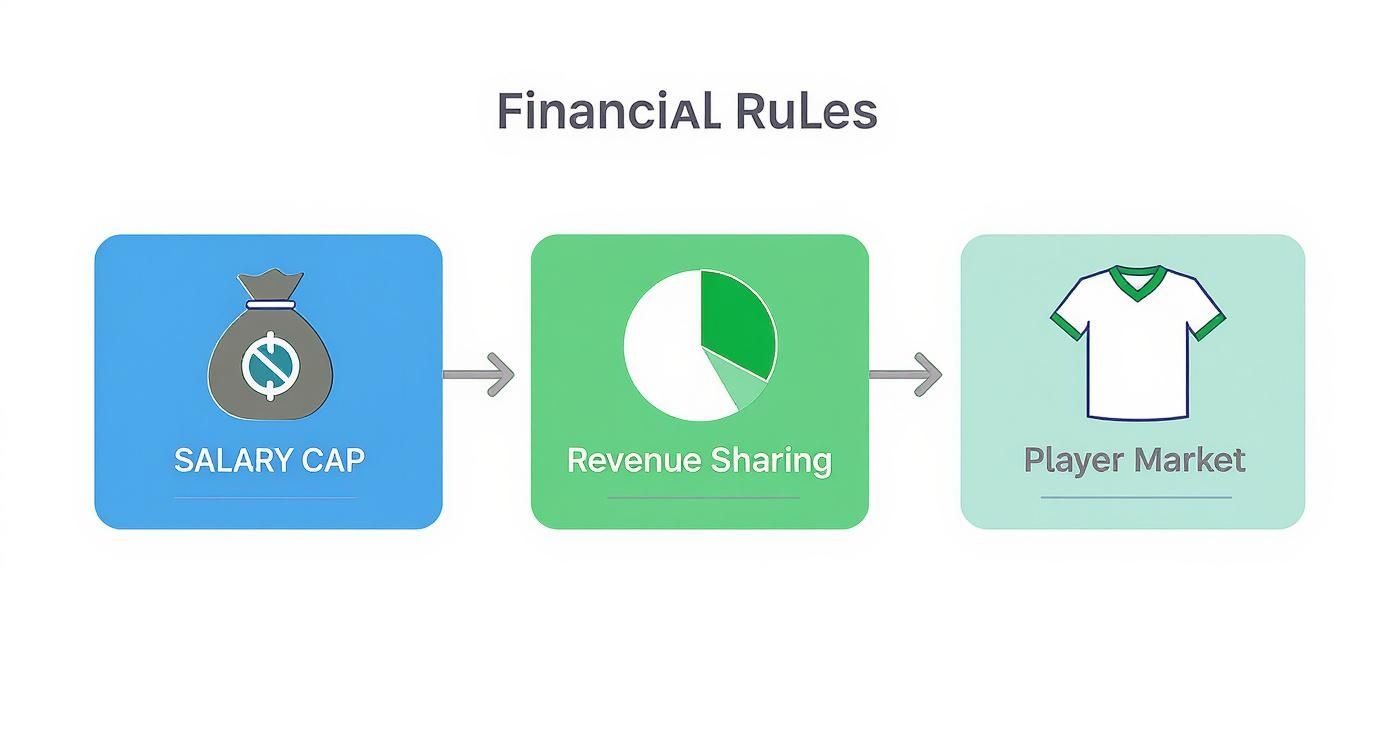
Getting a handle on how these mechanisms control team spending and long-term planning is absolutely critical for anyone looking to build a career in this field.
Essential Skills and Credentials to Stand Out
Loving sports isn't enough to land a job in finance—not by a long shot. Hiring managers are looking for a specific toolkit of hard and soft skills that prove you can handle the unique pressures and complexities of the sports business.
In sports finance, your real value isn't just in reporting the numbers; it's in using those numbers to tell a story about where the organization has been and where it needs to go to win—both on and off the field.
To become a top-tier candidate, you need to master these core competencies:
- Financial Modeling: The ability to build detailed, forward-looking spreadsheets to forecast revenue and expenses is completely non-negotiable.
- Data Analysis: You have to be comfortable swimming in large datasets to spot trends, value assets (including players), and find ways to make the business run smarter.
- Contract Negotiation: A deep understanding of the financial nuts and bolts of player and sponsorship contracts is crucial.
- Communication: Can you explain complex financial concepts to a head coach or a marketing manager without their eyes glazing over? This skill is priceless.
Beyond these skills, certain credentials will make your resume jump to the top of the pile. A Bachelor's degree in Finance, Accounting, or Economics is the standard price of admission. For those looking to advance, pursuing a Certified Public Accountant (CPA) license is a huge plus for accounting-focused roles, while the Chartered Financial Analyst (CFA) designation is highly valued for jobs centered on investment and valuation.
Understanding Salary Benchmarks
So, what can you expect to earn? Compensation in sports finance can vary quite a bit depending on your role, the organization you work for, and your experience level. Still, you can map out a general path.
- Entry-Level (Analyst, Coordinator): Getting your foot in the door usually starts with a salary in the $55,000 to $75,000 range. At this stage, you're focused on data entry, pulling basic reports, and supporting the senior members of your team.
- Mid-Level (Manager, Senior Analyst): Once you have a few years of experience under your belt, you can expect to move into the $80,000 to $120,000 range. Here, you’ll take on more ownership, managing budgets and leading smaller projects.
- Senior-Level (Director, VP, CFO): The top executives in sports finance can command salaries well into the six figures, often $150,000 to $250,000+. These roles also typically come with significant bonuses tied to the team's financial and on-field performance.
Keep in mind that these numbers can climb even higher if you're working for a major league team in a big market. A great way to get a real-time pulse on the market is to see what's out there right now. You can get a tailored look by browsing the latest finance roles in the sports industry on GetSportJobs to see exactly what qualifications employers are seeking and the salary ranges they're offering today.
Actionable Steps to Land a Sports Finance Job
https://www.youtube.com/embed/wK0xlniaqcg
Knowing the career paths is one thing, but actually landing one of those jobs in sports finance? That takes a real game plan. This industry is incredibly competitive, so your passion for the game has to be matched with a smart, professional approach to the job hunt.
Honestly, the real work starts way before you ever hit "submit" on an application. It begins with building relationships and understanding the landscape from the inside. Networking isn't just about collecting contacts; it's about learning from the people who are already doing the work you want to do.
Jump on LinkedIn and find finance professionals who work for teams or leagues you respect. Send them a polite message asking for a quick, 15-minute informational interview. You're just asking to hear about their career journey and what their day-to-day looks like. You'd be surprised how many people are happy to share their story, and those conversations can give you incredible insights—and, just as importantly, get you on their radar.
Crafting a Winning Application
When it's time to apply, your resume needs to do more than just list your credentials. It has to tell a story that connects your financial skills directly to the unique world of sports.
The key is to use numbers to show your impact. Don't just say you "managed budgets." Get specific. Say you "managed a $500,000 departmental budget, identifying cost savings of 12%." That kind of language shows a hiring manager you deliver real, tangible value.
To make sure your resume gets past the automated filters and grabs a recruiter's attention, you might want to run it through a specialized tool. You can get instant feedback with this helpful resume analyzer designed for sports industry jobs.
Your resume is your highlight reel. It should immediately demonstrate your financial acumen and analytical prowess, proving you can translate numbers into strategic advantages for a team or league.
Gaining Relevant Experience
At the end of the day, hands-on experience is what will set you apart. Everyone dreams of an internship with a major league team, but don't sleep on the opportunities at smaller organizations. What matters is getting in the door and doing the work.
Think about these pathways for building your experience:
- Collegiate Athletic Departments: See if you can volunteer or intern with your university's athletic department. You could offer to help with budget tracking, analyze ticket sales data, or assist with donor reporting.
- Minor League or Semi-Pro Teams: These teams usually have lean front offices, which means interns often get to take on serious, meaningful responsibilities.
- Sports Non-Profits: Look for organizations that run youth sports leagues or community athletic programs. They offer fantastic experience in managing grants, budgets, and financial reporting.
Every bit of relevant experience strengthens your application, no matter how big or small the organization. It proves you understand the real-world operations of finance in sports and are serious about building your career from the ground up.
Common Questions About Finance in Sports
As you dig into the world of sports finance, a few key questions always seem to pop up. Whether it's about breaking into the field, how smaller teams stay afloat, or the role of tech, getting straight answers is key to understanding how this industry really works.
What Education Is Best for a Sports Finance Career?
For most people starting out, a bachelor's degree in finance, accounting, or economics is the price of admission. This is your ticket to entry-level roles like analyst or coordinator, where you'll learn the ropes.
But if you’re aiming for the top spots? That's where advanced degrees and certifications come in. An MBA, especially one with a sports management focus, is a common path to leadership. Earning a Certified Public Accountant (CPA) or Chartered Financial Analyst (CFA) designation can also be a game-changer—it signals a level of expertise that really makes you stand out.
How Do Small-Market Teams Compete Financially?
It might seem like a David vs. Goliath situation, but leagues have built-in systems to help smaller market teams stay in the fight. The biggest equalizer is revenue sharing. Think of it as the league taking its massive national media and sponsorship deals and splitting the pot, giving every club a solid financial foundation to build on.
Salary caps and luxury taxes are also huge. They essentially stop big-market teams from hoarding all the top talent just by writing bigger checks. Beyond that, it comes down to being smart. Small-market teams have to nail their financial management, unearth undervalued players through sharp scouting, and build a die-hard local fanbase that fills the seats and buys the merch.
Data analytics has completely transformed the financial playbook. It allows organizations to make smarter, evidence-based decisions in every aspect of the business, from player valuation to fan engagement.
This is where the real edge is found today. Teams now use sophisticated data models to figure out exactly what a player is worth, making sure every dollar of their limited cap space is spent wisely. On the business side, analytics drives dynamic ticket pricing to squeeze every last drop of revenue out of a game and precisely measures the return on investment (ROI) from major sponsorship deals. It's no longer just about the size of your city; it's about how sharp your strategy is.
Ready to turn your financial skills into a career in the game? GetSportJobs is the premier platform for finding your next role in the sports industry. Browse hundreds of current openings from teams, leagues, and top brands to find the perfect fit for your expertise.
Start your job search today at https://www.getsportjobs.com.