How to Get Into Sports A Career Playbook
If you want to break into the sports industry, you need a smart game plan. It's about moving past just being a fan and showing you can bring real value to an organization. That means getting practical experience through internships, volunteering, or building specialized skills in areas like marketing, analytics, or operations. This guide is your playbook for turning that passion into a paycheck.
Your Starting Point for a Career in Sports
Landing a job in sports can feel like a long shot, but it's more achievable than most people realize. The industry is a massive, thriving ecosystem that goes way beyond the athletes on the field. From the front office of a pro team to a college athletic department or a sports tech startup, opportunities are everywhere if you know where to look and how to prepare.
Success here isn't about luck. It’s about strategy.
This means truly understanding the landscape, figuring out where your unique talents fit, and building the right connections. You absolutely do not need to be a former athlete to make it. Instead, your focus should be on developing professional skills that are in high demand across the business.
Mapping the Core Career Verticals
First things first: you need to see the full field of play. A lot of people get stuck thinking only about coaching or scouting, but most of the jobs—the real business-critical roles—are behind the scenes. The global sports industry is booming, with total sales hitting $521 billion in 2024 and projected to blow past $600 billion by 2030. You can read more about this incredible market expansion from Morgan Stanley.
All that growth means a constant need for talented people in a bunch of different specializations.
This diagram gives you a great visual breakdown of the main career paths you can take in sports, from team operations to marketing and media.
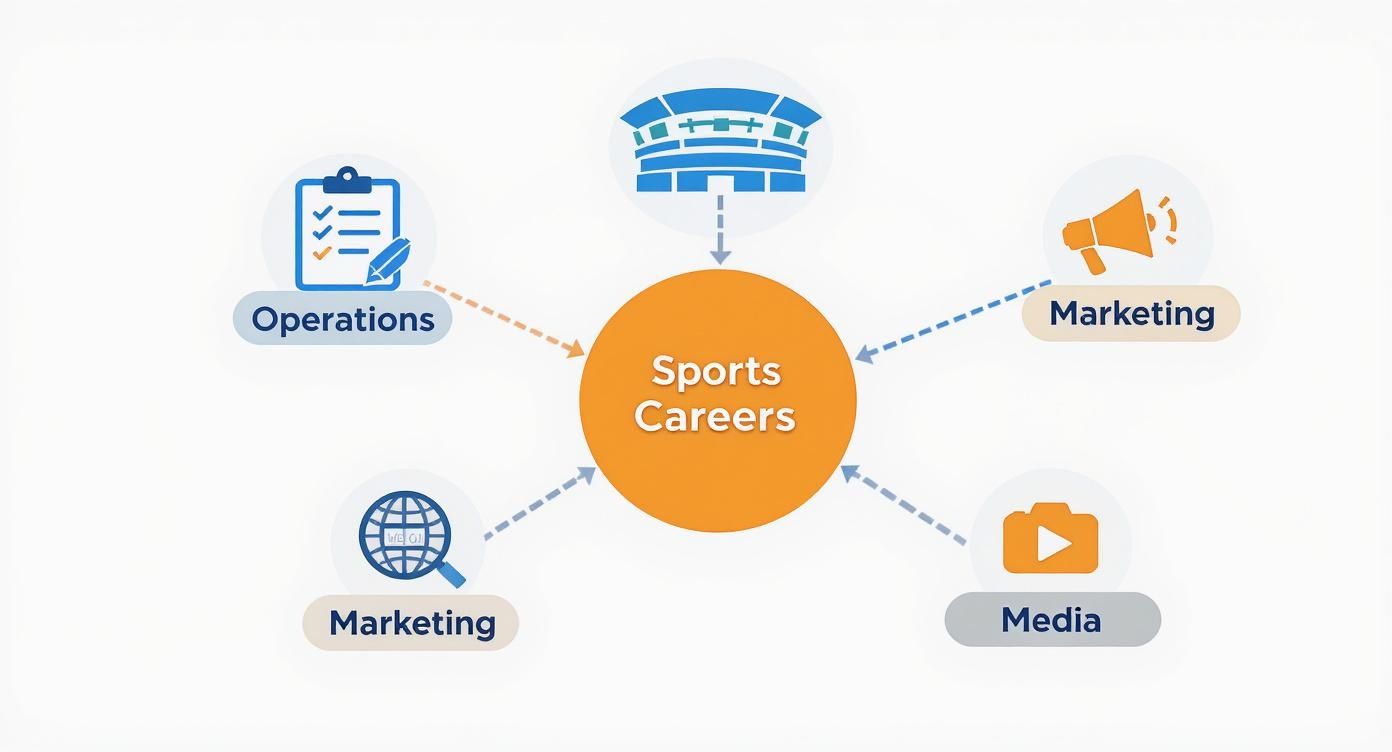
As you can see, each of these areas—operations, marketing, and media—is its own distinct world with its own set of skills and responsibilities.
Identifying Your Best Fit
Knowing these different paths is key to focusing your job search. Are you a data nerd who lives for stats? A career in sports analytics might be your calling. Or maybe you're a gifted storyteller who knows how to build a community on social media? The sports media and marketing worlds are waiting for you.
To help you visualize where you might fit, I've broken down some of the most common career verticals, what people in those roles actually do, and what it takes to get your foot in the door.
Mapping Your Path in the Sports Industry
| Career Vertical | Core Responsibilities | Essential Skills | Common Entry Point |
|---|---|---|---|
| Team/League Operations | Managing logistics, travel, scheduling, and game-day execution. | Organization, problem-solving, budgeting, communication. | Intern, Operations Coordinator. |
| Marketing & Promotions | Creating fan engagement campaigns, managing brand partnerships, and running social media. | Digital marketing, content creation, sales, graphic design. | Marketing Assistant, Social Media Coordinator. |
| Sports Media & Comms | Writing press releases, managing media relations, creating digital content (video/podcasts). | Strong writing, public speaking, video editing, PR strategy. | Communications Intern, Content Creator. |
| Sales & Sponsorships | Selling tickets, corporate sponsorships, and premium seating. | Salesmanship, negotiation, CRM software, networking. | Inside Sales Representative, Account Executive. |
| Sports Analytics | Analyzing player performance, fan data, and business metrics to inform decisions. | Data analysis (SQL, Python/R), statistics, data visualization. | Analytics Intern, Data Analyst. |
| Events Management | Planning and executing events, from single games to large-scale tournaments. | Project management, vendor relations, logistics, composure under pressure. | Event Coordinator, Game Day Staff. |
This table is just a starting point, but it should give you a clearer idea of the different lanes you can drive in. Your goal is to find the one that best matches your natural talents and interests.
The most successful people in sports are not just passionate fans; they are skilled professionals who apply their expertise to the business of the game. Your ability to solve problems and create value is your ultimate ticket in.
To start narrowing things down, work through these points:
- Self-Assessment: What are your strongest transferable skills? Are you a wizard with project management, a natural at sales, or a creative force in content creation?
- Deep Research: Dive into the roles that catch your eye. What does a "Director of Partnership Activation" actually do all day? Look up people with that title on LinkedIn.
- Get Experience: Find volunteer or internship roles to get your hands dirty. It doesn't matter if it's with a local youth league or helping at a college tournament—it all counts.
Doing this homework will help you focus your energy and build a targeted plan. Once you have a better sense of direction, you can start exploring available full-time sports jobs that truly align with your goals.
Exploring the Landscape of Sports Career Paths

So, you want to work in sports? The first thing to understand is that the industry is so much bigger than what you see on the field. For every star athlete making headlines, there are hundreds of professionals behind the scenes, in specialized roles, making the whole operation hum.
Forget the narrow view of just being a coach or an agent. The real opportunities are buried within a massive business ecosystem. Each career path offers a totally different way to contribute, demanding its own unique blend of skills, passion, and strategic thinking.
Let's break down the major sectors where you can actually build a lasting and rewarding career.
Team and League Operations
This is the central nervous system of any sports organization. Think of operations pros as the logistical wizards who make sure everything runs without a hitch, long before the lights come on. They are the ultimate problem-solvers, managing countless details that are invisible to the average fan but absolutely critical to success.
The responsibilities here are incredibly diverse and almost always hands-on. One day you could be coordinating travel for an entire NBA team during a grueling road trip, and the next you're managing the complex practice schedules for a college athletic department with over 20 different teams.
What does the day-to-day look like?
- Logistics Management: Arranging team travel, hotels, and equipment transport. It's a puzzle of moving parts.
- Game-Day Execution: Overseeing everything from stadium setup and credentialing to ensuring a seamless experience for both athletes and fans.
- Budgeting and Compliance: Juggling operational budgets and making certain the organization is playing by all the league's rules and regulations.
To thrive here, you need to be exceptionally organized, ridiculously adaptable, and cool under pressure. If you get a kick out of project management and have a knack for anticipating what's needed before anyone asks, this could be your calling. You can learn more about the dynamic world of sports management jobs on our platform to see what’s out there.
Sports Marketing and Sponsorship
Here’s where the business of sports meets the art of storytelling. Professionals in sports marketing are responsible for one of the most vital functions: building and monetizing the fan base. They forge that emotional bond between a team and its community, turning casual viewers into die-hard supporters.
Sponsorship, of course, is the financial engine that powers much of the industry. This is where iconic partnerships are born—think Nike and Michael Jordan or Gatorade's constant presence on every sideline. It’s a high-stakes world that demands a sharp combination of sales, relationship building, and creative strategy.
A marketer’s real goal isn't just selling tickets. It's creating an experience so compelling that fans feel like they're part of the team. That sense of belonging is what drives loyalty and, ultimately, revenue.
Key roles in this vertical focus on:
- Brand Activation: Bringing sponsorships to life through in-stadium promotions, digital campaigns, and community events.
- Fan Engagement: Using social media, email, and original content to build a direct, authentic relationship with fans.
- Corporate Partnerships: Identifying, pitching, and locking down sponsorship deals with brands that genuinely align with the team's identity.
To make it in marketing, you need a healthy mix of creativity and analytical thinking. It's crucial to understand your audience on a deep level and know exactly how to measure the impact of your campaigns.
Sports Media and Content Creation
In an age where content is king, the sports media world is absolutely exploding with opportunity. This path is for the storytellers—the writers, videographers, podcasters, and social media gurus who shape how the public sees teams and athletes.
It's no longer just about traditional journalism. Teams, leagues, and even individual athletes are now their own media companies, churning out a constant stream of content to connect directly with their audience. This shift has created a massive demand for creative pros who can produce amazing stories across every platform imaginable.
One day you could be live-tweeting a game, and the next you’re producing a documentary series for the team’s YouTube channel. The work is fast, fluid, and always changing.
Data Analytics and Performance Science
Often called the "Moneyball" effect, data analytics has completely changed how sports organizations make decisions. This field is for people who can find the story hidden in the numbers, giving their teams a competitive edge on and off the field.
Analysts aren't just tracking player stats anymore. They’re also digging into ticket sales data to optimize pricing, studying fan demographics to guide marketing efforts, and evaluating sponsorship ROI. It’s a field where a deep understanding of statistics, data visualization, and business intelligence is non-negotiable.
Sports Medicine and Athletic Training
Behind every elite athlete is a dedicated team of health professionals keeping them in peak condition. This crucial sector includes athletic trainers, physical therapists, strength and conditioning coaches, and sports nutritionists. Their job is simple but essential: optimize performance, prevent injuries, and manage rehabilitation.
These roles require a serious scientific background in human anatomy, physiology, and biomechanics, along with a host of specific certifications. It’s the perfect career for someone passionate about health and wellness who wants to directly impact an athlete's success and longevity.
Building Your All-Star Resume and Cover Letter
A generic resume is the quickest way to land in the "no" pile. When you're trying to break into the sports industry, your application has to do more than just list your job history—it needs to prove you get the business of sports, not just the game itself.
You have to learn how to reframe your experience, showing how it directly solves the problems a team, league, or sports company is facing.
A lot of people think their non-sports experience doesn't count. That’s a huge misconception. Your time in customer service, sales, or even managing a busy restaurant is a goldmine of transferable skills. You just have to know how to translate them.
Think about it: running a packed restaurant on a Saturday night is a crash course in event logistics and fan experience. Hitting sales targets at a retail store proves you can drive revenue—a skill that’s directly relevant to selling tickets or sponsorships.
Quantify Your Impact with the STAR Method
To make your resume pop, every bullet point needs to tell a story of success. The best way to do this is with the STAR method: Situation, Task, Action, and Result. This framework stops you from just listing duties and forces you to showcase your actual achievements.
Hiring managers in sports are obsessed with numbers. Did you boost efficiency? Grow sales? Improve customer satisfaction? Put a number on it. Numbers don't lie.
Here’s how you can transform a bland statement into a powerful, results-driven bullet point.
Translating Your Skills for a Sports Career
| Generic Skill Statement | Sports-Focused Resume Bullet (STAR Method) | Why It Works |
|---|---|---|
| "Responsible for social media accounts." | "Managed the brand's Instagram account (Situation), tasked with increasing fan engagement (Task). Implemented a new content strategy featuring behind-the-scenes player content and interactive polls (Action), resulting in a 25% increase in follower engagement and 15% growth in followers over six months (Result)." | It provides specific actions and, more importantly, measurable results. "Managed social media" is passive; "increased engagement by 25%" is a tangible business win that gets you noticed. |
See the difference? The second example tells a complete story of value, which is exactly what a hiring manager wants to see.
Tailor Your Resume for Every Single Application
One of the biggest mistakes I see is people sending the same resume out for every job. In a market as competitive as sports, that’s a non-starter. You absolutely have to customize your application for the specific role.
This means dissecting the job description, pinpointing the key skills they’re looking for, and then tweaking your resume to highlight your experience that lines up perfectly.
Before you hit send, get a second opinion. You can run your resume through our free resume analysis tool for instant feedback on how well it’s optimized.
It's also crucial to remember that most large sports organizations use Applicant Tracking Systems (ATS) to filter candidates. These bots scan for keywords and proper formatting. To make sure a human ever sees your resume, it's vital to create an ATS friendly resume template that can get past the first hurdle.
Write a Cover Letter That Tells Your Story
Your cover letter is where you connect the dots and let your personality shine. Don't just rehash what's on your resume. This is your chance to tell a compelling story that links your passion for the game with a sharp understanding of the organization's business goals.
Your cover letter should answer one fundamental question for the hiring manager: Why are you the perfect person to help this specific organization solve its specific problems and achieve its specific goals?
Show them you did your homework. Reference a recent marketing campaign, mention a specific challenge the team is facing, or talk about a community program they run that you admire. This proves you’re not just spamming applications; you're genuinely invested in their success.
Finally, don't just focus on the big leagues. The youth sports economy is a massive, and often overlooked, part of the industry. Parents now spend over $40 billion a year on their kids' sports, which is a 46% jump in family spending in just five years. This market is actually double the size of the NFL's annual revenue. Showing you understand these broader industry trends can make you stand out as a savvy candidate who sees the bigger picture.
Gaining Experience and Networking Like a Pro

In the sports industry, your resume might get you in the door, but it's your experience and network that will keep you in the room. This business is built on relationships and proven ability. Being a die-hard fan is a great start, but you have to show you're willing to do the work.
That means getting your hands dirty. Real-world experience is the most valuable currency you have, proving you understand the grind that happens behind the glamour.
Finding and Landing Meaningful Experience
Your path into sports doesn't have to start with a flashy internship at a pro team. In fact, some of the best, most impactful experience you can get happens far away from the major leagues. The goal is to find roles where you can take on real responsibility and get tangible results for your resume.
Think local. Every community has a thriving sports ecosystem:
- Youth Sports Leagues: Jump in and offer to help with administration, run their social media, or manage game-day operations. These roles are a crash course in the fundamentals.
- College Athletic Departments: Smaller colleges and non-revenue sports are often hungry for volunteers to help with marketing, ticketing, or event setup.
- Local Races and Tournaments: A 5K race or a weekend soccer tournament needs a small army of volunteers for everything from checking in participants to course management.
Consider these roles your training ground. They’re a place to learn the ropes, make mistakes when the stakes are low, and build a portfolio of actual accomplishments.
Building Your Professional Network from Scratch
Networking sounds intimidating, but it’s really just about building genuine relationships. It's a long game, not a quick transaction. You're looking to learn from people, offer value when you can, and establish yourself as a credible, passionate professional.
Of course, platforms like LinkedIn are essential tools. But before you start connecting, your foundation needs to be solid. The first step is to update and optimize your LinkedIn profile so it clearly communicates your goals and showcases your skills.
Once your profile is sharp, it's time to connect.
Networking Pro Tip: Never send a generic connection request. Your message should show you’ve done your homework. Reference an article they shared, mention a mutual connection, or comment on a recent win for their organization. Personalization makes all the difference.
Here’s how you can start building that network today:
- Ask for Informational Interviews: Reach out to people in roles you find interesting and ask for 15 minutes of their time to hear about their career path. Most people are generous and willing to share their story.
- Attend Industry Events: Go to webinars, local sports business meetups, or even major conferences if you can. Nothing beats a face-to-face connection.
- Volunteer Strategically: Pick volunteer gigs that put you in contact with industry professionals. Working the check-in table at a charity golf tournament is a fantastic way to meet almost everyone there.
Outreach That Actually Gets a Response
When you’re reaching out cold, your message has to be concise, respectful, and focused on them. The biggest mistake people make is asking for a job right away. Instead, ask for advice.
Here’s a simple template for a LinkedIn message that works:
"Hi [Name],
My name is [Your Name], and I'm an aspiring [Your Desired Role]. I'm really impressed with the work your team at [Their Company] is doing, especially the recent [Specific Project or Campaign].
I'm working on building my skills in [Skill 1] and [Skill 2] and would be grateful for any advice you might have for someone trying to break into the industry.
Thanks for your time,
[Your Name]"
This approach works because it respects their time and positions them as the expert.
Keep in mind that the sports world is expanding, especially into health and wellness. Physical inactivity is a global issue, with 31% of adults and a staggering 81% of adolescents not getting enough exercise. This has created a huge need for roles focused on community engagement and participation. Highlighting your awareness of these bigger industry trends in conversations can set you apart as a candidate who sees the bigger picture.
Mastering the Sports Industry Interview
You landed the interview—now it's game time. This is the moment where all your preparation, passion, and professional skills come together. Interviews in the sports world are a different beast; they move way beyond the generic questions you might expect elsewhere. They're built to test your business sense, your creativity, and whether you truly get the unique culture that makes a sports organization tick.
Hiring managers need to see that you've done more than just watch the games from your couch. They're looking for proof that you understand their brand, their fans, and the real-world commercial challenges they face every day. What will set you apart is your ability to think like a strategist, not just a spectator.
Answering Sports-Specific Questions
Standard interview prep is a decent starting point, but it's not enough. You have to be ready for questions that dig deep into the business of sports. These are often situational, designed to see how you think on your feet when presented with a genuine business problem.
Forget just being asked about your strengths. Instead, you're far more likely to hear things like:
- "How would you increase ticket sales for our team during a losing season?"
- "Walk me through a sponsorship activation you'd propose for a non-traditional brand partnership."
- "What strategies would you use to engage our younger fan demographic on a very limited budget?"
The trick here is to structure your answer with a clear framework. Don't just spitball random ideas. Show them your thought process: break down the problem, identify the target audience, propose a specific, creative solution, and—crucially—explain how you would measure its success.
Your goal isn't just to have the "right" answer. It's to demonstrate a structured, creative, and data-informed approach to problem-solving that proves you can add real value from day one.
The Power of Deep Research
Showing up prepared means going miles beyond a quick glance at the team's Wikipedia page. You need to completely immerse yourself in their world. This level of dedication shows you're genuinely invested and helps you craft the kind of insightful questions that really stick with a hiring manager.
Before you walk into that room, make sure you can confidently talk about:
- Their Business Operations: Who are their main sponsors? What were their biggest marketing campaigns over the last 12 months? How are they using tech to improve the fan experience at the stadium?
- Their Recent Performance (On and Off the Field): Is the team rebuilding or are they a championship contender? What are the biggest narratives surrounding the team in the media right now?
- Their Key Personnel: Who is the team president? The head of marketing? The director of gameday operations? Knowing the leadership structure shows you’ve put in the work.
Doing this deep dive does two critical things. First, it lets you tailor your answers, connecting your skills directly to their current projects or challenges. Second, it gives you the ammunition to ask incredibly smart, specific questions when it's your turn.
Asking Questions That Show Your Value
When the interviewer inevitably asks, "Do you have any questions for us?" this is your final chance to make a lasting impression. Sure, you can ask a generic question about company culture, but asking something that shows off your deep research is infinitely more powerful.
Instead of, "What's a typical day like?" try something with more substance:
- "I saw that you recently launched the Junior Fan Club initiative. I'm curious, what have been the biggest challenges and successes you've seen with engaging that younger audience so far?"
- "With the league's new media rights deal kicking in, how do you see the team's digital content strategy evolving over the next two years to capitalize on that?"
Questions like these prove you're already thinking about their business on a strategic level. They instantly shift the interview from a simple Q&A into a real, collaborative conversation. This small change positions you not as just another applicant, but as a potential colleague who is ready to hit the ground running.
Common Questions About Starting a Sports Career
Trying to break into a new industry always feels a bit like navigating in the dark. When you're figuring out how to get a foot in the door in sports, it’s easy to get sidetracked by common questions and myths that can kill your momentum before you even start.
Let's clear the air. I've pulled together the most frequent questions I hear from aspiring pros just like you, with direct, no-fluff answers to help you move forward with confidence.
Do I Need a Sports Management Degree?
This is easily one of the biggest misconceptions holding people back. Let me be clear: while a sports management degree provides a great, focused education and a built-in network, it is absolutely not the only path. The industry is full of successful people with degrees in business, marketing, law, communications, and data analytics.
What really moves the needle is your ability to demonstrate transferable skills, a genuine passion for the business of sports, and relevant, hands-on experience. A finance major can be an absolute rockstar in a team's business operations department. A communications grad is a natural fit for a media relations role.
The trick is to supplement whatever you studied with practical experience. Go get those internships, volunteer at local sporting events, and network like your career depends on it—because it does. Your degree is the foundation, but your experience is what will land you the job.
How Important Is It to Have Been an Athlete?
Sure, being a former athlete can give you a leg up. You inherently understand team dynamics, the competitive mindset, and the life of the people you'll be working alongside. But for the overwhelming majority of jobs in sports, it is not a prerequisite.
Think about it: sports organizations are complex businesses. They need skilled marketers, data scientists, event planners, salespeople, and operations experts. For these roles, your professional skills and business savvy are far more critical than anything you did on a court or field.
Your expertise is what makes you a valuable asset. Focus on demonstrating how your unique skill set can help a sports organization achieve its business goals—whether that's increasing ticket sales, securing major sponsorships, or enhancing fan engagement.
Instead of getting hung up on a lack of playing experience, concentrate on framing your professional abilities within a sports context. Your value is in what you can do for the business.
What Are the Best Ways to Find Entry-Level Sports Jobs?
Finding that first opportunity requires a smart, multi-pronged attack. Don't put all your eggs in one basket. A successful search combines specialized platforms with proactive, personal outreach.
Here are the strategies that actually work for uncovering those entry-level gems:
- Hit the Industry-Specific Job Boards Start with platforms built exclusively for the sports world. Websites like TeamWork Online and the NCAA Market are essential. This is where teams, leagues, and colleges post their openings, cutting through the noise of massive job sites.
- Use LinkedIn Like a Pro Don't just scroll through job listings. Follow your target organizations, join sports industry groups, and connect directly with recruiters and current employees. A short, personalized connection request can make a world of difference.
- Network in the Real World Never underestimate the power of showing up. Go to local sporting events, industry conferences, and professional meetups. These are invaluable chances to build genuine relationships with people who can open doors for you.
- Look Beyond the Big Leagues Some of the best entry points aren't with the major pro teams. Check out opportunities with college athletic departments, youth sports organizations, and sports marketing agencies. These roles often give you broader experience and more responsibility right out of the gate.
When you weave these tactics together, you create a powerful job search strategy that dramatically increases your odds of finding the right role to launch your career.
Ready to turn this advice into action? GetSportJobs is the industry's go-to job board, connecting you with hundreds of openings from professional teams, college programs, and top sports brands. Start your search on GetSportJobs today and take the next real step toward your dream career.