Finding Jobs in College Athletics a Complete Guide
When you think of a career in college athletics, what comes to mind? For most people, it's the head coach—the one calling plays from the sideline, headset on, under the bright stadium lights.
But that’s just the tip of the iceberg. Behind every successful team and every sold-out game is a massive, complex organization that looks a lot more like a Fortune 500 company than a simple sports club. A modern athletics department is a powerhouse of business, marketing, data, communications, and operations pros, all working to win on and off the field.
The Real World of College Sports Careers
It's time to set aside the old notion that college sports is just about the games. We're talking about a multi-billion dollar industry fueled by massive media rights deals, dedicated alumni donors, and the constant pressure to deliver an elite experience for student-athletes. This evolution has opened up a whole world of professional careers that have little to do with a playbook.
The best way to think about an athletic department is as a company with a very passionate, very public-facing brand. And just like any other business, it needs a deep bench of specialists to truly succeed. You'll find roles that mirror almost every corporate function, just adapted for the unique, high-energy environment of college sports.
More Than Just a Game
The demand for specialized skills in college athletics is skyrocketing. Departments aren't the small, informal operations they once were. They're now sophisticated organizations juggling multi-million dollar budgets, running complex marketing campaigns, and navigating a labyrinth of compliance rules. That kind of complexity demands a true professional workforce.
Take a successful football program, for example. A great coach is essential, but they can't do it alone. The program also needs:
- Marketing gurus to fill the stadium and build an unbreakable fan community.
- Skilled fundraisers to bring in the big donations needed for new facilities and scholarships.
- Compliance experts to make sure the department stays on the right side of the NCAA's dense rulebook.
- Dedicated academic advisors to help student-athletes balance their coursework and their sport.
- Data analysts to find the hidden insights that sharpen recruiting strategies and on-field performance.
A Major Employer on Campus
College athletics departments have become some of the largest and most dynamic employers on campus. The NCAA itself includes over 1,000 member schools, and each one runs a department that employs a small army of staff. Your average NCAA Division I athletic department has between 100 and 200 full-time employees. At the Power Five level, those numbers can easily swell to over 300.
The financial scale is just as stunning. The median annual salary for an athletic director at a Division I school has climbed past $400,000, with some of the top jobs commanding salaries well over $1 million. You can dig into some of the official numbers in the NCAA's recruiting fact sheet.
The modern athletic department is a sophisticated business. Its success hinges on a team of professionals who can manage budgets, drive revenue, and build a brand—proving that a passion for sports can be channeled into dozens of fulfilling corporate-style careers.
The bottom line is this: you don’t need to have been a star athlete to build a fantastic career here. A degree in business, communications, finance, or data science can be every bit as valuable as a championship trophy. This guide will walk you through how to turn your professional skills into a rewarding role, breaking down the different jobs and giving you a clear roadmap to get your foot in the door.
Understanding the Roles Inside an Athletic Department
To find your footing in college sports, you first need to understand the team behind the team. It's easy to think it's all just coaches and players, but that view misses the massive network of professionals who make everything happen. A college athletic department is a complex organization, and most roles fall into one of three main areas: Administration, Coaching, and Business Operations.
Each division is crucial. They all have to work in sync to support student-athletes, chase championships, and keep the department financially healthy. The best way to see how it all fits together is with a quick look at an organizational chart.
This chart lays out the typical structure, showing how administrative and coaching divisions serve as the two main pillars of the entire department.
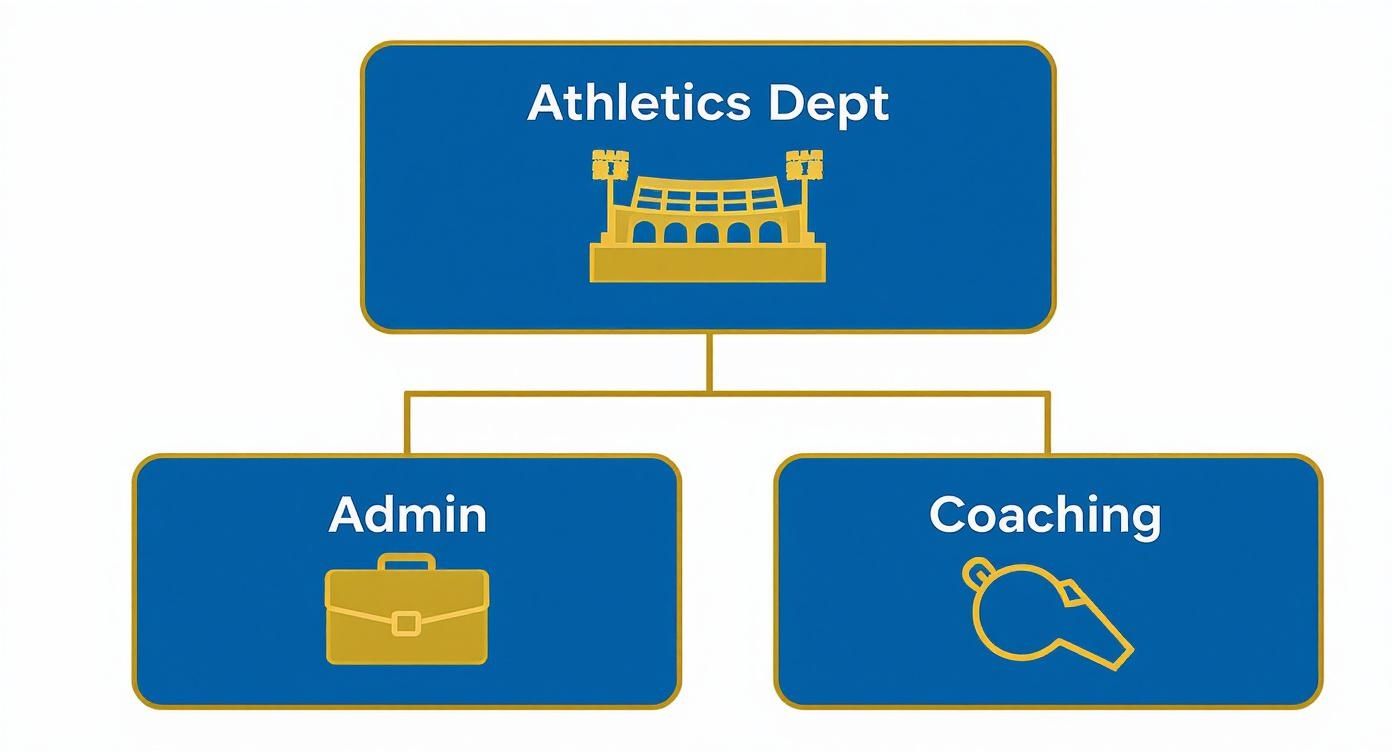
As you can see, while the coaches are the most visible part of the operation, the administrative and business side is just as big and absolutely vital to the department's success.
To give you a clearer picture of where you might fit, the table below breaks down some of the most common jobs. It compares what they do day-to-day, what it takes to get hired, and what you can expect to earn at the Division I level.
Overview of Common College Athletics Positions
| Job Title | Primary Responsibilities | Required Qualifications | Average Salary Range (Division I) |
|---|---|---|---|
| Athletic Director | Oversees entire athletic department, including budgets, hiring, fundraising, and strategic vision. | Master's degree (often in Sports Admin), extensive leadership experience. | $175,000 - $1,000,000+ |
| Compliance Officer | Ensures the department follows all NCAA, conference, and university rules and regulations. | Bachelor's or Law degree; detail-oriented with deep knowledge of NCAA bylaws. | $55,000 - $120,000 |
| Academic Advisor | Supports student-athletes' academic progress, eligibility, and path to graduation. | Master's degree in counseling, education, or related field. | $45,000 - $75,000 |
| Head Coach | Leads a specific sports team, including recruiting, game strategy, and player development. | Bachelor's degree, extensive coaching experience, and sport-specific knowledge. | Varies widely by sport, from $75,000 to over $10 million. |
| Strength & Conditioning Coach | Designs and implements training programs to improve athlete performance and prevent injuries. | Bachelor's degree; CSCS or SCCC certification is standard. | $50,000 - $500,000+ |
| Athletic Trainer | Provides medical care, injury prevention, and rehabilitation for student-athletes. | Master's degree; BOC certification and state licensure required. | $50,000 - $90,000 |
| Marketing Director | Develops campaigns to sell tickets, increase fan engagement, and promote the athletic brand. | Bachelor's degree in Marketing, Business, or a related field. | $60,000 - $110,000 |
| Sports Information Director | Manages media relations, social media, statistics, and all team communications. | Bachelor's degree in Communications, Journalism, or a related field. | $50,000 - $95,000 |
This is just a snapshot, of course. Each role has its own unique pressures and rewards, but this gives you a solid starting point for exploring what's out there.
The Brains of the Operation: Administration and Leadership
This is the strategic core of the athletic department. These are the people setting the vision, wrestling with the budget, and making sure everyone stays on the right side of the NCAA's incredibly complex rulebook. It’s a world that demands sharp leadership skills, a mind for strategy, and an almost obsessive attention to detail.
- Athletic Director (AD): Think of the AD as the CEO of the athletic department. They're on the hook for everything—from hiring the next head football coach and managing a multi-million dollar budget to wooing donors and being the public face of the university's sports programs.
- Compliance Officer: This is the ultimate rule-keeper. Their entire job is to ensure that every coach, staff member, and student-athlete is playing by the book according to NCAA, conference, and school rules. It’s a make-or-break role that shields the university from massive fines and penalties.
- Academic Advisor: This person is all about the "student" in student-athlete. They are the guide who helps players navigate their class schedules, stay eligible to compete, and, most importantly, make real progress toward a degree.
These high-level administrative jobs usually require advanced degrees and years of experience. If you’re drawn to the big-picture strategy that steers a major sports organization, our guide to sports management careers is a great place to learn more.
The Competitive Engine: Coaching and Performance
This is the side of college athletics that everyone sees on TV. It’s made up of the people who work directly with student-athletes every single day, pushing them to reach their peak physical and mental potential. Here, success is often measured in wins and losses, but it's really about player development.
A coach's impact extends far beyond the scoreboard. They are mentors, teachers, and leaders who shape young adults during a formative period of their lives, teaching lessons in discipline, teamwork, and resilience.
Key roles on the performance side include:
- Head Coach: The undisputed leader of a program. They're responsible for everything from recruiting top talent and designing game plans to building a winning team culture.
- Assistant Coach: A specialist who focuses on a specific part of the game. They might be a position coach, an offensive or defensive coordinator, or a recruiting coordinator.
- Strength and Conditioning Coach: This is the architect of an athlete's physical power. They design workout programs to build speed, strength, and endurance, all while working to reduce the risk of injury.
- Athletic Trainer: The first responder for player health. They handle everything from preventative care and taping ankles to providing emergency medical attention and guiding athletes through injury rehabilitation.
These jobs aren’t for just anyone; they often require specialized certifications. For example, strength coaches typically need credentials from the National Strength and Conditioning Association (NSCA), while athletic trainers must be certified by the Board of Certification for Athletic Trainers (BOC).
The Revenue Drivers: Business and Fan Engagement
This division is all about the money and the buzz. These teams handle the external-facing side of the department, with the primary goals of generating revenue, building the university's brand, and creating an electric atmosphere for fans. In short, they are the sales and marketing engine.
These jobs are a perfect fit for creative, business-savvy people who love sports. You get to blend that passion with skills in marketing, sales, and communication to connect teams with the community and fuel the department's financial growth.
- Marketing and Promotions: This is the crew tasked with putting butts in seats. They run advertising campaigns, dream up fun game-day promotions, and do whatever it takes to sell tickets and fill the stadium.
- Fundraising/Development: These are the relationship-builders. They work with alumni and major donors to secure the large financial gifts needed for scholarships, new facilities, and other big-ticket program needs.
- Sports Information Director (SID): Often called a communications director, this is the storyteller. They manage media relations, run the team's social media, and write all the press releases and game notes.
- Event and Facilities Management: The logistics gurus of game day. This team makes sure the stadium runs like a well-oiled machine, handling everything from security and concessions to parking and guest services.
Each of these categories offers a distinct career path. Whether your strengths lie in leadership, teaching, or business, there’s a place for you to make a real impact in the world of college athletics. The trick is figuring out which area speaks to you and then starting to build the specific experience you'll need to break in.
How to Get Your Foot in the Door
Trying to break into college athletics can feel like trying to walk on to a D-I team. It's incredibly competitive, and just being a huge fan won't get you on the roster. You need a real game plan, one that goes beyond the generic advice and focuses on the stuff that actually makes athletic directors and hiring managers sit up and take notice.
Think of it like a playbook. You can't just run the same play over and over. You need a mix of strategies—getting hands-on experience, making real connections, and absolutely nailing your application—to land that first big role. It’s about putting it all together to show you belong on the field.
Gain Relevant Experience Early and Often
The single biggest thing that separates the people who get hired from those who don't? Real-world, hands-on experience. An athletic department is a chaotic, fast-moving environment, and nobody has time to hold your hand. They need to see you can jump in and contribute from day one. Your degree gets you in the door, but it's what you've done that builds your career.
These are the best ways to get that experience:
- Internships: This is the gold standard, period. A real internship in marketing, compliance, or game-day operations gives you actual skills and projects you can put on your resume. It's your shot to learn the unique rhythm of a department and show them you have a killer work ethic.
- Volunteer Roles: Don't ever sleep on the power of volunteering. Offering a hand on game days, helping with team travel logistics, or chipping in at a booster event is a fantastic, low-pressure way to get inside the building. You’ll meet the key players and prove you're all-in.
- Graduate Assistantships (GAs): If you're thinking about a master's degree, a GA position is the ultimate opportunity. It's an intense combination of your graduate studies and serious professional duties, and it often comes with a tuition waiver and a small stipend. These gigs are tough to get for a reason—they provide an incredible, immersive experience.
Treat every one of these roles like an audition. You're proving you’re more than a fan; you're a professional ready to get to work.
Build Your Network Authentically
In the tight-knit world of college sports, who you know often matters just as much as what you know. But let's be clear: "networking" isn't about speed-walking through a conference trying to collect business cards. It's about building genuine relationships with people who can give you advice, mentor you, and maybe down the line, point you toward an opening.
"People hire people they know, like, and trust. Your goal in networking isn't to ask for a job; it's to build a reputation as a smart, reliable, and passionate professional who others want to work with."
Start making connections with a purpose. Follow staff from athletic departments you admire on LinkedIn and X (formerly Twitter) and actually engage with their content. Don't be afraid to reach out for an informational interview—not to ask for a job, but to learn. A simple message like, "Your career path is really inspiring, would you have 15 minutes to share some advice for someone just starting out?" can open more doors than you'd think.
And yes, get yourself to industry events. Big national conferences like the one hosted by the National Association of Collegiate Directors of Athletics (NACDA) are great, but even smaller, regional meetups can be a goldmine for meeting people.
Craft a Sports-Centric Application
When it's time to apply, your resume and cover letter have to speak the language of college athletics. A generic application that looks like it could have been sent to a bank or a tech company will get tossed in the trash immediately. You have to customize your materials to show you get the culture and the specific demands of an athletic department.
On your resume, translate your skills into a sports context. Instead of just saying "managed social media," write something like, "Grew fan engagement on Instagram by 25% for the women's basketball team." Put numbers on your accomplishments wherever you can.
Your cover letter is where you connect your personal drive to that specific school's mission. Mention a recent team's success or a marketing campaign you thought was brilliant. It proves you've done your homework and aren't just spamming applications. Before you hit send, get a second opinion. You can get a free evaluation from our sports resume analyzer to see how your resume stacks up against what insiders are looking for. It's a quick step that can be the difference between getting the interview and getting ignored.
Emerging Careers and Future Industry Trends
The world of college sports is changing fast. Seriously fast. And all that change is kicking up a wave of brand-new career opportunities. Roles that didn't even exist a decade ago are now becoming mission-critical for athletic departments.
Think of it like a football team adjusting its playbook mid-season. Just as offenses and defenses have to evolve, the business side of athletics has to innovate to keep its edge. This means the demand for certain skills is exploding, creating some really exciting new jobs for people who can keep up.
This evolution is making the job market inside athletic departments much more diverse. The old career paths—basically coaching or admin—have branched out in a big way, opening doors for specialists in tech, media, and athlete support. In fact, a recent survey found that nearly 22% of professionals now work in communications, marketing, or media. If you're curious to see how things are shifting, you can review key findings on top student jobs in college sports.
The Rise of Data and Digital Content
Data analytics isn't just for the pros anymore. College programs are now hiring analysts to comb through everything from recruiting patterns and opponent tendencies to fan engagement and ticket sales. These folks are the modern-day scouts, using numbers to find that slight advantage that wins games and sells out stadiums.
At the same time, the need for top-notch digital content creators has gone through the roof. Every department needs skilled people to manage its brand across a dozen different platforms.
- Social Media Managers: These are the people who give the program its voice, building a community of fans and talking with them every single day.
- Graphic Designers and Videographers: They’re the ones creating all the awesome visual content—from the hype videos that give you chills to the slick graphics that catch a recruit's eye.
- Digital Strategists: These experts look at the big picture, analyzing what content works and what doesn't to grow the department's online footprint and brand power.
A New Focus on the Student-Athlete Experience
Maybe the biggest shift we're seeing is the massive investment in the student-athlete as a whole person. This has been supercharged by the new rules around Name, Image, and Likeness (NIL) and a much-needed focus on mental health. It’s created a whole new category of essential jobs.
The modern student-athlete is an entrepreneur, a brand, and a high-performing individual all at once. Athletic departments are building support systems to help them succeed in every aspect of their lives, creating jobs that blend mentorship, business, and wellness.
This intense focus has spurred the growth of a few key roles:
- NIL Coordinators: These pros are part career counselor, part business advisor. They teach athletes how to build a personal brand, handle endorsement deals, and stay compliant with all the complex rules.
- Mental Health and Wellness Specialists: Departments are finally recognizing the incredible pressure on student-athletes. More and more are hiring dedicated psychologists, counselors, and wellness coaches to provide that crucial support.
- Player Development Directors: This job goes way beyond the court or field. It’s all about teaching life skills, prepping athletes for future careers, and fostering personal growth so they're ready for life after sports.
These new and emerging careers are a clear sign of where the industry is heading. As the business of college sports gets more complex, the need for specialized talent is only going to grow, opening up some incredible opportunities for those ready to jump in.
Where to Find College Athletics Job Postings
Having a polished resume and sharp interview skills won't get you far if you’re looking in the wrong places. While you might stumble upon a college sports job on a massive site like Indeed or LinkedIn, it’s often like finding a needle in a haystack.
To get a real edge, you need to go where athletic directors, coaches, and hiring managers are actively looking for talent. Think of it this way: you wouldn't go to a local park to scout a 5-star quarterback prospect; you'd go to the elite recruiting camps. Your job search works the same way—you need to be on the industry-specific platforms where the real opportunities are.
Top Job Boards and Resources for College Athletics Careers
To cut through the noise, it's best to focus your energy on job boards and resources built specifically for the sports industry. These platforms are the primary channels athletic departments use to post their openings. The table below highlights the go-to spots for any serious job seeker.
| Resource | Best For (Job Types) | Key Features |
|---|---|---|
| Teamwork Online | All levels: internships, admin, coaching, external relations | Industry leader with deep partnerships; powerful search filters. |
| JobsInSports.com | Broad range of roles across all divisions | Massive job database, user-friendly interface for easy browsing. |
| The NCAA Market | Compliance, administration, coaching, academic support | The official job board of the NCAA, featuring direct listings from member schools. |
| GetSportJobs | Aggregated listings from multiple sources | A fantastic aggregator that pulls jobs from various sites into one place. |
| NACDA Convention | All roles, especially senior leadership | The premier networking event with on-site job placement services. |
By bookmarking these resources and checking them regularly, you're plugging directly into the hiring pipeline of college athletics.
Beyond the Job Boards: Networking and Direct Channels
Online job boards are a fantastic starting point, but they don't tell the whole story. The world of college athletics is incredibly tight-knit, and many positions are filled through word-of-mouth and professional connections before a public posting ever goes live.
Searching for a job on a generic site is like shouting into the wind. Niche sports job boards are like having a direct line to the hiring manager—they cut through the noise and connect you straight to the heart of the industry.
This is where networking becomes your superpower. Attending major industry conferences is one of the best moves you can make. The annual convention held by the National Association of Collegiate Directors of Athletics (NACDA), for example, is a goldmine for making connections and can even have on-site interview opportunities.
Finally, don't forget to go straight to the source. Many athletic departments post openings on their own university employment websites first. If you have a dream school or a list of target universities, make it a habit to check their career pages directly. Setting up job alerts for those specific schools ensures you'll be among the first to know when a role opens up.
Answering Your Questions About a Career in Athletics
As you think about breaking into college sports, you're bound to have some questions. It's totally normal. Let's tackle some of the most common ones we hear from people just starting out, so you can map out your next steps with confidence.
Do I Have to Be a Former College Athlete to Work in Athletics?
This is probably the biggest misconception out there, and I want to be crystal clear: no, you absolutely do not.
Sure, being a former student-athlete can give you a certain kind of insight and an immediate network, but it’s far from a prerequisite for most jobs. Think of an athletic department as a complex business—because that's what it is. They need people with specialized skills to make everything run.
Your talent in marketing, accounting, event management, or digital media is what really opens doors. Some of the most influential Athletic Directors in the country never played a single down of college football or a minute of college basketball. What really gets you hired is your professional skill set, your drive, and a real passion for helping student-athletes succeed.
An athletic department hires for skill, not just for sport. Your business acumen, creativity, or technical expertise is your ticket in—your playing history is just a bonus.
What's the "Best" Degree to Get?
There’s no magic-bullet degree that works for every single job. The "best" degree is really the one that lines up with the specific role you're chasing.
- Sports Management/Administration: A Master’s degree here is a common and powerful path, especially if you have your sights set on being an Athletic Director or working in compliance.
- Business or Marketing: If you're drawn to the revenue-generating side of things—like fundraising, ticket sales, or corporate sponsorships—this is your sweet spot.
- Communications or Journalism: This is the perfect background for anyone who wants to become a Sports Information Director (SID) or run the department's social media and content creation.
- Finance or Accounting: Every department has a business office that manages massive budgets. If you're good with numbers, this is a critical and often overlooked area.
The secret sauce isn't just the degree, though. It's pairing that academic knowledge with real-world internships. That combination is what truly makes you a standout candidate.
What Does a Typical Career and Salary Path Look Like?
How quickly you move up and how much you earn really depends on your specific job, the NCAA Division (I, II, or III), and the school itself. But there's a general progression you can expect to see.
Most people start out in an entry-level position like an academic advisor or a marketing assistant, where you can expect to make somewhere in the $35,000 to $50,000 range. It’s a grind, but it’s where you learn the ropes.
After you’ve got a few years under your belt, you can start looking at mid-level roles, maybe an Assistant Athletic Director. At that stage, salaries often jump to the $60,000 to $90,000 bracket.
The big money comes when you reach the senior level. An Associate AD at a major Division I school can easily earn over $150,000. And of course, the top earners are the Athletic Directors and head coaches of major sports, whose compensation can climb well into the high six-figures and beyond. In this industry, your hard work and experience are directly tied to your earning potential.
Ready to find your place on the team? GetSportJobs is the go-to source for the latest job openings from across the college sports world, putting all the best opportunities right at your fingertips. Start your search today.