Your Guide to Jobs in Professional Sports Teams
Let's be honest, when you think of a job in pro sports, you probably picture the players on the field or the coach on the sidelines. But that’s just the tip of the iceberg.
For every star quarterback or point guard, there are literally hundreds of dedicated professionals working behind the scenes. These are the people in marketing, operations, data analytics, and healthcare who make the whole operation run. If you've got a passion for the game, there's a good chance there's a career waiting for you, and you don't need a 40-inch vertical to get there.
Your Playbook for a Career in Pro Sports
So, you don't have a pro-level fastball? No problem. The reality is, the vast majority of people working in professional sports never wear a uniform. They're the ones who build the business, tell the stories, and create the unforgettable experiences for fans.
Think of a pro sports team less like an athletic club and more like a major entertainment company. You have front office executives managing multi-million dollar budgets, gameday crews ensuring tens of thousands of fans have a seamless experience, and data scientists looking for the next hidden gem in the draft. It’s a fast-paced world where business, technology, and human performance all collide. Getting your foot in the door takes more than just being a fan; it requires a real understanding of how these complex organizations are built.
More Than Just a Game
A career in sports isn't just a dream—it's a stable and growing field. Employment in entertainment and sports is projected to grow steadily over the next decade. We're looking at an estimated 99,700 new job openings each year through 2034, fueled by both industry expansion and the natural turnover of people retiring or changing careers. You can dig into the specifics by checking out the sports career growth projections on BLS.gov.
This demand isn't just for a few high-profile roles. It's spread across the entire organization. Just a few of the core areas where people build incredible careers include:
- Business Operations: This is the team's financial engine. Think ticket sales, corporate sponsorships, finance, and marketing.
- Player Personnel & Analytics: The talent scouts and data gurus who find and evaluate players.
- Athletic Performance & Medicine: The "team behind the team"—athletic trainers, strength coaches, and medical staff keeping players healthy.
- Media & Communications: The storytellers. They handle public relations, run the social media accounts, and create broadcast content.
A professional sports team operates much like any other major corporation, with one key difference: its product is live entertainment and emotional connection. This unique blend of business and passion is what makes a career in sports so compelling.
To give you a clearer picture of where you might fit in, let's break down the major departments you'll find inside almost any pro sports team. The table below gives you a quick snapshot of the main career paths, what they do, and how you can get started.
Key Departments in a Pro Sports Organization
| Department | Core Function | Example Entry-Level Role |
|---|---|---|
| Coaching & Player Personnel | On-field strategy, player development, and talent scouting. | Video Coordinator Assistant |
| Business & Team Operations | Managing logistics like team travel, scheduling, and facilities. | Operations Intern/Coordinator |
| Data & Analytics | Using statistics for player evaluation and business strategy. | Data Analyst Intern |
| Marketing & Community | Building the fan base through promotions, events, and outreach. | Community Relations Assistant |
| Athletic Training & Performance | Keeping athletes healthy through medical care and conditioning. | Assistant Athletic Trainer |
| Media & Communications | Managing the team's public image, content, and media relations. | Social Media Coordinator |
| Sales & Partnerships | Generating revenue through ticket sales and corporate sponsorships. | Inside Sales Representative |
| Event & Gameday Management | Ensuring a smooth and engaging experience for fans at the venue. | Gameday Staff / Event Coordinator |
This table is your starting point—a high-level map of the professional sports landscape. Each of these departments is a world of its own, with unique challenges, skills, and opportunities for growth. Now, let's dive deeper into each one.
Mapping the Field of a Sports Organization
Think of a professional sports team like an iceberg. What you see on game day—the players and coaches—is just the tip. Beneath the surface is a massive, complex organization working year-round to make that on-field performance possible.
Every department has a specific role to play, and true success only happens when they all move in sync toward the same goal: winning championships and building a die-hard fan base. It’s a fascinating ecosystem where business strategy, athletic science, and fan engagement have to click perfectly.
While every team has its own unique org chart, most are built on the same fundamental pillars. From the front office executives to the gameday crew, everyone has a job to do.
The visual below breaks down the three major hubs of a pro sports team: the Front Office, Gameday Operations, and the Performance staff.
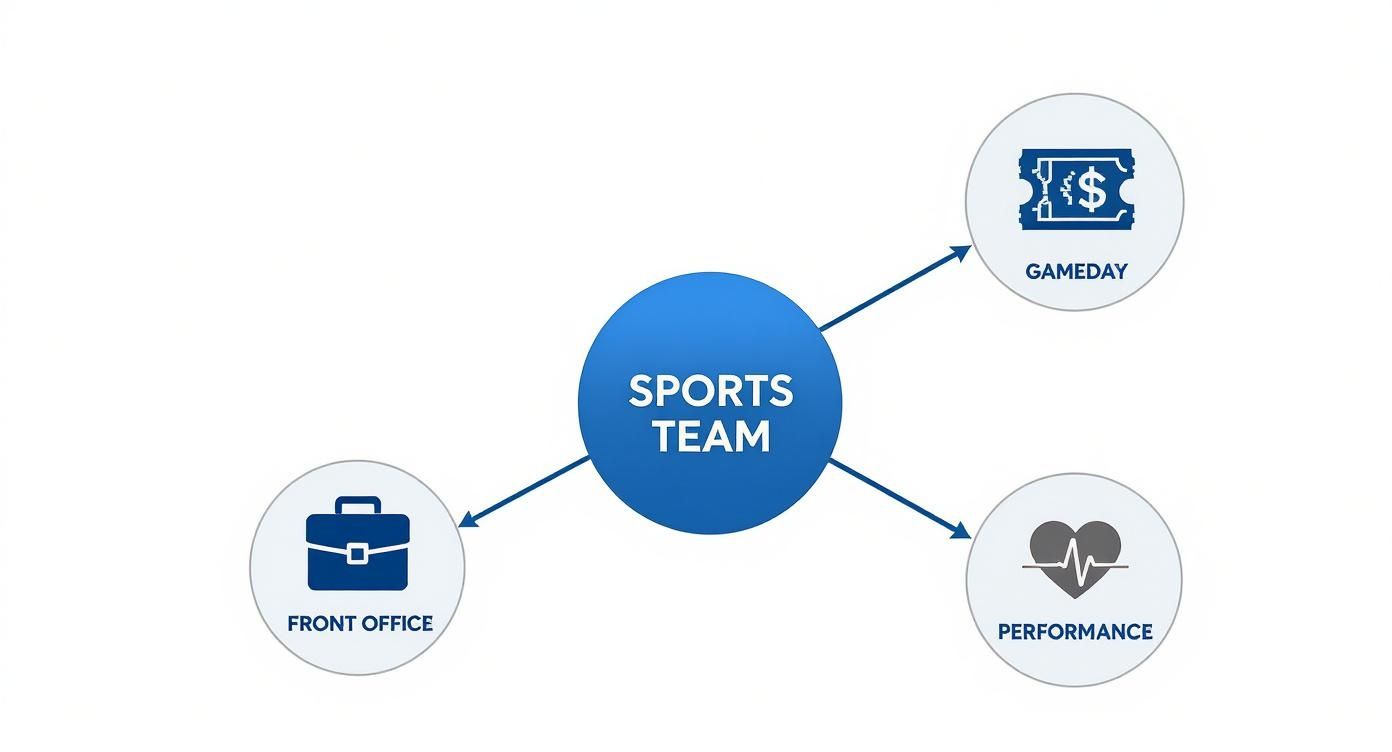
This map shows how different career paths all connect to support the athletes at the center. It’s a coordinated effort between business gurus, event experts, and performance specialists. Let’s dive into what these departments actually do.
Business and Team Operations
This is the team’s central nervous system. The "front office" handles all the strategic and financial heavy lifting that keeps the lights on and the team competitive. Without a sharp business operations department, the team on the field simply wouldn't have the resources it needs to win.
Think of these folks as the general manager for the entire company, not just the roster. Their responsibilities are huge and absolutely essential for long-term stability.
Key roles in this area include:
- Sales and Corporate Partnerships: These are the primary revenue-generators. They’re the ones selling tickets, luxury suites, and sponsorships, building relationships with everyone from local businesses to national brands.
- Marketing and Community Relations: The storytellers. They build the team's brand, create hype, manage advertising, and connect with fans through outreach programs and events.
- Finance and Human Resources: This group keeps the machine running. They manage the budget, payroll, and all things employee-related, making sure the organization is financially sound and a great place to work.
Coaching and Player Personnel
This is the side of the business most fans know and love—the people directly responsible for what happens on the field, court, or ice. Their world revolves around finding talent, developing players, and drawing up game-winning plays. Deep, obsessive knowledge of the sport isn't just a plus here; it's a requirement.
Their work is a relentless cycle of evaluation, preparation, and competition. They live under a microscope, with their performance judged in real-time by millions of passionate fans.
In player personnel, you're part talent scout, part data scientist, and part psychologist. You're not just finding athletes; you're building a roster with the right chemistry, skill sets, and mindset to win a championship.
This department is usually split into two main functions:
- Coaching Staff: Led by the head coach, this group includes coordinators, position coaches, and video analysts. Their entire focus is on player development, practice planning, and in-game strategy.
- Scouting and Personnel: These are the talent hunters. They crisscross the country (and often the globe) to identify the next generation of stars, analyzing athletes from college all the way up to other pro leagues.
Athletic Performance and Medical Staff
Behind every superstar athlete is a dedicated team of specialists whose job is to keep them healthy, strong, and ready to perform at an elite level. This department is a blend of sports science, medicine, and strength training, all working to maximize player potential and extend careers.
Their goal is simple: keep the team’s most valuable assets—the players—on the field. The importance of this group has exploded as teams invest more in data, analytics, and preventative care. For anyone interested in the intersection of sports and health sciences, exploring roles in sports management and athletic administration is a great way to see how business principles support athlete well-being.
The medical and performance staff is made up of a range of specialists:
- Athletic Trainers: The first responders for any player injury. They provide daily medical care, oversee rehab programs, and work hand-in-hand with doctors to diagnose and treat issues.
- Strength and Conditioning Coaches: These are the architects of athlete performance. They design and run training programs to improve speed, power, and endurance, all while helping to prevent injuries.
- Team Physicians and Specialists: A network of doctors, including orthopedists, neurologists, and cardiologists, who provide elite, specialized medical care to players all season long.
The Skills That Get You in the Game
Passion for the game is a great start, but it won't land you one of the most sought-after jobs in professional sports. Think of it this way: your resume is a scouting report. Teams want to see that you not only love the sport but also have the specific skills to help them win, both on and off the field.
The industry has changed dramatically. A decade ago, one "marketing person" might have run everything from social media to ticket promotions. Today, those are completely separate roles, each demanding a unique and deep skillset. This kind of specialization is happening in every department, from the analytics gurus to the athletic training staff.
The good news? This evolution is creating more opportunities than ever. The U.S. Bureau of Labor Statistics, for instance, projects that jobs for coaches and scouts will grow by 11 percent through 2028—way faster than the average for most other jobs. You can dive deeper into these employment trends in the global sports industry to see just how much the landscape is expanding.
Mastering the Hard Skills
Hard skills are your bread and butter—the technical, teachable things you can do. They’re the first thing a hiring manager scans for on a resume because they prove you have the tools to get the job done right out of the gate.
These are like a player's core athletic abilities: speed, strength, and agility. You simply can't compete at this level without them.

Here are some of the most critical hard skills teams are looking for right now:
- Data Analysis & Visualization: Teams are obsessed with data. From player performance metrics to fan engagement numbers, you need to be able to make sense of it all. Knowing your way around tools like SQL, R, Python, and especially data visualization software like Tableau gives you a massive leg up in analytics, scouting, and business roles.
- CRM Software Proficiency: The sales and marketing departments essentially live inside their Customer Relationship Management (CRM) software. If you have hands-on experience with a platform like Salesforce or Microsoft Dynamics, you’re already speaking their language. It's how they manage season ticket accounts, track new leads, and build corporate partnerships.
- Video Editing & Production: Content is king. Whether it's cutting hype videos for social media or breaking down game film for the coaching staff, video skills are non-negotiable. Being proficient in Adobe Premiere Pro, Final Cut Pro, or sports-specific software like Hudl is a huge asset for media and coaching roles.
- Digital Marketing & SEO: A modern marketing role demands a solid grasp of social media advertising, search engine optimization (SEO), email campaigns, and content management systems (CMS) like WordPress. It's all about reaching fans where they are.
Cultivating Winning Soft Skills
Hard skills might get your resume to the top of the pile, but it's the soft skills that get you the job and help you build a career. These are the interpersonal traits that define how you work, communicate, and collaborate—and in the high-pressure, team-first world of pro sports, they're everything.
Soft skills are the "intangibles" that never show up in a box score but are absolutely essential for building a championship culture. Things like resilience, communication, and a team-first mindset are what separate the good hires from the great ones.
Focus on developing these critical traits:
- Unwavering Resilience: The sports world is a rollercoaster of wins and losses. You’re going to face impossible deadlines, last-minute crises, and even public criticism. The ability to take a hit, shake it off, and get right back to work is a quality every single hiring manager looks for.
- Exceptional Communication: Can you present a scouting report to a GM? Pitch a sponsorship deal to a skeptical CEO? Coordinate with gameday staff in a chaotic environment? Clear, concise communication—both written and verbal—is the glue that holds a team together.
- Collaborative Teamwork: No one in a sports organization works in a silo. The marketing team needs to sync with sales, operations has to support the coaches, and the analytics group provides insights for everybody. You have to prove you’re a "we" person, not a "me" person. It's that simple.
Education and Certifications That Open Doors
Your degree and professional certifications are your foundation. While a sports management degree is a common starting point, it's definitely not the only path. Teams are constantly hiring people with backgrounds in business, finance, communications, computer science, and kinesiology.
For certain roles, however, specific certifications aren't just a bonus—they're a requirement. If you want to be a strength and conditioning coach, for example, you absolutely must have the Certified Strength and Conditioning Specialist (CSCS) certification. Likewise, athletic trainers need to be certified by the Board of Certification (BOC). These credentials aren't just letters after your name; they’re proof that you meet the industry standard for some of the most critical jobs in professional sports teams.
Understanding the Sports Industry Hiring Seasons
In professional sports, timing isn't just critical on the field—it's everything when you're trying to land a job. Forget the typical corporate rhythm of year-round hiring. The sports world moves in cycles, driven entirely by the calendar of its playing seasons. Nailing one of the best jobs in professional sports teams often comes down to knowing exactly when to make your move.
Trying to apply for a marketing job in the middle of a playoff push is like trying to get a coach's attention during the last two minutes of a tied game. It’s just not the right time. If you can learn to read this rhythm, you give yourself a massive strategic advantage. It lets you time your job search for the moments when teams are actively looking to build their rosters, both on the field and off.
The Offseason: The Real "Business Season"
When the final whistle blows on the season, the front office doesn't go on vacation—it kicks into high gear. This is the "business season," the window where the real strategic planning, budget setting, and major hiring decisions for the non-player side of the organization get made.
This period is your prime opportunity for full-time roles, especially in:
- Sales and Corporate Partnerships: The team needs to sell season tickets and lock in sponsorships for the upcoming year.
- Marketing and Communications: This is when they plan and launch new campaigns to build hype.
- Finance and Administration: Budgets are finalized, and the core operational staff is put in place.
If you’re aiming for a corporate-style role within a team, think of the offseason as your personal draft day. It’s when organizations have the bandwidth to find the right talent to drive revenue and map out the future.
Pre-Season and In-Season: The Gameday Blitz
As the next season gets closer, the hiring focus shifts dramatically. The preseason is all about assembling the huge temporary workforce needed to create a flawless gameday experience for thousands of fans. This is the peak hiring time for anyone interested in operational and event-focused jobs.
Think about it: a pro sports team's gameday operation is like a small city that springs to life for a few hours and then vanishes. Staffing that city is a massive logistical undertaking that ramps up right before the season starts and often continues as needs change.
This seasonal surge is even visible in national employment data. Jobs with sports teams and clubs can climb past 100,000 during peak seasons in late spring and summer, then dip to between 70,000 and 80,000 in the winter. You can dig into more of this data on seasonal sports employment from the BLS. This pattern proves just how tied the industry’s hiring is to league calendars.
Post-Season: The Performance Deep Dive
The moment a season ends, the review process for the on-field product begins. Teams immediately start analyzing what worked, what didn't, and what changes are needed to get a competitive edge. This creates a critical hiring window for highly technical and performance-related jobs.
Scouting departments are overhauling their strategies, and analytics teams are diving deep into the data, hunting for any insight that could make a difference next year. This is the time to be on the lookout for openings like:
- Scouts and Player Personnel Staff
- Video Coordinators
- Data Analysts and Sports Scientists
- Athletic Trainers and Strength Coaches
For these specialized roles, the end of one season is the immediate start of the next. Teams move fast to fill these positions to get ready for the draft, free agency, and the new training cycle. If you have performance-related skills, this is your window.
Your Game Plan for Landing a Job in Sports
Knowing when to apply is half the battle, but having a winning strategy for how to apply is what gets you across the goal line. Landing one of the most sought-after jobs in professional sports teams takes more than just passion for the game. It demands a specific, well-crafted approach that makes you stand out from the sea of other applicants.
Think of your job search as your own personal season. Every step—from polishing your resume to making a new connection—is a critical play. Generic advice just doesn't cut it here; you need a playbook built for the unique, competitive world of sports.

H3: Polish Your Resume Until It Shines
Your resume isn't just a list of past jobs; it's your personal highlight reel. In the sports world, hiring managers are scanning hundreds of these a day, looking for industry-specific keywords and, most importantly, measurable results. A generic resume will get you sent to the bench—fast.
Start by tailoring your resume for every single application. Applying for a ticket sales job? Don't just say you made calls. Highlight your experience with CRM software and include hard numbers, like "exceeded sales quota by 15% for two consecutive quarters." Going for a marketing role? Emphasize your direct experience with digital ad campaigns, social media analytics, and content that actually drove engagement.
To make sure your resume is speaking the right language, getting it reviewed is a smart move. You can get instant, targeted feedback with a dedicated sports industry resume analyzer that knows exactly what teams are looking for.
H3: Build Your Network, Not Just Your Contact List
In the tight-knit sports community, who you know can be just as important as what you know. Networking isn't just some corporate buzzword; it's how you hear about the best opportunities before they even get posted. Building genuine, authentic connections is non-negotiable.
Here are a few ways to start making real connections:
- Be a Pro on LinkedIn: Don't just hit "connect" and hope for the best. Send a personalized note mentioning a recent team campaign you loved or a specific career move of theirs that caught your eye. It shows you've done your homework.
- Ask for Advice, Not a Job: Reach out to people in roles you admire and ask for 15 minutes of their time for an "informational interview." Your goal is to learn about their journey and build a relationship. People are far more willing to help when you're not asking for a job outright.
- Show Up and Get Involved: Volunteer at a local marathon, a college tournament, or even a pro team’s community event. You’ll meet industry insiders on their home turf and prove you’re committed to the business of sports.
"The biggest mistake I see is people only networking when they need something. Build your relationships before you need them. Be genuinely curious, offer value where you can, and the opportunities will follow. It's a long game."
H3: Master the Application and Interview
Once you spot an opening, your application has to make an impact. The cover letter is your chance to connect your skills directly to that team's specific needs and show your personality. Ditch the generic templates and tell a compelling story about why you belong with that organization.
When you finally land the interview, be ready for questions that test your skills and, just as importantly, your fit with the team culture. Expect to hear things like:
- "Why do you want to work for our team, specifically?"
- "Tell me about a time you worked under a tight deadline in a high-pressure situation."
- "How do you stay on top of what's new and changing in the sports business?"
Your answers need to be sharp, specific, and show you’ve done your research. A detailed game plan for your job search is just as crucial as the one a coach draws up before a championship game.
To help you organize your approach, here’s a quick checklist of the key moves to make.
Actionable Steps for Your Sports Job Search
This table breaks down the essential actions you should take at each phase of your job search to maximize your chances of success.
| Phase | Action Item | Why It Matters |
|---|---|---|
| Preparation | Tailor your resume with quantifiable results and sports-specific keywords. | Hiring managers scan for immediate relevance and impact. A generic resume gets ignored. |
| Preparation | Optimize your LinkedIn profile with a professional headshot and detailed experience. | Your online presence is your digital first impression and a key networking tool. |
| Networking | Schedule 2-3 informational interviews per week with industry professionals. | Builds genuine connections and provides insider knowledge you can't find online. |
| Networking | Attend at least one industry event or volunteer at a local sporting event per month. | Puts you face-to-face with decision-makers and demonstrates your commitment. |
| Application | Write a unique cover letter for every single job application. | Shows you're genuinely interested in the specific role and organization, not just any job. |
| Application | Set up job alerts on sports-specific boards like TeamWork Online. | Ensures you're among the first to know about new, relevant opportunities. |
| Interview | Research the team's recent business news, campaigns, and challenges. | Allows you to ask intelligent questions and tailor your answers to their current needs. |
| Follow-Up | Send a personalized thank-you note within 24 hours of every interview. | Reinforces your interest and professionalism, leaving a strong final impression. |
Treating your job search with this level of strategic focus is what separates the fans in the stands from the pros on the field.
Common Questions About Sports Industry Careers
Trying to break into a sports career can feel like you're on the outside looking in. It’s a notoriously competitive world with its own unique culture, which naturally brings up a lot of questions—and more than a few myths. Let's clear the air and tackle some of the biggest questions aspiring pros have about landing a job with a team.
Think of this as your personal Q&A with an industry vet. We’ll give you the straight-up, honest answers you need to separate fact from fiction and build a smart, realistic game plan for your career.
What Are Typical Salaries for Entry-Level Sports Jobs?
This is the big one, and the truth is, it's complicated. A common myth is that every job in sports comes with a massive paycheck right out of the gate. In reality, what you make at the start depends heavily on the department you're in, the league, and even the city you work in.
A lot of people get their start fueled by sheer passion, accepting more modest salaries just to get their foot in the door and soak up priceless experience. For example, an inside ticket sales rep—a classic entry point—might start with a base between $30,000 and $40,000, but they have the chance to earn a lot more through commissions.
On the other hand, a job that needs more specific skills, like a social media coordinator or a data analyst, could start somewhere in the $45,000 to $55,000 range. The main takeaway here is that your first job is about gaining a foothold. The real money comes later, after you’ve proven your worth and started climbing the ladder.
How Important Is an Internship to Get a Full-Time Job?
In the sports world, an internship isn't just a nice-to-have on your resume—it's practically a requirement. I'd go as far as to say it is the single most important thing you can do to land a full-time role. This industry is built on experience and relationships, and internships give you a crash course in both.
Think of an internship as your season-long tryout for a spot in the front office. It's the number one way teams vet new talent. They get a firsthand look at your work ethic, see your skills in action, and figure out if you can hang in their fast-paced environment.
An internship is your all-access pass. It’s where you learn the unwritten rules of the game, build your professional network from the ground up, and prove you have what it takes to handle the pressure. A huge number of full-time hires are made directly from a team’s pool of former interns.
If you're a student or just graduated, your top priority should be locking down an internship. Look at pro teams, minor league clubs, college athletic departments, or sports agencies. That hands-on experience is the currency of the sports world.
Can I Get a Job in Sports Without a Sports Management Degree?
Absolutely. While a sports management degree gives you a fantastic, focused foundation, it's definitely not the only path into the industry. At the end of the day, teams are businesses, and they need talented people from all sorts of backgrounds to succeed.
The real trick is showing how your specific skills meet the needs of a sports organization. Your major matters a lot less than what you can do.
- Business or Finance Degree: You’re a natural fit for roles in corporate partnerships, accounting, or business intelligence.
- Communications or Journalism Degree: These are perfect for media relations, content creation, and digital marketing jobs.
- Statistics or Computer Science Degree: You’re exactly who teams are looking for to build out their growing analytics departments.
- Kinesiology or Exercise Science Degree: This is the direct pipeline to jobs in athletic training and strength and conditioning.
The strategy is to back up your degree with relevant, real-world experience. Volunteer, grab a part-time job, or secure that critical internship to prove how your skills apply directly to the sports business. Our GetSportJobs blog has more advice on how to break into sports from any background.
What Is the Best Way to Network in the Sports Industry?
Networking in sports isn't about collecting a stack of business cards; it’s about building genuine, lasting relationships. It's a surprisingly small, tight-knit community where a good reputation built on authentic connections will open doors that a cold application never will. Forget the generic outreach—your approach has to be personal and thoughtful.
Start on LinkedIn, but do it the right way. When you send a connection request, always add a personalized note. Mention a team's recent marketing campaign you loved or congratulate them on a big win. Show you're actually paying attention.
Another powerful move is to ask for informational interviews. Reach out to people in roles that interest you and ask for 15 minutes of their time to hear about their career path. The goal here is to ask for advice, not a job. This approach builds real rapport and often leads to mentorship down the road.
Finally, get out from behind the computer screen. Go to industry conferences, join local sports business meetups, or volunteer at major sporting events in your city. Being there in person puts you in the room with industry insiders and shows a level of commitment that makes you stand out from the crowd.
Ready to make your move? At GetSportJobs, we connect passionate professionals like you with the best career opportunities in the industry. Stop dreaming and start applying. Find your next role today at https://www.getsportjobs.com.