Your Guide to Sports and Entertainment Careers
Think a career in sports and entertainment is just for athletes and actors? It's time to look beyond the field and the stage. The truth is, the world of sports and entertainment careers is a massive business, with roles in marketing, operations, technology, and media that power every single game, concert, and production.
Exploring Careers Beyond the Sidelines and Spotlight
When you see a game-winning touchdown or attend a sold-out concert, you're only seeing the final product. Behind that one incredible moment are hundreds of professionals working together.
Think of the industry less like a stage with a few stars, and more like a bustling city. It has interconnected neighborhoods—operations, marketing, media, tech—and each one is vital for the city to function. This guide is your map to that city, showing you all the different districts where your skills can find a perfect home.
This vibrant world is far more than just a passion project; it’s a serious economic engine. The global sports industry alone is on track to generate around USD 521 billion in 2024, with an average annual growth rate of about 8%. That kind of expansion means new and exciting roles are opening up every year. If you're curious, you can find more insights from Morgan Stanley on how technology is driving this growth.
More Than Just a Game
The industry's complexity demands a wide array of talent. You don’t need to be a former star athlete to build a wildly successful career here. What matters are specialized skills that support the talent on the field and on the stage.
These roles are the backbone of the industry, handling everything from ensuring a stadium runs smoothly to analyzing fan engagement data on social media.
Some of the key areas where professionals thrive include:
- Business Operations: Managing the finances, logistics, and day-to-day functions that keep teams and venues running.
- Media and Content Creation: Producing the broadcasts, articles, and digital content that bring fans closer to the action.
- Marketing and Fan Engagement: Building passionate fanbases and creating unforgettable experiences for everyone in the crowd.
- Data and Analytics: Using statistics to make smarter decisions on everything from player performance to ticket sales.
This industry is built on the hard work of thousands of individuals whose names you'll never see on a jersey. Their passion fuels the business side of sports and entertainment, creating the foundation upon which stars are made.
Understanding this structure is the first step toward finding your place. Whether your strengths lie in numbers, creativity, or leadership, there's a path for you. The key is to shift your perspective and see the vast machinery working behind the curtain.
To dive deeper into the various roles and career paths available, explore the insights and advice on the GetSportJobs blog. This guide will help you navigate this dynamic landscape and turn your passion into a profession.
2. Finding Your Position on the Team
Think of the sports and entertainment world like a championship team. It takes more than just the star player to win. You've got the coaches, the training staff, the front office, the marketing crew—everyone has a crucial role. The same is true for the industry itself. From the person negotiating a TV deal to the one running the Jumbotron, every job is vital to creating the magic we see on screen and in the stands.
Figuring out where you fit in starts with understanding these different "departments." Instead of seeing it as one giant, intimidating industry, it's much more helpful to break it down into its core functions. Each area has its own rhythm, its own language, and needs a specific type of talent to thrive. This way, everything from player contracts to social media campaigns is handled by people who live and breathe that specific part of the business.
This diagram shows how we can split the industry into three main pillars that hold everything up:
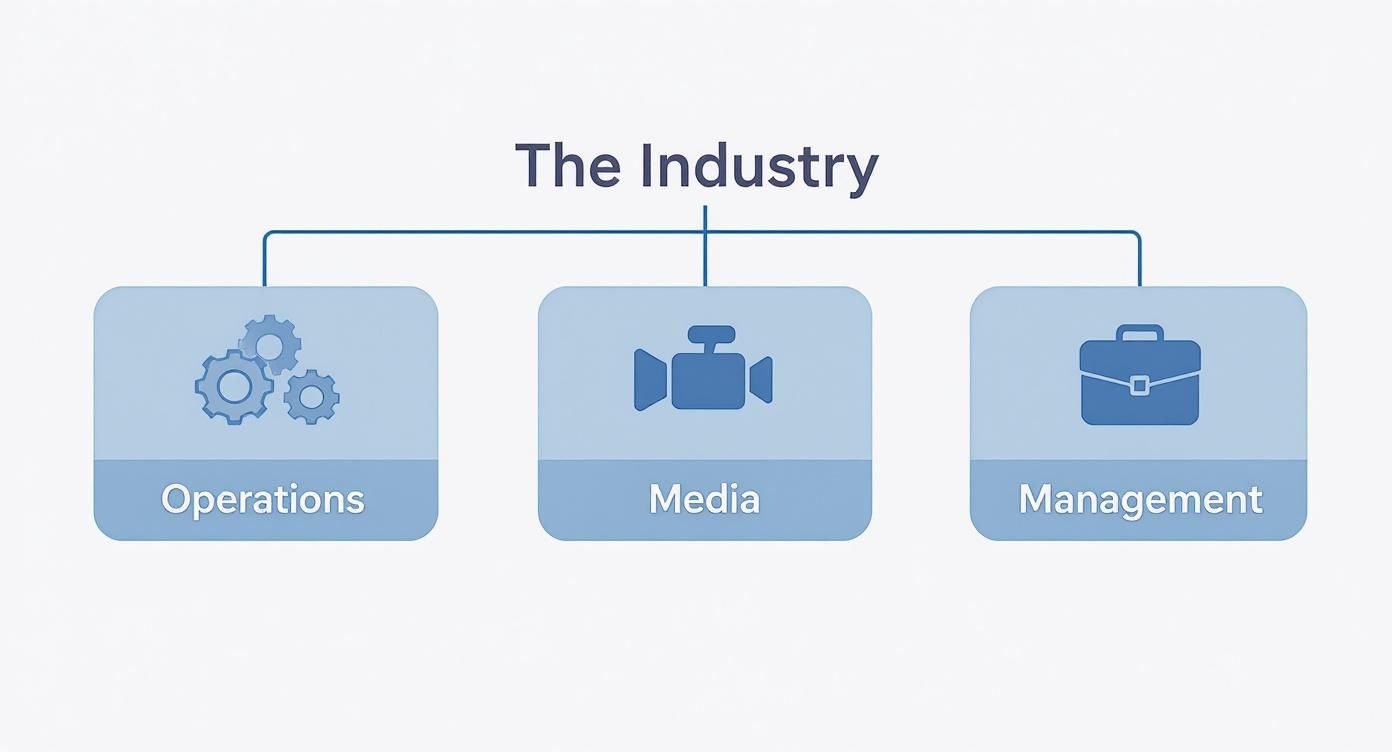
As you can see, media, management, and operations are the foundation for every team, league, artist, and event. Let's break down what actually happens in each of these areas.
The Front Office: Business and Strategy
This is the nerve center. The front office is where the big-picture strategy and financial health of an organization are managed. These are the people handling the business-critical functions that drive revenue, keep the lights on, and steer the ship for the long haul.
A sharp mind for numbers, killer negotiation skills, and a deep understanding of the market are non-negotiable here. This is where billion-dollar broadcast deals get done and long-term financial futures are mapped out. It's also home to crucial roles like agents and business managers for artists, performers, and athletes, who are the unsung heroes navigating contracts and careers.
The Performance Crew: Coaching and Analytics
This division is all about one thing: winning. Whether it's on the field, the court, or the stage, this crew is obsessed with optimizing performance. It's a fascinating blend of art and science, where old-school intuition meets cutting-edge data. They handle everything from designing an athlete's training program to breaking down game film to find a competitive edge.
The modern performance team is swimming in data. A scout's gut feeling is now backed up by sophisticated statistical models that can project a player's potential or pinpoint a weakness no one else sees. To succeed here, you need to respect the traditional craft while also being fluent in the language of analytics.
The greatest athletes are supported by an equally talented team of coaches, trainers, and analysts. This group works tirelessly behind the scenes to turn raw talent into championship-winning performance.
The Broadcast Booth: Media and Content
If a game-winning shot happens and no one is there to capture it, did it really happen? The media and content teams make sure the answer is a loud and clear "YES!" These are the storytellers. They capture all the drama, the sweat, and the glory and beam it out to millions of fans across the globe.
Their work isn't just about the live broadcast anymore. They're creating viral TikToks, producing in-depth documentaries, and writing articles that keep fans engaged 24/7. Teams and leagues are essentially full-blown media companies now, so a career here means being creative, quick on your feet, and knowing how to use the latest digital tools. You can see how these roles fit into the bigger ecosystem by exploring different types of sports management positions.
The Fan Zone: Marketing and Events
This is where the magic connects directly with the people. The fan zone team is responsible for getting butts in seats, creating an electric atmosphere, and building a passionate community that lasts a lifetime. Their job starts long before the gates open and ends long after the lights go out.
They're the masterminds behind ticket sales, advertising campaigns, sponsorships, and the flawless logistical execution of a massive concert or game day. It's a high-energy, fast-paced world where creativity and obsessive planning are the keys to success. You measure your wins in sold-out stadiums, social media buzz, and the deafening roar of the crowd.
To help you visualize where you might fit, the table below provides a snapshot of these major career verticals, what they do, what it takes to get in, and where you might start.
Key Career Categories in Sports and Entertainment
| Career Category | Core Function | Essential Skills | Example Entry-Level Roles |
|---|---|---|---|
| Business/Strategy | Manages finance, legal, partnerships, and overall business health. | Financial acumen, negotiation, strategic planning, legal knowledge. | Junior Accountant, HR Assistant, Legal Intern |
| Performance/Coaching | Optimizes athlete/performer potential and competitive strategy. | Leadership, data analysis, sports science, talent evaluation, communication. | Video Coordinator, Assistant Trainer, Scout |
| Media/Content | Creates and distributes stories to engage a global audience. | Storytelling, video production, writing, social media management, graphic design. | Production Assistant, Social Media Coordinator |
| Marketing/Events | Builds fan loyalty and manages the live event experience. | Event planning, sales, marketing strategy, customer service, creativity. | Ticket Sales Rep, Event Operations Crew |
Each of these paths offers a unique way to be part of the action. Whether you're a numbers wizard, a natural leader, a creative storyteller, or a master planner, there’s a spot on the team for you.
Building Your Professional Playbook
Passion gets your foot in the door, but a smart game plan is what keeps you on the field. Building a career in sports and entertainment isn't a game of chance. It’s about methodically piecing together the right skills, education, and connections. This is where you stop being just a fan and start becoming an indispensable part of the team.
Think of it like a franchise building a championship contender. It all begins with a strong offseason of preparation (your education and training). That’s followed by executing smart plays during the season (gaining real-world experience), which ultimately puts you in a position to compete for the title (advancing your career). Simply showing up isn’t an option—you need a strategy.
Laying the Foundation with Education and Certifications
While you won't always find a specific degree listed as a hard requirement, the right educational background gives you a massive head start. It tells a hiring manager you already speak the language of the business. But let's be clear: not all degrees are created equal, and the "best" one depends entirely on where you see yourself.
A Sports Management degree, for example, is the classic go-to for roles in operations, marketing, and team administration. It gives you a fantastic 30,000-foot view of how the industry's business side works.
But the game has changed. These days, other specialized degrees can be even more valuable for certain roles:
- Data Science or Analytics: This is a non-negotiable for anyone getting into performance analysis, business intelligence, or even marketing. The ability to translate numbers into winning decisions is what front offices crave.
- Marketing or Communications: If you want to work in fan engagement, run a team's social media, handle public relations, or create content, this is your direct path.
- Finance or Accounting: This is the bedrock for anyone with ambitions to work in the front office, managing everything from nine-figure budgets to complex player contracts.
Beyond your diploma, professional certifications are what can really make your resume pop. They prove you’ve gone the extra mile and have specific, ready-to-use skills. Think about credentials in project management (like a PMP), specialized digital marketing certificates, or official coaching licenses.
Mastering the Intangibles: Soft Skills
Your degree and technical skills might land you the interview, but it’s your soft skills that will get you hired and, more importantly, promoted. This industry is built on relationships, high-stakes pressure, and snap judgments. How you carry yourself and work with others is every bit as critical as what you know.
In sports and entertainment, your reputation is your most valuable asset. Technical expertise can be taught, but resilience, integrity, and the ability to build genuine connections are the traits that define long-term success.
These aren't just fluffy buzzwords; they are the tools you'll use every single day. Three of the most crucial are:
- Resilience: You’re going to face rejection. Your dream team might pass on you, or a marketing campaign you poured your heart into might not perform. The pros are the ones who can take a hit, learn from it, and get right back in the game without losing their drive.
- Communication: It’s everything. Whether you’re pitching a sponsorship deal to a Fortune 500 company, explaining complex data to a skeptical coach, or coordinating with a venue’s security chief, you have to be clear, confident, and persuasive.
- Networking: This is so much more than adding contacts on LinkedIn. It's about building real, authentic relationships. Ask for informational interviews. Volunteer at events. Show up at industry conferences. A career fair, like the annual Sports, Media & Entertainment Career Fair at the Schulich School of Business, isn't just a place to drop off resumes—it's a chance to make connections that could define your career.
Charting Your Path from Intern to Leader
So, how do people actually move up? The progression usually follows a familiar pattern: get your hands dirty with entry-level experience and prove you belong. An internship isn’t just a line on your resume; it’s your audition. It’s where you absorb the culture, make your first real connections, and show everyone you have an unbeatable work ethic.
Picture this common trajectory: you start as a marketing intern for a pro team. You show initiative and a knack for the work, and that turns into a full-time job as a Marketing Coordinator. From there, you deliver results and climb the ladder to Manager, then Director, and maybe one day, Vice President of Marketing. This isn't a fantasy—it’s a very real roadmap for people who are both strategic and relentless.
What Can You Realistically Earn?
Let's get right to it. Passion for the game is great, but you need to know what a career in sports and entertainment actually pays. It’s one of the first questions I get asked, and for good reason—you need to build a life, not just a career.
The truth is, salaries are all over the map. They depend entirely on your role, your experience, and whether you're working for a minor league team or a global entertainment brand. Think of it like a team's payroll: the star quarterback's salary is worlds away from the practice squad player's, and the general manager's is different still. An entry-level ticket sales rep will have a different pay structure than a seasoned marketing director for a major league franchise.
It’s also easy to get distracted by the salaries of the on-field talent. The U.S. Bureau of Labor Statistics notes the median annual wage for athletes and sports competitors was about $62,360. While that’s a solid number, it only tells a tiny part of the story. The professionals working behind the scenes—in analytics, operations, and marketing—often have more predictable and stable career paths with steady salary growth. You can dig into the official athlete employment data on the BLS website to see for yourself.
Salary Expectations Across Key Roles
To give you a better feel for the numbers, here’s a rough breakdown of what you might expect at different stages of your career. Keep in mind, these are just ballpark figures; your location, the league, and your own performance can shift them significantly.
- Entry-Level (0-3 years): Getting your foot in the door in roles like Marketing Coordinator, Social Media Assistant, or Junior Data Analyst will likely land you in the $45,000 to $65,000 range. This is where you learn the ropes and prove your worth.
- Mid-Level (3-8 years): Once you've paid your dues and moved up to a Manager or Senior Analyst position, your pay and responsibilities jump. You can expect to be in the $70,000 to $110,000 bracket, often with performance bonuses sweetening the deal.
- Senior-Level (8+ years): This is where you have real strategic impact. Directors, VPs, and other executives can command salaries from $120,000 to well over $200,000, plus significant bonuses and sometimes even equity.
Your starting salary is just that—a start. In this industry, the fastest way to increase your earnings is to deliver tangible results and build a rock-solid professional network.
Riding the Wave: Key Market Trends
Your earning potential isn't just about what you make today. It's about skating to where the puck is going. The entire sports and entertainment world is shifting, and if you align your skills with the biggest trends, you’ll set yourself up for long-term success.
Three trends, in particular, are changing everything:
- The Esports Boom: This isn't just a niche for gamers anymore; it's a massive global industry. That explosion has created a huge need for professionals who get the esports world—people in event production, broadcast management, player relations, and marketing who can connect with this unique audience.
- Data is King: Gut feelings don't cut it. Organizations now lean on hard data for everything from drafting players and setting ticket prices to figuring out the most effective fan engagement campaigns. Being skilled in data analysis isn't just a "nice-to-have" anymore; it's quickly becoming a non-negotiable.
- Every Team is a Media Company: Modern sports and entertainment brands are creating content 24/7. They need an army of skilled storytellers—video producers, graphic designers, writers, and social media gurus—to feed the beast and keep fans hooked across every platform.
If you focus on developing skills in these high-growth areas, you're not just getting ready for your next job. You're building a foundation for a career with real financial security and plenty of room to grow.
Landing Your Dream Job in the Industry

Alright, it's time to make the leap from the stands to the front office. But breaking into the sports and entertainment world takes more than just being a fan. It’s a competitive field, and landing a great role requires a smart, actionable game plan.
Think of your job hunt not as just firing off resumes into the void, but as a strategic campaign. Your mission is to show the right people, at the right time, that you're more than just passionate—you're a professional who can bring real value from day one.
Sourcing Opportunities Beyond the Obvious
The most exciting jobs often aren't posted on those massive, one-size-fits-all job boards. To get a real edge, you have to go where the insiders are. This means focusing your search on the specialized platforms where teams, leagues, and agencies actually list their openings.
Niche job boards like GetSportJobs are gold because they cut through all the noise. They connect you directly with the roles you're actually qualified for. Beyond that, a smart LinkedIn strategy is non-negotiable. Follow the organizations you dream of working for, connect with people in roles you admire, and actually engage with their posts to get on their radar.
Here’s a quick checklist to make your search more effective:
- Niche Job Boards: Make these your first stop for the most relevant listings.
- Company Career Pages: Go straight to the source and check the websites of your target teams and companies.
- LinkedIn: Use it actively. It's for more than just having a profile; it's for networking and finding roles that may never be advertised publicly.
- Industry Newsletters: Subscribe to key publications. They often have career sections with fresh openings.
Crafting an Unforgettable Application
Your resume and cover letter are your personal highlight reel. In a stack of hundreds of applications, you have just a few seconds to grab a hiring manager's attention. The key is to translate your experience—even if it's from another industry—into the language of sports and entertainment.
Focus on measurable results. Don't just say you "managed social media." Instead, say you "grew social media engagement by 30% in six months." Numbers give them concrete proof of what you can do. To truly stand out, it helps to learn how to write a professional CV that gets results and meticulously tweak it for every single job you apply for.
Your application isn't just a list of past duties. It's a compelling story about why your unique skills are the perfect solution to the hiring manager’s problems.
Before hitting "send," it’s a good idea to make sure your resume can get past the automated systems that screen applications first. You can get instant feedback and tips by using a resume analyzer tool built specifically for the sports industry.
The Power of Genuine Networking
In an industry built on relationships, who you know can be just as important as what you know. But "networking" isn't about awkwardly passing out business cards at a mixer. It's about building real, mutually beneficial relationships over time.
A great way to start is by asking for informational interviews. These are just low-pressure chats where you're asking for career advice, not a job. You'd be surprised how willing people are to share their story and insights when you approach them with genuine curiosity.
Volunteering is another fantastic way in. Offer your time at a local marathon, a film festival, or a team's charity golf tournament. It puts you right alongside industry pros, giving you a chance to prove your work ethic and passion in a natural way. These are the kinds of connections that can open doors you never even knew existed.
A Day in the Life of an Industry Pro
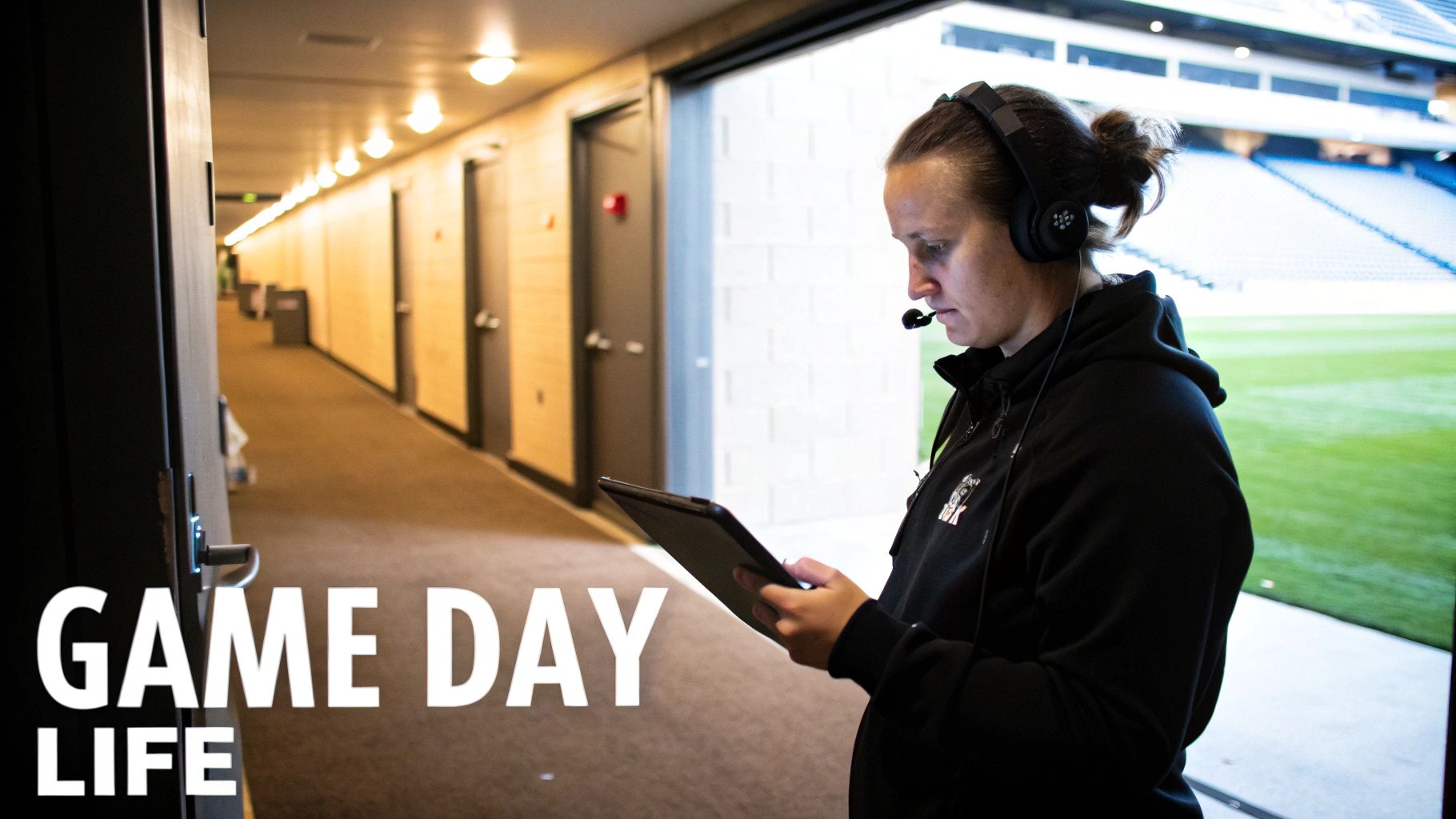
Job descriptions can tell you what you'll do, but they almost never capture the feeling of the job. The real story of sports and entertainment careers is found in the daily grind, the organized chaos, and those unforgettable moments that make it all worthwhile.
To see if this world is really for you, let's walk through a typical day for a few different roles.
Orchestrating the Show
Picture this: you're an event coordinator for a massive arena. Your day doesn't start with the roar of the crowd, but in the eerie quiet of an empty stadium. You're walking the concourse with a checklist, confirming security staffing for the night, making sure concession deliveries are on schedule, and getting on the radio about a glitchy ticketing scanner.
Your phone is buzzing nonstop with updates from a dozen different departments. You’re the conductor of a huge orchestra, and your job is to make sure every single instrument—from the parking attendants to the pyrotechnics crew—is perfectly in sync for showtime. It's a universe of constant problem-solving.
Behind the Screens and Spreadsheets
Now, shift gears and imagine you’re a data analyst for a pro sports team. Your morning isn't spent on the field; it’s spent deep inside spreadsheets and data visualization tools. You're digging into performance metrics from last night’s game, searching for tiny patterns the coaching staff might have missed.
Maybe you build a report that shows how a specific defensive formation is getting torched by left-handed players. You’re not just crunching numbers; you’re delivering a concrete, evidence-based recommendation that could change how they play the next game. It’s a quiet, intense role where your work can become the hidden key to a win.
The most impactful moments in sports and entertainment often begin far from the spotlight—in a quiet office with a dedicated professional who uncovered a game-changing insight or flawlessly executed a complex plan.
Crafting the Narrative Online
Finally, let's put you in the shoes of a social media manager for an entertainment brand. Your entire day is dictated by the relentless 24/7 news cycle. You're scripting a quick TikTok video, designing graphics for an Instagram story announcing a new tour, and jumping into online conversations to engage directly with fans.
It’s a constant blend of creativity and split-second analysis, as you tweak your content strategy based on what’s getting a reaction. You aren't just posting updates; you're building a community and telling a story that keeps people hooked.
This part of the industry is exploding. The global sports event market was valued at about USD 452.8 billion in 2024 and is on track to hit USD 687.7 billion by 2030, a surge powered by digital media and fan engagement. You can dive deeper into these numbers in a detailed report on the sports event market.
Frequently Asked Questions
Getting started in any industry comes with a lot of questions. Let's tackle some of the most common ones we hear about building a career in the fast-paced world of sports and entertainment.
Do I Need a Specific Degree to Work in Sports and Entertainment?
Not necessarily, but the right one can give you a serious leg up. A degree in Sports Management or Marketing is a great starting point, but what really turns heads are tangible skills. If you can show proven experience in data analytics, digital media, or corporate sales, you're often just as valuable as someone with a specialized degree.
At the end of the day, your passion for the industry and the practical skills you bring to the table often speak louder than the name of your major.
Is It Necessary to Have Been an Athlete to Get a Job in Sports?
Absolutely not. This is one of the biggest misconceptions that keeps talented people from even trying to break into sports and entertainment careers. Think of it this way: a sports team or a concert venue is a massive business. They need experts in finance, law, technology, HR, and marketing just like any other company.
While a love for the game is a must-have, your professional expertise is what truly matters for the vast majority of off-field roles.
The strongest organizations are built by a diverse team of specialists. Former athletes offer incredible insight, but it's the business pros, creatives, and tech experts who drive the industry's growth and innovation behind the scenes.
How Important is Networking in This Industry?
It’s everything. The sports and entertainment worlds are built on relationships. Many of the most exciting jobs are filled through referrals and connections long before they ever get posted online. Building a genuine network isn't just a good idea—it's a core part of your career strategy.
Start making those connections now. Go to industry events, volunteer for a local team or festival, or reach out for informational interviews. These are the practical steps that open doors to incredible opportunities.
Ready to find your place on the team? GetSportJobs is the go-to platform connecting talented professionals with the best careers in sports and entertainment. Start exploring hundreds of roles from leading organizations today at https://www.getsportjobs.com.