Launch Your Career in sports data science jobs: A Proven Guide
Sports data science is where the rubber meets the road in modern athletics, blending sophisticated analytics with the grit of on-field strategy to find that next competitive edge. These roles are all about digging into massive amounts of data—on everything from player performance and team chemistry to fan behavior—to help make critical decisions. We're talking about everything from scouting the next superstar to figuring out how to price tickets for Tuesday night's game.
The Moneyball Revolution 2.0 and Your Career
Welcome to the new era of professional sports, where the data analyst is arguably one of the most valuable players off the field. This guide is your playbook for building a career in the fascinating and high-stakes world of sports data science. We'll cut through the buzzwords and give you a real-world roadmap, showing you how data went from a quirky side project to the central nervous system of today's sports franchises.

Think of this role as less of a traditional statistician and more of a strategic partner to the coaches and general managers. You're the one who translates complex numbers into clear, game-winning insights. Your journey to landing one of the most coveted sports data science jobs starts right now.
Beyond Simple Statistics
The modern sports analyst does a lot more than just calculate batting averages or count completed passes. Today’s jobs demand a deep, nuanced understanding of the game, backed by some serious technical firepower. The entire field has shifted its focus from what happened to why it happened and, most importantly, what’s likely to happen next.
This evolution is what many are calling Moneyball 2.0. If the original Moneyball story was about using basic stats to find undervalued players, this new chapter is about using advanced tools to see things the human eye completely misses.
Just look at how the game has changed:
- Player Tracking Data: Tiny sensors in arenas and on players are churning out millions of data points every single game, tracking everything from a player's top speed to their acceleration out of a turn.
- Biometric Information: Wearable tech gives us a window into player fatigue, exertion, and injury risk, which is a game-changer for managing player health and workload.
- Computer Vision: AI models can now watch game film and automatically pick out tactical patterns, defensive schemes, and subtle player movements that a coach might miss.
Your Role as a Strategic Partner
In this environment, a data scientist is a core member of the strategy team. You don't just hand over a spreadsheet; you build a story with the data and deliver clear, actionable recommendations. For example, you wouldn't just report that a basketball player is shooting poorly from the left corner. You'd dive into the tracking data to figure out why.
Is he rushing his shot because a specific defender is closing in too fast? Does his accuracy drop off after he's been on the court for more than five straight minutes? Answering those kinds of questions is how you turn raw data into a real competitive advantage.
This requires a special mix of technical skill and deep sports knowledge. You have to be the translator—the person who can bridge the gap between complex algorithms and the fast-paced, high-stakes reality of the front office. Your work can directly influence everything from draft day decisions to mid-game adjustments, making this a career where a passion for sports and a talent for analytics truly come together.
What a Sports Data Scientist Actually Does
So, what does a sports data scientist really do all day? Forget the stereotype of a lone coder staring at endless spreadsheets. The job is much more dynamic. It’s about being a detective, a strategist, and a storyteller all rolled into one, translating raw data into a real-world competitive edge.
It's not just about what the numbers are, but what they mean.
Imagine a basketball team struggling on defense. The old-school approach might be to look at points allowed and call it a day. A modern data scientist goes way, way deeper. They'll use player tracking data to see which defensive rotations are a half-second too slow, or which player matchups the opponent is systematically exploiting. They might even analyze biometric data to see how player fatigue in the last two minutes of a tight game craters their defensive efficiency.
That’s the difference-maker right there. It’s about finding the hidden patterns that lead to wins.
From Reporting the Past to Shaping the Future
At its core, the job is about moving a team along a three-stage journey of understanding. Each step builds on the last, giving coaches, GMs, and even the marketing team more powerful information to work with.
- Descriptive Analytics (What Happened): This is the bedrock. It’s all about organizing historical data to get a clear picture of performance. Think of a dashboard showing a soccer team's shot map, passing networks, and every defensive action from last season. It’s the essential first step of understanding where you've been.
- Predictive Analytics (What Will Happen): Now we're getting into forecasting. Here, you use statistical models and machine learning to make educated guesses about the future. A great example is building a model to project a rookie quarterback's career arc based on his college stats, combine metrics, and even the scheme he's being drafted into.
- Prescriptive Analytics (What Should We Do): This is the holy grail. You take those predictions and turn them into concrete, actionable advice. Let's say your model predicts an opponent has an 80% chance of running a specific play on 3rd-and-short. A prescriptive model would then recommend the single best defensive formation to shut it down.
A great sports data scientist connects all three. They don't just report that a pitcher's fastball velocity is down. They predict the heightened injury risk because of it, and then prescribe a specific rest and recovery plan to get him back on track.
Not Just On-Field Tactics
While player performance gets the headlines, the reach of sports data science jobs goes far beyond the field, court, or pitch. These skills are now being applied across the entire organization to solve business problems and create better fan experiences.
A sports data scientist's week could involve jumping between wildly different projects:
- Player Performance Modeling: Building models to scout talent, project player development, or find undervalued gems in the transfer market.
- Fan Engagement Analytics: Digging into ticket sales, social media data, and viewership numbers to figure out what fans really want and how to keep them coming back.
- Business Intelligence: Creating dashboards for the front office that track revenue, help set ticket prices, or show the ROI on a multi-million dollar sponsorship deal.
The field is exploding with new and specialized roles. To help make sense of it all, here’s a look at the key players you'll find on a typical sports data team.
Key Roles in a Sports Data Science Team
| Job Title | Primary Responsibility | Common Tools & Technologies |
|---|---|---|
| Data Analyst | Cleans, analyzes, and visualizes data to answer specific business or performance questions. Creates dashboards and reports for stakeholders. | SQL, Excel, Tableau, Power BI, Python (Pandas), R |
| Data Scientist | Develops predictive models and machine learning algorithms to forecast outcomes, from player performance to fan churn. | Python (Scikit-learn, TensorFlow), R, SQL, Cloud Platforms (AWS, Azure) |
| Data Engineer | Builds and maintains the data infrastructure (pipelines, databases) that analysts and scientists rely on. Ensures data is clean and accessible. | SQL, Python, Spark, Kafka, Cloud Data Warehouses (Snowflake, BigQuery) |
| BI (Business Intelligence) Analyst | Focuses on the business side, tracking key metrics like ticket sales, revenue, and marketing campaign effectiveness. | SQL, Tableau, Power BI, Google Analytics |
| Machine Learning Engineer | A specialized role focused on deploying and scaling machine learning models into production systems for real-time use. | Python, Docker, Kubernetes, Cloud ML services |
As you can see, there's a role for every type of technical and strategic skill set. As people grow in their careers, they might start as a Data Analyst and eventually become a Head of Data Scouting or Director of Analytics, leading entire departments and shaping the organization's overall strategy.
By mastering the journey from descriptive to prescriptive insights, you make yourself indispensable—someone who can directly impact both the scoreboard and the bottom line.
Building Your Championship-Caliber Skillset
To land one of the top sports data science jobs, you need a versatile roster of skills. Much like a championship team, your abilities need to cover offense (technical execution), defense (deep sports knowledge), and special teams (clear communication). This is your practical training plan, broken down into those three core areas.
Think of it like a three-legged stool. If the technical leg is weak, you can't build anything. Without the sports knowledge leg, your models are built on a shaky foundation, completely missing the context. And without the communication leg, your brilliant insights will never make it out of the analytics department. Getting all three right is what turns a good analyst into a truly game-changing one.
The Technical Playbook
This is your foundation. It's not enough to just list programming languages on a resume; you have to show how you've used them to solve real-world sports problems. These are the absolute non-negotiables.
- Python: This is the lingua franca of sports data science. You’ll be using libraries like Pandas to wrangle and clean massive datasets, like player tracking data from a whole season. Then you'll turn to libraries like Scikit-learn or TensorFlow to build the predictive models that forecast everything from player performance to game outcomes.
- SQL (Structured Query Language): Picture a team's entire historical database, going back decades. SQL is the key that unlocks it. You’ll write queries to pull incredibly specific data, like every single pitch a certain batter has faced with runners in scoring position.
- Data Visualization Tools: A model’s output is worthless if a coach can't understand it. Tools like Tableau or Power BI are how you turn raw numbers into intuitive dashboards and charts. For instance, you could build an interactive shot chart that lets a basketball coach filter by player, quarter, or defensive coverage.
To really stand out, you have to master statistical techniques such as interpreting correlation matrices to uncover how different performance stats influence each other. A rock-solid grasp of statistics is the bedrock of all your technical work.
Essential Skills for Sports Data Science Jobs
This table breaks down how the focus on technical, domain, and soft skills evolves as you advance in your sports data science career.
| Skill Category | Entry-Level Focus | Mid-Level Focus | Senior-Level Focus |
|---|---|---|---|
| Technical Skills | Strong proficiency in Python (Pandas, Scikit-learn) and SQL for data extraction and cleaning. Basic data visualization. | Advanced modeling techniques, cloud computing (AWS, Azure), and MLOps principles. Building and deploying models. | Architectural design, leading technical strategy, and evaluating new technologies. Mentoring junior staff. |
| Domain Knowledge | Solid understanding of rules and basic stats (e.g., batting average, goals). Familiarity with common advanced metrics (e.g., WAR, xG). | Deep knowledge of sport-specific advanced analytics and tactical nuances. Ability to connect data patterns to on-field strategy. | Expert-level understanding of league operations, roster construction, and player valuation. Able to drive research into new metrics. |
| Soft Skills | Clear communication, ability to explain simple technical concepts, and a collaborative attitude. Strong attention to detail. | Effective data storytelling, presenting findings to non-technical stakeholders (coaches, scouts). Project management. | Strategic thinking, influencing executive decisions, mentoring, and building a data-driven culture across the organization. |
As you can see, the journey moves from pure technical execution toward strategic leadership and influence.
Deep Sports Domain Knowledge
You don't need to be a former pro, but you absolutely have to speak the language of the sport fluently. Technical skills without context produce flawed, useless analysis. This means you need to go way beyond the box score and get into the weeds of what really drives strategy and player value.
For example, just knowing a baseball player's batting average isn't nearly enough. A hiring manager will expect you to understand advanced metrics like WAR (Wins Above Replacement), which quantifies a player's total contribution, or wOBA (Weighted On-Base Average), which more accurately captures offensive value. In soccer, this means moving beyond goals and assists to metrics like xG (Expected Goals) to evaluate the quality of a scoring chance.
Having this domain expertise allows you to ask much smarter questions. You stop just analyzing what the data says and start digging into the why behind the numbers, connecting statistical patterns to on-field tactics and player tendencies.
This hierarchy shows how analytics maturity grows from simply understanding what happened to actively making better things happen.
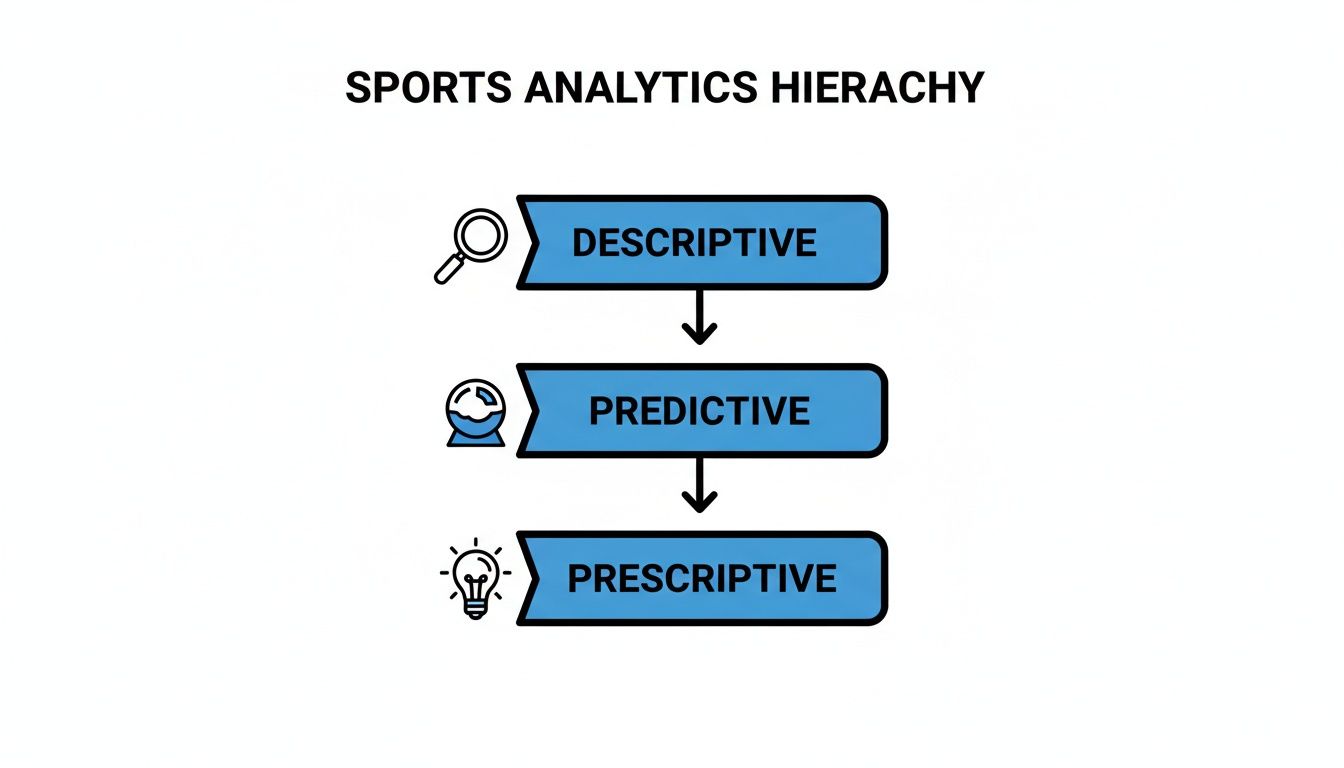
This framework is key: foundational descriptive analytics ("what happened") informs predictive models ("what will happen"), which in turn powers the prescriptive insights ("what should we do") that win games.
The Art of Communication and Storytelling
Finally, we get to the most underrated skill in the entire field: communication. You can build the most accurate model in the world, but if you can't explain its findings clearly and persuasively to a general manager or head coach, it has zero real-world impact.
This isn't just about being a good talker. It's about a few specific abilities:
- Data Storytelling: You have to frame complex analysis as a compelling, easy-to-understand narrative. Don't just show a chart; explain what it means for next week's game plan. For example, "Our model shows their star striker's shot accuracy plummets by 40% when pressured by a left-footed defender, so we need to adjust our matchups."
- Collaboration: You'll be in the trenches with scouts, coaches, and executives who all have different priorities and perspectives. Being able to listen, understand their needs, and integrate their expertise into your work is absolutely essential.
- Problem-Solving: The biggest breakthroughs often come from asking questions nobody else has thought to ask. A curious, creative mindset helps you find new ways to look at the data that can give your team a genuine competitive edge.
Let's Talk Money: Salaries and Market Demand
Alright, let's get down to the numbers—what can you actually earn in sports data science? It's one of the biggest draws to this career path. The combination of high demand and genuinely attractive paychecks is hard to beat. As teams and leagues ditch old-school "gut feelings" for hard data, the people who can make sense of that data have become incredibly valuable.
This isn't just a hunch; the hiring data speaks for itself. The field has absolutely exploded. A quick search on major job boards right now will show you hundreds of open roles. As of early 2026, for example, a look at Indeed.com showed 597 sports data science jobs, and ZipRecruiter had 342 openings with salaries spanning from $48,000 to $190,000. This isn't a small trend. It’s a fundamental shift in how the sports world operates, with analytics departments becoming a standard part of the playbook for gaining a competitive edge.
What to Expect on Your Paycheck: Salary Bands by Experience
Salaries will always shift based on your location, the sport you're in, and the size of the organization. Still, we can sketch out some pretty reliable salary bands to give you an idea of what to expect as you climb the ladder.
Entry-Level (0-2 years): If you're just starting out as a Data Analyst or Research Analyst, you're likely looking at a range of $60,000 to $85,000. For some of the more operational, seasonal gigs—think a data operator with an MLB team—the pay might be hourly, often around $25 to $27.50.
Mid-Career (3-6 years): Once you've got a few years under your belt and a solid track record as a Data Scientist or Data Engineer, your earnings jump to the $90,000 to $140,000 bracket. This is where you really start digging into specialized work, like building machine learning models or focusing on performance analytics.
Senior-Level (7+ years): At the top of the food chain, Senior Data Scientists, Lead Analysts, or Directors of Analytics are pulling in the big numbers—typically $145,000 to $200,000+. These roles are less about crunching the numbers yourself and more about leading teams and setting the entire analytical strategy for the organization.
Think of it this way: your salary reflects the value you create. An entry-level analyst might save a team thousands of dollars by optimizing their travel schedule. A senior data scientist might influence a multi-million dollar decision on which player to draft with a powerful predictive model. The pay scales with the impact.
Of course, these are just ballpark figures. Want a more personalized estimate? You can plug your own skills, experience, and location into a tool built for the industry. Check out our sports industry salary calculator to get a much clearer picture of your own earning potential.
How to Earn Top Dollar
So, what separates a good salary from a great one? A few key things can seriously boost your paycheck. If you focus on these areas, you'll put yourself on the fast track.
The single biggest factor is specialization. A generalist is useful, but a data scientist with deep expertise in a hot area like machine learning or computer vision is a game-changer. For instance, if you can build an ML model that accurately predicts player injury risk, you become an indispensable asset to any team.
Where you work matters, too. A major league team in the NFL, NBA, or the Premier League will almost always have a bigger budget than a smaller club or a college athletics department. But the universe of sports jobs is bigger than just teams.
- Sports Betting Companies: These places are on the bleeding edge of predictive modeling. They pay top dollar for quantitative analysts who can give them even a slight advantage.
- Media Outlets: Think about companies like ESPN. They hire data scientists to figure out viewership patterns, create those cool on-screen graphics, and tell compelling stories with numbers.
- Apparel and Tech Giants: Brands like Nike and wearable tech companies are sitting on mountains of performance data from their products. They need data scientists to turn all that raw information into better products and marketing.
At the end of the day, the people who command the highest salaries are the ones who can draw a straight line from their analytical work to a direct impact—whether that's more wins on the field or more revenue in the bank.
How to Craft a Winning Application
In the hyper-competitive world of sports analytics, a generic resume is a one-way ticket to the "no" pile. To land one of these incredible sports data science jobs, your application can't just be a list of what you did. It needs to tell the story of the impact you made.
This means you have to shift your thinking from describing duties to showcasing actual accomplishments.

Trust me, every hiring manager has seen "Used Python for data analysis" a thousand times. What they haven't seen is your specific, tangible result that proves you can add real value. The goal is to turn every bullet point on your resume into a mini-case study.
Instead of just stating what you did, quantify it. Frame it with a clear, measurable outcome.
Before: "Analyzed player performance data using SQL."
After: "Queried three seasons of historical data with SQL to pinpoint a key defensive inefficiency, leading to a tactical shift that cut opponent scoring by 7%."
Before: "Built a predictive model in Python."
After: "Developed a Python model that predicted player injury risk with 88% accuracy, which allowed our training staff to better manage player workloads and reduce time lost to injury."
See the difference? This simple tweak transforms you from someone who just follows instructions into a proactive problem-solver. Before you hit send, it's always a good idea to run your resume through a quick check. A specialized tool like a sports resume analyzer can catch weaknesses and help you polish your language for maximum impact.
Showcase Your Work with a Public Portfolio
A resume makes claims; a portfolio provides cold, hard proof. For a sports data scientist, having a public portfolio on a platform like GitHub or a personal blog isn't a bonus—it's practically a requirement. It’s the single best way to show off your skills and, more importantly, your raw passion for the game.
Your portfolio is where you show, not just tell. It should feature a mix of projects that highlight your diverse skillset:
- A GitHub Repository: Share the code for a predictive model you built. Just make sure it's clean, well-commented, and includes a solid README file that walks people through your process.
- A Blog Post: Write an in-depth breakdown of a recent game or a season-long trend. This is your chance to showcase both your domain knowledge and your ability to communicate complex ideas in a way people can actually understand.
- An Interactive Dashboard: Use a tool like Tableau or Power BI to create a public dashboard visualizing player stats or team performance. This gives them tangible proof of your data viz skills.
A strong portfolio tells a hiring manager you aren't just looking for a paycheck—you are genuinely obsessed with using data to solve sports problems. It demonstrates an initiative and a love for the work that no resume bullet point ever could.
Preparing for the Interview Gauntlet
Once your application gets your foot in the door, get ready for a multi-stage interview process designed to test you from every angle. Most sports data science interviews will hit you with three distinct types of challenges.
1. The Technical Gauntlet
This is where they pop the hood and see if your coding and stats knowledge is legit. You might be asked to solve a coding problem on a whiteboard, explain a statistical concept like p-values from scratch, or debate the trade-offs between different machine learning models. They need to verify that your technical skills are as sharp as you claim.
2. Sports-Specific Case Studies
Here's where your technical chops and your sports smarts have to collide. Expect open-ended, strategic questions that mimic the real-world problems you’d face on the job.
- "How would you even begin to measure the defensive value of a midfielder in soccer?"
- "Design a system to evaluate a quarterback's decision-making, completely independent of the outcome of the play."
- "If we gave you full access to our player tracking data, what's the very first question you would try to answer?"
There’s rarely one "right" answer here. They want to see how you think. The interviewer is evaluating your thought process: how you define the problem, what data you'd want to use, and how you'd structure the analysis.
3. Behavioral and Collaboration Questions
Finally, they need to know if you can actually work with other humans, especially those who don't speak "data." You'll be collaborating with coaches, scouts, and trainers. Be ready for questions like, "Tell me about a time you had to explain a complex model to someone without a stats background." They're testing your ability to translate numbers and charts into insights the whole organization can use to win.
Finding Openings and Future-Proofing Your Career
Alright, you've put in the work. Your skills are sharp, your resume is polished, and now it's time to actually find a job. The good news is that demand for sports data talent is high. The challenge is knowing where to look.
You can’t just rely on the big, general job boards. The best roles are often tucked away in more specialized corners of the industry. Think of your job search as a multi-channel attack: start with dedicated sports job boards, keep an eye on team and company career pages, and get active in the online communities where real hiring managers are looking for talent.
Where to Focus Your Job Search
- Industry-Specific Job Boards: This is your first stop. Places like GetSportJobs are fantastic because they cut through the clutter and only show you roles that are actually in the sports world.
- Team and League Websites: Go straight to the source. Most pro teams and leagues have a "Careers" page, and they'll often post jobs there a few days before they show up anywhere else.
- Niche Online Communities: Get involved in analytics-focused groups on LinkedIn or sports-specific subreddits. It's a great way to network, but it's also where you'll find roles that might not be advertised widely.
- Recruitment Agencies: If you're looking for more hands-on help, connecting with some of the top data science recruitment agencies can give you a real edge.
The future for sports data science jobs looks incredibly strong. The industry’s appetite for analytics is only growing. Leagues like the NFL, NBA, and major global soccer organizations have been on a hiring spree, building out their data science departments.
We're seeing roles like Associate Data Scientist at the NFL pulling salaries in the $90,000-$120,000 range. That level of investment tells you everything you need to know about where the industry is heading. This isn't just a trend; it's a fundamental shift, creating openings at teams, sports tech companies, and even in college athletic departments.
Staying Ahead in a Fast-Moving Field
Landing that first job is a huge milestone, but it's just the starting line. To build a career with real longevity, you have to stay curious and keep learning. The field is moving too fast to stand still.
The tools and techniques that are groundbreaking today will be standard practice tomorrow. The professionals who thrive are the ones who are constantly learning, experimenting, and figuring out how to solve the next problem before it even arrives.
Here are a few areas you absolutely need to keep on your radar:
- Computer Vision: The ability for AI to analyze game film automatically is no longer a "nice-to-have." It’s becoming a core competency. If you can work with this technology, you'll be in high demand.
- Wearable Sensor Data: The amount of data pouring in from player-worn devices is staggering. This is a goldmine for anyone who can analyze it to understand performance, manage fatigue, and predict injury risk.
- Advanced Machine Learning: As the volume of data grows, so does the need for more sophisticated models to make sense of it all. Deep learning isn't just for Big Tech anymore.
Think of your career in sports data science as a constant learning process. If you follow the advice here, actively build your portfolio, and never stop sharpening your skills, you won't just find a job—you'll build a lasting, exciting career. The game is waiting.
Frequently Asked Questions
Jumping into a career in sports analytics brings up a lot of questions. Let's tackle some of the most common ones I hear from people trying to break into the field.
Do I Need a Specific Degree?
Not really. While you'll see plenty of people with degrees in Computer Science, Statistics, or Data Science, what hiring managers really care about is what you can do. I've seen successful analysts come from physics, engineering, and even economics backgrounds.
The common thread? They all had portfolios that proved they could apply their quantitative skills to solve real sports problems. Your degree gets you in the door, but your projects get you the job.
How Important Is a Public Portfolio?
It's everything. Honestly, in a field this competitive, your portfolio is the single most important thing that will set you apart. It's the tangible proof that you've got the technical chops and, just as importantly, a genuine passion for the work.
Think about it from a hiring manager's perspective. A resume is just a piece of paper. But a well-written blog post breaking down a team's strategy, a GitHub repo with your predictive model, or an interactive Tableau dashboard visualizing player performance? That tells a story. It shows initiative and a true love for the game.
Can I Get Hired Without Professional Experience?
Absolutely, but you have to create your own experience first. Those entry-level jobs almost always go to candidates who have built an impressive body of personal projects.
This could mean contributing to open-source sports data projects or sharpening your skills in a sports-themed Kaggle competition. Networking is huge, too. Reaching out for informational interviews can give you incredible insight and open doors you didn't even know existed. In this industry, your projects are your professional experience.
Which Sport Has the Most Data Science Jobs?
Historically, baseball, basketball, and global soccer have led the pack. Baseball has its deep roots in Sabermetrics, and basketball has a treasure trove of player-tracking data. These sports have large, established analytics departments.
But things are changing fast. The biggest growth right now is happening in American football, hockey, and even motorsports as they rush to build out their own data teams. The field is expanding, so my best advice is to focus on the sport you're most passionate about. Your domain knowledge will be a massive advantage.
Ready to find your place on the team? GetSportJobs is the go-to job board for the sports industry, connecting talented people with top roles in analytics, coaching, marketing, and more. Stop searching and start applying. Find your next sports data science job today!