Finding Sports Management Job Opportunities
When people think of a "career in sports," they usually picture athletes on the field or coaches on the sidelines. But that's just the tip of the iceberg. The truth is, the sports industry is a massive, global business—a complex machine with countless moving parts that need skilled professionals to keep things running smoothly.
Why Sports Management Is More Than Just a Game
For every star player making headlines, there are literally hundreds of people working behind the scenes. Think of a major sports team like a big-budget movie production. The athletes are the on-screen stars, but the real work that makes the whole show possible happens off-camera. This is where you’ll find the real depth of sports management job opportunities.
The Business Behind the Passion
At its heart, sports management is simply applying core business principles—finance, marketing, operations—to the world of sports and recreation. It covers everything from managing nine-figure budgets and negotiating player contracts to orchestrating a flawless fan experience for 80,000 people on game day.
The field is generally broken down into a few key sectors, each with its own unique flavor:
- Professional and Collegiate Sports: These are the jobs working directly for teams and athletic departments, in roles like scouting, team operations, or player development.
- Marketing and Sponsorship: This is the world of creating powerful advertising campaigns and securing the corporate partnerships that fund so much of the industry.
- Event and Facility Management: Someone has to run the stadiums and arenas, overseeing the complex logistics of game days, concerts, and major tournaments.
- Sports Media and Technology: This sector involves everything from data analytics and broadcast production to creating digital content that engages fans around the globe.
This variety means there’s a place for almost any background. Whether you're a numbers wizard, a creative storyteller, or a logistics guru, there’s a path for you. To get a better sense of the organizations involved, you can explore the top sports companies hiring right now.
The industry isn't just large; it's expanding rapidly. This growth creates a constant demand for new talent capable of navigating the business side of sports, from contract negotiations to digital fan engagement strategies.
To give you a clearer picture, let's break down these sectors with some real-world context.
Sports Management Career Sectors at a Glance
The table below offers a high-level look at the major career paths in sports management. It highlights some typical roles you might find, what you can generally expect in terms of salary, and the overall outlook for that sector.
| Sector | Example Roles | Average Salary Range | Growth Outlook |
|---|---|---|---|
| Pro & Collegiate Teams | General Manager, Scout, Operations Director, Athletic Director | $60,000 - $250,000+ | Strong |
| Marketing & Agencies | Sponsorship Manager, Brand Strategist, Player Agent | $55,000 - $180,000+ | Very Strong |
| Events & Venues | Facility Manager, Event Coordinator, Ticketing Director | $50,000 - $150,000+ | Steady |
| Media & Content | Broadcast Producer, Social Media Manager, Data Analyst | $50,000 - $160,000+ | Excellent |
| Fitness & Recreation | Gym Manager, Program Director, Personal Training Manager | $45,000 - $120,000+ | Strong |
As you can see, the opportunities are incredibly diverse, with strong potential across the board. The key is finding the niche that best aligns with your skills and passions.
A Field with Strong Growth Potential
This demand for talented professionals isn't slowing down anytime soon. According to the U.S. Bureau of Labor Statistics, jobs in entertainment and sports are projected to grow faster than the average for all other occupations between 2023 and 2033.
That growth translates to an estimated 108,900 new openings annually. This boom is fueled by the increasing commercialization of sports and its ever-growing global popularity. If you've been thinking about getting into the business side of sports, there has rarely been a better time to start planning your move.
When you first start thinking about a career in sports management, the sheer number of job titles can feel a bit overwhelming. It's a massive industry, and it's easy to get lost in the sea of possibilities. The best way to get your bearings is to step back from specific roles and first look at the core sectors that make up the sports world.
Think of each sector as a different league within the broader game of sports. Each one has its own pace, its own set of challenges, and its own unique rewards. Once you understand the day-to-day reality of these different fields, you can start to see exactly where your talents and passion fit in. Let’s break down the major arenas where sports management pros make their mark.
The entire sports industry is a massive ecosystem, but it really boils down to three core business functions that have to work together: finance, marketing, and operations. Everything else branches out from there.
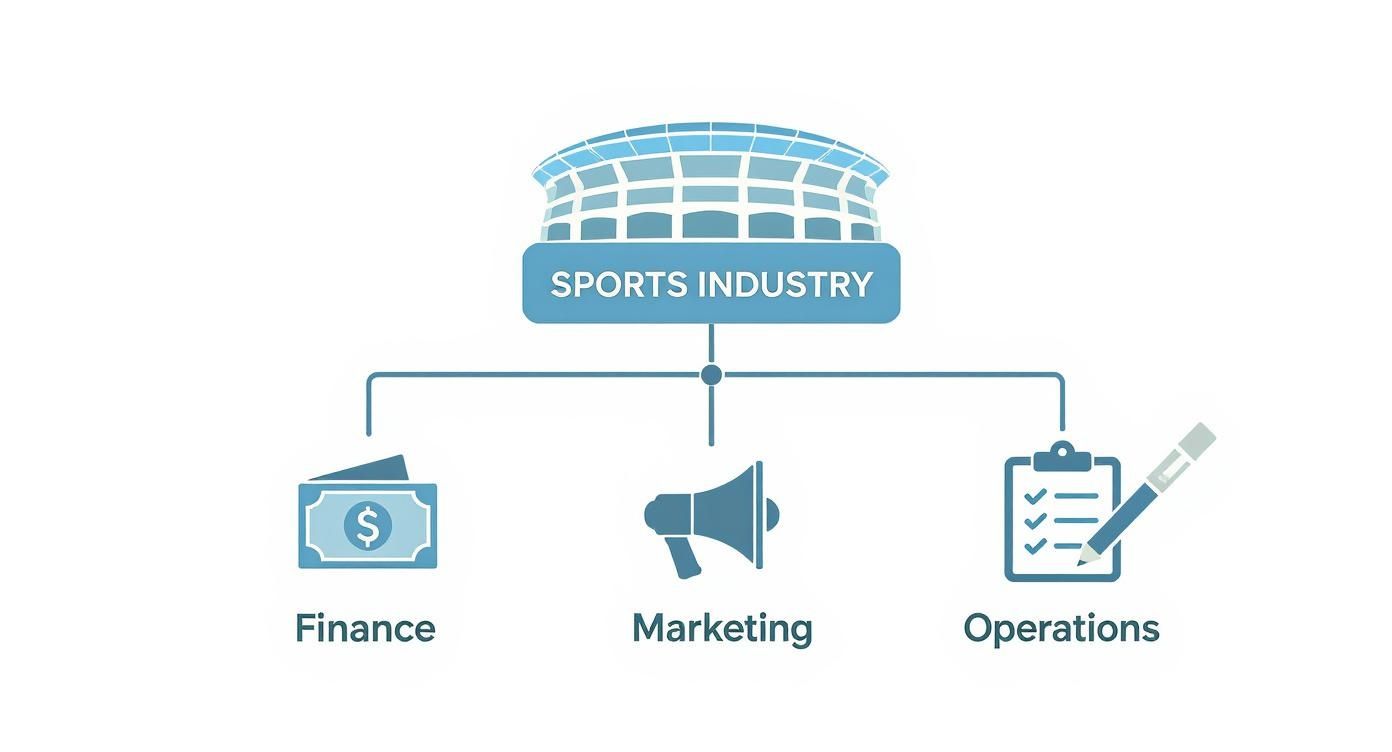
This visual is a great reminder that a successful sports organization is so much more than what happens on the field. It’s a business that needs sharp minds handling the money, connecting with fans, and making sure every single detail runs like clockwork.
Professional and Collegiate Sports Organizations
This is the one everyone pictures first—working right inside a pro team's front office or for a big-time university athletic department. These are high-stakes, high-pressure environments where passion is the fuel and performance is everything. The mission isn't just about winning games; it's about building a sustainable organization that can compete for years to come.
The roles here are incredibly varied, demanding a smart mix of business acumen and a genuine feel for the sport itself.
- General Manager (GM): The ultimate architect of the team. They’re responsible for everything from player trades and contract negotiations to setting the long-term competitive vision.
- Director of Ticket Operations: This person is laser-focused on revenue, managing ticket sales, dynamic pricing strategies, and keeping season ticket holders happy.
- Community Relations Manager: They build the essential bridge between the team and its community through outreach programs, charity work, and player appearances.
- Athletic Director (Collegiate): Essentially the CEO of a university’s athletic department. They oversee massive budgets, ensure NCAA compliance, manage the coaching staff, and are ultimately responsible for the student-athlete experience.
Working this close to the action is a huge thrill, but it's not for the faint of heart. It demands long hours and the ability to stay cool under pressure.
Corporate Partnerships and Sports Marketing
Let's be real: no team, league, or event can survive without money. That's where the sports marketing and corporate partnerships folks come in. These are the storytellers and the deal-makers who connect big brands to the raw power and emotion of sports. They're the ones behind the sponsorships, broadcast deals, and ad campaigns that keep the lights on.
Every time you see a company’s logo stitched on a jersey or plastered on a stadium wall, a partnerships manager made that happen. They found a way to create a deal that made perfect sense for both the brand and the team.
Success in sports marketing isn't just about selling ad space. It’s about creating authentic connections between a brand, a team, and its passionate fan base.
Some of the key roles include:
- Sponsorship Manager: These pros identify and land corporate partners, building custom sponsorship packages that align with a company's marketing goals.
- Brand Strategist: They shape the entire marketing identity of a team or league, making sure the message is powerful and consistent everywhere fans see it.
- Sports Agent: Working on the athlete side, agents represent players to negotiate their contracts and line up lucrative endorsement deals.
This field is a perfect fit for creative, outgoing people who are sharp negotiators and know how to build lasting relationships.
Facility and Event Management
Every single game, tournament, or championship has to happen somewhere, and someone has to make sure that "somewhere" is ready for action. Facility and event managers are the master coordinators who ensure stadiums and arenas are safe, functional, and primed to deliver an amazing fan experience. They are the invisible engine that makes live sports possible.
This world is all about logistics, meticulous planning, and solving problems on a massive scale, often in real-time. On game day, the venue manager is overseeing everything from security and cleanup crews to concessions and emergency plans. If you're looking for hands-on work where you can see immediate results, you’ll find plenty of great sports operations jobs that fit the bill.
Common roles in this sector include:
- Venue General Manager: The head honcho of a stadium or arena. They oversee the entire operation, from booking events and managing hundreds of staff to controlling the budget.
- Event Coordinator: This person is in the weeds, planning and executing specific events. They manage every single logistical detail, from a single game to a week-long tournament.
- Guest Relations Manager: They lead the front-line customer service teams, making sure every fan has a positive and safe experience from the second they walk in the door.
This career path is made for highly organized people who don't just survive under pressure—they thrive on it. If you have a knack for turning chaos into a perfectly executed plan, you’ll feel right at home here.
Building Your Sports Industry Skill Set
Getting that sports management degree is a great start, but let's be real—it's your skills that will land you the job. Think of your degree as the playbook; it teaches you the X's and O's of the business. Your skills are how you actually perform on game day—how you adapt, make smart plays, and execute when it counts.
Hiring managers want to see people who can do more than just recite theories from a textbook. They're looking for problem-solvers. Can you dive into ticket sales data to find new revenue streams? Can you create a social media campaign that gets fans genuinely excited? Your value is all about what you can do, and that only comes from rolling up your sleeves and getting some real-world experience.

From Classroom Theory to Real-World Application
So how do you bridge that gap between the classroom and the front office? Experience. It’s that simple. The people who climb the ladder fastest are the ones who jump on every opportunity to apply what they’ve learned. Internships, volunteer gigs, and part-time jobs aren't just lines on a resume; they're your training ground.
This is where you learn the unwritten rules of the industry and prove you have what it takes. Focus on getting hands-on with skills that matter.
- Data Analytics: Get comfortable with Excel or even dip your toes into SQL. Knowing how to analyze fan demographics or track social media metrics helps teams make smarter decisions.
- Sales and Sponsorship: Any sales experience is good experience. Learning how to pitch, build relationships, and close a deal is a skill that translates directly to selling sponsorships or season tickets.
- Event Operations: Volunteer at a local 5K, a college basketball game, or a charity golf outing. You'll quickly learn the insane logistics and behind-the-scenes chaos of running a smooth event.
- Digital Marketing: Offer to run the social media for a small local club or team. It’s the perfect way to learn how to build a community and drive real engagement online.
And don't forget the "soft" skills—they're anything but. You need to learn how to develop crucial soft skills for the workplace like communication and teamwork. Often, those are what separate the good candidates from the great ones.
The global sports market is expected to hit $614.1 billion by 2026. That kind of money means organizations are desperate for talent—specifically, talent with modern skills who can help them navigate an increasingly complex business.
Gaining a Competitive Edge with Specialized Skills
As the industry gets bigger, the opportunities get more specific. That massive market growth is creating a demand for people with niche expertise. In the U.S. alone, the industry is projected to add around 60,600 new jobs by 2029, and many of these roles didn't even exist a decade ago.
If you really want to stand out from the crowd, think about building skills in these high-growth areas:
- Sustainability Practices: Teams and venues are under pressure to go green. That means new jobs are opening up for people who understand sustainable operations.
- Diversity, Equity, and Inclusion (DEI): Every major sports organization needs leaders who can foster an inclusive environment for employees and fans alike.
- Esports Management: Competitive gaming isn't a fad; it's a phenomenon. This has created a whole new world of jobs in league operations, player management, and event production.
By building a mix of hard skills and people skills, you’re not just another applicant with a degree. You're a professional who can walk in and make an impact on day one.
Your Playbook for Landing the Job

Knowing the roles and building your skills is just half the battle. The other half is running a smart, strategic job search, and simply blasting your resume to every online posting is a rookie mistake. Sports is a relationship-driven industry, and getting noticed means combining a perfectly crafted resume with a more tactical approach.
This is your game plan for turning those qualifications into a compelling offer. Let’s break down where to find the best sports management job opportunities and how to tap into the "hidden job market," which is where many of the best roles are really filled.
Crafting a Resume That Speaks the Language
Think of your resume as your personal highlight reel—it needs to make an impression in less than ten seconds. Hiring managers in sports aren't just looking for a list of your past duties; they want to see quantifiable achievements. Vague statements like "Managed social media" are easy to forget.
Instead, you need to translate your responsibilities into tangible results. Think like a scout analyzing a player's stats. Did you grow follower engagement by a certain percentage? Did you help sell a specific number of ticket packages? Numbers tell a powerful story.
- Before: "Responsible for coordinating event volunteers."
- After: "Recruited, trained, and managed a team of 50+ event volunteers for a charity 5K, resulting in a 15% increase in participant satisfaction scores."
That small shift from describing duties to showcasing impact is what separates an average resume from one that gets a call back. As you get your materials ready, this complete guide to crafting a winning resume is a great place to start for foundational tips. For industry-specific feedback, you can run your document through our sports resume analyzer to see how it stacks up against real job descriptions.
Tapping Into the Hidden Job Market
A huge number of the most exciting sports management jobs are never advertised publicly. They're filled through referrals and personal connections—this is the hidden job market. In this industry, your network is your single most valuable asset. But building one takes genuine effort, not just firing off random connection requests on LinkedIn.
Think of it as building a team of allies. Start by finding people in roles or organizations that you find interesting. Follow them, engage thoughtfully with what they post, and then reach out with a message that is clear, concise, and respectful.
The goal of your first message isn't to ask for a job; it's to ask for advice. People are far more willing to share their story and offer guidance than they are to hand a job to a stranger.
Your message can be as simple as: "Hi [Name], I'm a recent Sport Management grad and have been following your career journey at [Company]. I'm really interested in event operations, and I was wondering if you might have 15 minutes in the coming weeks to share some insights from your experience."
Where to Find the Best Listings
While networking is your inside track, dedicated job boards are still an essential tool. The trick is to look beyond the massive, generalist sites and focus on platforms built specifically for the sports industry. These niche boards bring all the relevant openings together and connect you directly with hiring managers who want to see that passion for sports on your resume.
The sports world is also global, which opens up a whole different set of possibilities. For instance, the United Kingdom has seen jobs in sports and fitness occupations jump by 20% since 2021, with the sector now employing around 183,300 people. The UK's booming sports tech scene is a big part of that growth, creating brand-new roles that didn't exist a few years ago.
By combining a targeted search on specialized platforms with a proactive networking strategy, you create a powerful, two-pronged attack. This approach puts you in a position to find both the advertised openings and the hidden opportunities that everyone else misses, dramatically boosting your chances of landing that dream job.
Growing Your Career from Rookie to Veteran
Landing your first gig in sports is a huge win, but it’s just the first quarter. Building a career that lasts? That's the real championship run. It takes a game plan, a ton of hustle, and an eye for what's coming next. The path from coordinator to the C-suite isn't a straight shot; it's a series of smart plays, calculated risks, and constant learning.
Think about it like an athlete's career. Your first few years are about proving you can hang, mastering the basics, and being a great teammate. Over time, you start to specialize, take on more responsibility, and eventually, you're the one leading the huddle.
Mapping Your Path Up the Ranks
That first job, whether you're slinging tickets or running community events, is where you build your foundation. The trick is to be a sponge. Pay attention to how your work impacts other departments. Figure out how the organization actually makes money, what keeps the operations team up at night, and what the big-picture goals are. This is the stuff that separates future leaders from people who just punch a clock.
Let’s follow a realistic path. Imagine "Alex" starts out as a Marketing Coordinator for a minor league baseball team. Here’s how that journey could unfold:
- Entry-Level (Years 1-3): Marketing Coordinator. Alex gets really good at the day-to-day grind: social media posts, email newsletters, and running in-game contests. But the key move? Alex volunteers to help the sponsorship team on game days, getting a firsthand look at how corporate partnerships work.
- Mid-Level (Years 4-7): Corporate Partnerships Manager. That extra experience pays off. Alex parlays it into a new role with a bigger team, now managing relationships with a portfolio of sponsors. It's less about posting and more about negotiating contracts, keeping partners happy, and proving their investment is worthwhile. The focus shifts from doing to strategizing.
- Senior-Level (Years 8-12): Director of Business Development. With years of partnership experience, Alex is now hunting bigger game. This role is all about finding and closing major new revenue streams, like stadium naming rights or new broadcast deals.
- Executive-Level (Year 13+): Vice President of Revenue. At the top of the ladder, Alex now oversees the entire money-making machine—ticketing, partnerships, marketing, the works. The job is to set the financial strategy that keeps the whole organization thriving.
Alex didn't just stumble into these promotions. Each step was built on crushing the current role while actively picking up the skills needed for the next one.
Staying Ahead of the Curve
The sports industry changes fast. The skills that get your foot in the door today won't necessarily be what gets you promoted five years from now. If you're not constantly learning, you're falling behind. It's that simple.
A long-term career in sports isn't just about climbing the ladder; it's about making sure your ladder is leaning against the right wall. The most successful people see where the industry is going and get there first.
To keep yourself valuable and in-demand, you need to be paying attention to these areas:
- Embrace Data: Knowing how to read the story in fan data, sales reports, and social media engagement is no longer optional. It's central to making smart decisions in every single department.
- Adapt to New Tech: From AI-powered ticketing to immersive VR fan experiences, technology is changing everything. Being the person who understands what's next gives you a massive leg up.
- Understand Sustainability: Teams and venues are getting serious about their environmental impact. Having expertise in "green" operations is quickly becoming a highly valuable niche.
- Navigate the Creator Economy: The explosion of Name, Image, and Likeness (NIL) deals and athlete-driven content has created a whole new world of sports management job opportunities for people who get personal branding and digital media.
By deliberately building your skills and networking with a purpose, you can turn that first job into an incredible career. The secret is to never stop being a student of the game.
The Future of Jobs in the Sports Industry
The sports industry never sits still. Just like the games themselves, the career landscape is constantly evolving. If you want to stay competitive, you have to look beyond the classic roles and start thinking about the skills that will be in high demand over the next decade.
The future of sports management job opportunities isn't just about what happens on the field—it's about the intersection of technology, data, and entirely new ways of connecting with athletes and fans.
Think about it. A decade ago, a team's success was pretty much all about wins and losses. Now, it's also measured by social media engagement, digital ticket sales, and the return on investment from a sponsorship deal. These are metrics that demand a completely different playbook.
The Rise of the Sports Technologist
The biggest game-changer by far is how technology has woven itself into every part of the business. This isn't just about fancier equipment for players; it's about building a smarter, more efficient organization from the ground up. Teams and leagues are actively hunting for people who can speak this new language.
Here are a few emerging roles you should have on your radar:
- Data Analysts and Scientists: These are the people who make sense of everything from player performance stats to fan spending habits. Their insights help teams make smarter, data-backed decisions both on and off the field.
- Esports Program Managers: Competitive gaming has exploded into a multi-billion-dollar industry. This has created a huge need for managers who get the digital arena—handling team operations, event logistics, and player development.
- NIL Coordinators: Name, Image, and Likeness (NIL) legislation has opened up a whole new world in college and pro sports. Athletes now need experts to help them build their personal brands and navigate endorsement deals effectively.
“The world is changing a lot. Not everyone wants to attend [sporting events] in-person. There’s an entire culture around watching them on TV. People need to be aware of those shifts and how to be successful as the habits of fans change.” - Jeremy Foley, University of Florida Athletic Director Emeritus
This really highlights the need for a modern skill set. Your passion for sports is the perfect foundation, but your ability to analyze data, manage digital platforms, and understand new revenue streams is what will make you indispensable.
As you plan your next move, make continuous learning a priority. Stay curious about new technologies, connect with people who are pushing the industry forward, and never stop sharpening the skills that will keep you in the game. If you embrace how the industry is changing, you won't just find a job—you'll build a career that grows right alongside the sports you love.
Frequently Asked Questions
Stepping into the world of sports business can feel like a whole new ballgame, and it's natural to have questions. Let's tackle some of the most common ones that come up as people try to break into the industry.
What's the Best Degree for a Sports Management Job?
A degree in Sports Management is a solid, direct route, but it's far from the only one. Honestly, a lot of the best people I've worked with came from broader backgrounds like Business, Marketing, or Communications. They just made sure to get their foot in the door with relevant internships or volunteer work along the way.
At the end of the day, what you can do often speaks louder than the name of your major. Hiring managers are looking for tangible skills and real-world experience. If you've got your eyes on a C-suite office down the road, though, an MBA can be a game-changer, giving you the high-level finance and leadership chops you'll need.
Just How Competitive Is the Sports Job Market?
I won't sugarcoat it: it’s tough. A lot of people love sports, so you’ll have plenty of competition for just about any opening. But it's absolutely not impossible to get in.
Breaking through really boils down to three things: getting hands-on experience, building a great network, and just plain refusing to give up. A great way to get an edge is to specialize in something the industry desperately needs right now. If you have skills in data analytics, digital marketing, or sponsorship sales, you’re going to stand out in a sea of applicants.
The candidates who get hired aren't just fans; they're problem-solvers. They bring specific business skills that help a team sell more tickets, grow an online audience, or make smarter decisions with data.
Which Sports Management Jobs Pay the Most?
The biggest paychecks are almost always at the executive level. These are the people making the major strategic and financial calls, and their compensation reflects that responsibility. We're talking well into the six figures because their decisions directly impact the bottom line.
A few of the top-earning roles include:
- Athletic Director for a major NCAA Division I university
- General Manager of a pro sports franchise
- Vice President of Corporate Partnerships for a team or league
- A top-tier Sports Agent representing star athletes
These aren't entry-level gigs, of course. They're the summit of a long, successful career built on years of hard work, a stellar track record, and deep connections across the industry.
Can I Work in Sports If I Wasn't an Athlete?
Absolutely. This is one of the biggest myths out there. While playing the game can give you a certain insight, it's not a prerequisite for most sports management job opportunities.
Think about it: pro sports is a massive business that needs experts in finance, law, marketing, event operations, and tech. Your professional skills and ability to drive results for the organization are what truly count. A passion for the sport is great—it'll fuel you through the long hours—but it’s your expertise that will land you the job.
Ready to find your place in the game? GetSportJobs is the premier job board dedicated to the sports industry, connecting talented professionals like you with top organizations. Stop searching everywhere and start finding the best opportunities in one place. Explore current openings on GetSportJobs today!