Crafting Your Winning Curriculum Vitae Sports
In the hyper-competitive world of sports, your standard resume just isn’t going to fly. You need a specialized curriculum vitae sports professionals use—a document that does more than list jobs. It needs to tell a compelling story, showcasing your biggest wins and proving you live and breathe the industry.
Your First Impression in the Sports Industry
Trying to break into the sports sector means you’re up against some seriously tough competition for every single role. Your CV is the first hurdle, and it has to prove you belong. A generic, one-size-fits-all approach is the quickest ticket to the "no" pile, especially with hiring managers who are laser-focused on finding people with relevant experience and a true passion for the game.
The real goal here isn't just to list what you did. It's about framing your duties within a sports context. For instance, don't just say you "managed budgets." Instead, get specific: "Managed a $250,000 travel budget for a Division I collegiate team, cutting costs by 12% through strategic vendor negotiations." See the difference? That subtle shift turns a bland task into a tangible, industry-specific achievement.
Blending Professional Wins with Industry Culture
Understanding the unique DNA of the sports world is non-negotiable. This is an industry built on passion, teamwork, and an almost obsessive drive to win. Your CV has to reflect that.
This means you’re not just showing off professional skills, but also your cultural fit. Highlighting experiences that prove your leadership, resilience, and ability to collaborate—qualities that are prized on and off the field—can make all the difference. For some great starting points, check out these 5 essential tips to boost your CV.
The global sports market is exploding, with a projected value of around $617.57 billion by 2029. While that growth opens up a ton of opportunities, it also attracts a massive talent pool. Making a powerful first impression has never been more critical.
Think of your sports CV as your personal highlight reel. It should immediately communicate your biggest wins, your specialized skills, and your authentic connection to the sports world.
And remember, the industry offers a massive range of roles far beyond the sidelines. To get a feel for what’s out there, take a look at our guide to the diverse https://getsportjobs.com/blog/careers-with-sports-teams.
Core Components of a Winning Sports CV
Before we get into the more advanced strategies, let’s make sure your foundation is solid. Every great sports CV is built around a few core sections that recruiters and hiring managers absolutely expect to see. This structure gives them a clear roadmap of who you are and what you can do.
Here’s a quick-reference table breaking down the essential components and why they matter.
Core Components of a Winning Sports CV
| CV Section | Primary Goal | Key Information to Include |
|---|---|---|
| Professional Summary | To grab attention with a concise pitch highlighting your top skills and career goals. | 3-4 sentences summarizing your experience, key achievements, and specific role you're targeting. |
| Work Experience | To detail your professional history with a focus on quantifiable accomplishments. | Job titles, employer names, dates, and 3-5 achievement-focused bullet points per role. |
| Skills & Certifications | To showcase your technical abilities, licenses, and industry-specific software knowledge. | Coaching licenses (e.g., USSF 'A'), software (e.g., Hudl, Catapult), and technical skills (e.g., data analysis). |
| Playing History (Optional) | To leverage your athletic background as relevant experience, especially for coaching roles. | Team name, level of play (e.g., NCAA Division I), years played, and leadership roles (e.g., Team Captain). |
| Education | To list your formal academic qualifications and relevant coursework. | Degree, university name, location, and graduation date. Include GPA only if it's 3.5 or higher. |
Getting these sections right is the first step toward building a CV that not only gets noticed but gets you in the door for an interview.
Your CV Has Six Seconds. Make Them Count.
Hiring managers in sports are swamped. It’s not uncommon for a single job opening to attract hundreds of applicants, which means your CV gets a fleeting glance before a snap judgment is made. We're talking seconds, not minutes.
This isn't a deep read-through of your life's work. It's a quick, visual test. Is it clean? Can I find what I need immediately? Does this person look like they know what they're doing? If your CV is a cluttered mess, it's heading for the bin, no matter how qualified you are.
The hard truth is that most recruiters spend an average of only six to seven seconds on a CV before making that initial "yes" or "no" decision. Your document has to pass this blink-and-you'll-miss-it scan.
This is why design isn't just about looking pretty—it's about strategy. A clean, well-structured layout does the heavy lifting for the recruiter, pulling their eyes directly to your biggest wins and most relevant skills. You have to make every second count.
Picking the Right CV Format for Your Career Stage
How you structure your CV should tell a story that fits your professional journey. There's no one-size-fits-all template; the best format depends on your experience, your career goals, and the specific job you're chasing.
Let's look at the three main plays you can run:
- The Chronological Format: This is the industry standard for a reason. You list your jobs from most recent to oldest. It’s perfect if you have a solid, consistent career history, like a coach who has clearly climbed the ranks from an assistant to a head coaching position.
- The Functional Format: This one is all about your skills. Instead of focusing on where you worked and when, you highlight what you can do. It's a smart move for people changing careers, recent grads without a ton of formal job experience, or anyone with noticeable gaps in their work history.
- The Hybrid (or Combination) Format: This blends the best of both worlds. You lead with a powerful summary of your key skills and qualifications, then follow it up with a more streamlined work history. This is ideal for experienced pros who need to showcase specific technical abilities—think of a sports data analyst skilled in Tableau and SQL—while also proving their steady career growth.
For example, a Director of Operations with 15+ years in the game should absolutely use a chronological format. It clearly shows a career built on increasing responsibility. But a former pro athlete aiming for a sports marketing role? They’d be better off with a functional format to emphasize transferable skills like leadership, public speaking, and brand ambassadorship.
How to Make Your CV Easy to Scan (For Humans and Robots)
Once you've chosen your format, you need to think about two audiences: the human recruiter and the Applicant Tracking System (ATS). That’s the software many companies use to filter applications before a person ever sees them.
Your best bet is a clean, straightforward design. Forget the fancy graphics, weird fonts, or complicated columns—they often confuse both the software and the hiring manager.
Here’s how to nail the design:
- Embrace White Space: Don’t try to cram everything onto one page. Generous margins and spacing between sections make your CV feel organized and easy to read, guiding the eye naturally through your story.
- Choose a Pro Font: Stick with the classics. Fonts like Calibri, Arial, or Garamond are easy on the eyes. Keep the size between 10 and 12 points for maximum readability.
- Use Bullet Points: Nobody wants to read a wall of text. Break up your experience into bullet points that highlight your accomplishments. Always start them with a strong action verb to add some punch.
Getting this right is non-negotiable. If you're not sure how your CV will hold up, run it through a tool like the GetSportJobs Resume Analyzer. It can help you spot potential red flags before you hit "send," ensuring all your hard work actually gets seen.
Tailoring Your CV for Specific Sports Roles
Sending the same CV for every job in sports is like a quarterback running the same play over and over—it gets predictable, and it doesn't work. The sports industry isn't just one big arena; it’s a collection of highly specialized fields, from the analytics department to the broadcast booth. A generic, one-size-fits-all document screams that you haven't bothered to understand the role.
The secret to standing out is customization. A CV that grabs the attention of a head coach will look completely different from one that impresses a director of corporate partnerships. It's about knowing your audience, reframing your experiences, and speaking their language. You need to translate your skills into the value that specific hiring manager is desperate to find.
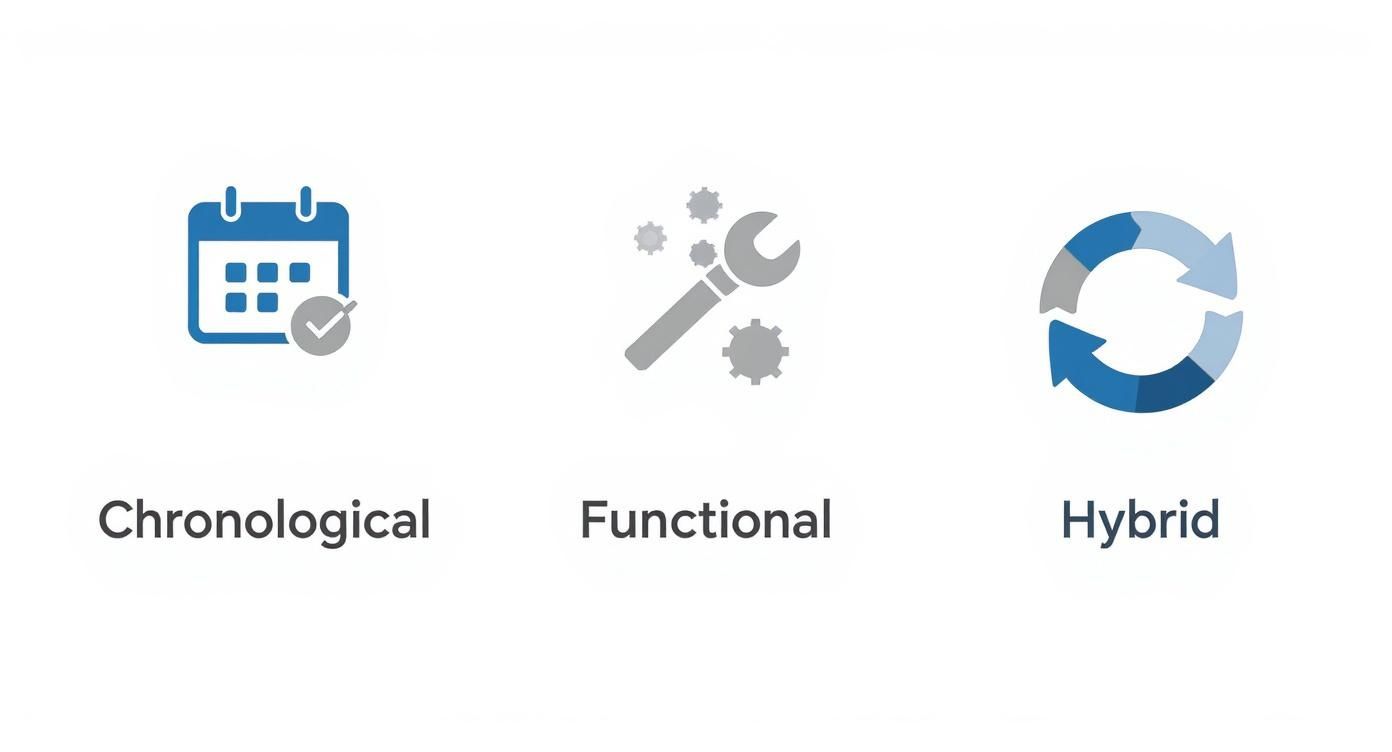
This image breaks down the three core CV formats: Chronological, Functional, and Hybrid. Choosing the right one is your first strategic decision. It ensures your most relevant and powerful information is front and center, making an immediate impact.
For the Coach: It's All About Player Development
When you're applying for a coaching job, your CV needs to be your stat sheet. This world is driven by results, and your ability to win games, develop talent, and build a winning culture is everything. Think of your CV as a highlight reel of your coaching philosophy in action.
Lead with cold, hard numbers. Don't just say you "improved the team." Prove it. "Guided the team to a 22-5 record, securing the program's first conference title in 12 years." That kind of specific, data-backed claim provides undeniable proof of your impact.
Make sure these areas jump off the page:
- Win-Loss Records: Clearly list your records season by season, especially highlighting championship runs or significant turnarounds.
- Player Progression: Show how you make athletes better. Did you mentor 5 players who earned NCAA Division I scholarships? Did you coach the league MVP for two years straight? Put it in.
- Tactical Prowess: Briefly mention your philosophy or system. "Implemented a high-press defensive scheme that cut goals conceded by 30%."
A coach's CV isn't the place for corporate jargon. It's about competitive success. Frame every single point around tangible outcomes—trophies won, records broken, and athletes you helped advance to the next level.
For the Sports Marketer: ROI and Engagement Are King
Now, let's switch to the business side. For a sports marketing role, the focus shifts entirely from on-field performance to off-field results. Hiring managers are looking for proof that you can grow a brand, drive revenue, and create campaigns that get fans talking.
Your CV needs to be loaded with metrics that show your commercial impact. Think in percentages, follower counts, and dollar signs. "Ran social media" is weak. "Executed a content strategy that boosted fan engagement by 45% and directly contributed to a 15% rise in online merchandise sales" is what gets you the interview.
This is more important than ever. With the sports sponsorship market projected to soar past $115 billion by 2025, organizations are laser-focused on data-driven marketing. Showcasing your ability to contribute to that bottom line is your greatest advantage. You can dig deeper into these trends in this insightful PwC sports outlook report.
Key metrics for a marketer's CV:
- Campaign ROI: "Managed a $50,000 digital ad budget, generating $200,000 in direct ticket revenue."
- Audience Growth: "Grew the team's Instagram following from 10k to 50k in 18 months through a targeted influencer and content plan."
- Sponsorship Activation: "Developed unique activation campaigns for key partners, resulting in a 95% sponsor retention rate."
For Sports Operations: Efficiency Is the Name of the Game
If you're in sports operations, you're part of the backbone that makes everything happen. You ensure the games go off without a hitch, the facilities are pristine, and the complex logistics are handled flawlessly. Your CV must project reliability, meticulous planning, and grace under pressure.
You might not have win-loss records, but you have efficiency metrics. Frame your accomplishments around saving time, saving money, and improving processes. "Managed event logistics" is vague. Try this: "Coordinated all home game logistics for a 40,000-seat stadium, cutting event setup time by 20% by implementing a new vendor management system."
The verbs you choose are critical. Strong action words tell the story of your impact.
Action Verb Comparison for Different Sports Roles
The right verb can transform a simple duty into a powerful achievement. This table shows how to pick verbs that resonate within different corners of the sports industry.
| Role Category | Recommended Action Verbs | Example Bullet Point |
|---|---|---|
| Coaching | Mentored, Recruited, Developed, Guided, Instructed, Scouted | Recruited and signed 3 nationally-ranked prospects, strengthening the team's future talent pipeline. |
| Marketing | Generated, Increased, Launched, Captured, Grew, Activated | Launched a targeted email campaign that generated a 25% increase in season ticket renewals. |
| Operations | Coordinated, Streamlined, Negotiated, Executed, Managed, Organized | Negotiated with 15+ vendors to reduce operational costs by 10% without sacrificing quality. |
| Media | Authored, Produced, Published, Broadcasted, Interviewed, Edited | Produced a weekly podcast that became the #1 team-specific show, securing two major sponsorships. |
Choosing dynamic, role-specific verbs makes your contributions feel more active and impactful. For more detailed examples of how to frame these accomplishments, take a look at our guide on building powerful sports management resume examples.
For Sports Media: Your Storytelling Is Your Currency
Finally, if your target is a role in sports media—journalism, broadcasting, content creation—your CV must prove you’re a compelling storyteller. While analytics like page views or audience size matter, the quality of your work and your distinct voice are what truly separate you from the pack.
Don't just list your duties; showcase your work. Your CV should include a prominent link to your portfolio, letting your articles, video reels, or podcasts do the talking. When you do describe your experience, focus on the impact of your stories.
Think along these lines:
- "Authored a feature on a local athlete that was syndicated by national outlets, driving over 500,000 unique page views."
- "Produced and hosted a weekly podcast that hit #1 on Apple Podcasts for team-specific shows, landing two major sponsorship deals."
- "Pioneered the team's live-tweeting strategy during games, which grew our account's follower count by 300% in one season."
Each of these roles demands a fundamentally different approach. By taking the time to tailor your CV, you're not just applying for a job—you're proving you already get what it takes to win in that specific part of the industry.
Showcasing Your Athletic and Technical Skills

Your personal history in sports isn't just a hobby; it’s a foundational asset. For many roles, especially in coaching or player development, your own athletic background gives you a layer of credibility that a traditional CV just can't touch. The trick is to frame this experience professionally, so it boosts your qualifications instead of distracting from them.
At the same time, the modern sports industry runs on technology. From video analysis software to complex data platforms, technical skills are no longer a nice-to-have—they're a must. A sharp, well-organized skills section on your curriculum vitae sports document can be the very thing that proves you’re ready for the future of the industry.
Strategically Including a Playing History Section
So, should you include a "Playing History" section? It all comes down to the role you're chasing. If you're aiming to be a coach, scout, or work in any player-facing role, this section is non-negotiable. It proves you have firsthand knowledge of the game's pressures, understand team dynamics, and possess that competitive fire.
On the other hand, for a job in sports analytics or corporate partnerships, a detailed playing history might be less critical. If you were a high-level collegiate or professional athlete, it's definitely worth a mention, but keep it concise. The goal here is to highlight valuable transferable skills—like discipline and teamwork—without overshadowing your main qualifications.
When you do list your athletic career, make it count. Don't just list titles; turn them into powerful statements of what you can do.
- Instead of: "Team Captain, 2019-2020"
- Try: "Led a Division I team as Captain, serving as the primary liaison between 45 players and the coaching staff to improve team cohesion and communication."
See the difference? This reframing turns a simple title into a quantifiable leadership accomplishment, which is exactly what hiring managers are looking for.
Your athletic background is your origin story. Use it to build a narrative of leadership, discipline, and a deep, authentic understanding of the competitive environment. It’s not just what you did, but what you learned and how you can apply it.
Highlighting Technical Skills and Certifications
In an industry where every play is analyzed and every fan interaction is tracked, technical proficiency gives you a massive leg up. Your CV needs a dedicated section for these skills, organized logically so recruiters can quickly see what you bring to the table.
Grouping your skills into clear categories is the best way to show the breadth of your knowledge. This structure helps a hiring manager immediately spot the tools they use every day.
Example Skills Section Format
- Video Analysis Software: Hudl, Catapult Vision, Sportscode
- Data & Analytics Tools: Tableau, SQL, R, Microsoft Excel (PivotTables, VLOOKUP)
- Team Management Platforms: Teamworks, SportsEngine
- Social Media & Marketing: Sprout Social, Hootsuite, Google Analytics
This clean formatting prevents a messy, jumbled list and immediately showcases your capabilities.
Listing Certifications and Licenses
Certifications are your proof of specialized knowledge and a clear sign of your commitment to professional development. Make sure they're featured prominently, either in their own subsection or right at the top of your skills section where they can’t be missed.
Always list the full name of the certification and the issuing body.
- Certified Strength and Conditioning Specialist (CSCS) - National Strength and Conditioning Association (NSCA)
- USA Football Heads Up Certified - USA Football
- U.S. Soccer 'A' License - U.S. Soccer Federation
- First Aid/CPR/AED Certified - American Red Cross
These credentials add serious weight to your application, especially in coaching, athletic training, and other performance-focused roles.
Technology isn't just changing the game; it's driving its growth. The global sports industry is on track to generate $521 billion in sales in 2024, with another $130 billion in growth possible through faster tech adoption. When you highlight your software and analytics skills, you're showing you’re ready to contribute to this evolution. You can find more insights about technology's impact on the global sports industry on MorganStanley.com. This proves you aren't just qualified for today’s jobs, but that you're prepared for where the industry is headed next.
Writing a Professional Summary That Gets You the Interview
https://www.youtube.com/embed/QPUmFKboiqY
Think of your professional summary as the first play of the game. It's the opening kickoff, the first pitch, the tip-off. This short block of text—just three or four sentences at the top of your CV—is your chance to set the tone and grab the hiring manager's attention immediately.
A weak, generic opening gets your resume sent to the sidelines. A powerful one makes them want to see your highlight reel. This isn't just a summary of your past; it’s your elevator pitch, telling the recruiter exactly who you are, what you bring to the table, and why you're the perfect fit for their team.
From Bland to Bold: The Power of a Results-Driven Intro
Too many people write a summary that just lists their job duties. That's a huge mistake. Don't tell them what you did; show them how well you did it. You need to shift your mindset from describing responsibilities to showcasing accomplishments.
Let's break down the difference.
Before: A Generic Summary
"Experienced sports marketing professional with a background in social media management, campaign execution, and fan engagement. Seeking a challenging role in a dynamic sports organization to apply my skills and grow professionally."
This is okay, but it’s forgettable. It's all about what the applicant wants ("seeking a role") and uses vague language that could apply to anyone.
After: A Results-Driven Summary
"Data-driven Sports Marketing Manager with 8+ years of experience building passionate fan communities for professional soccer clubs. Proven success in executing multi-platform campaigns that boosted digital engagement by 45% and drove a 15% increase in merchandise sales. Eager to apply expertise in sponsorship activation and content strategy to elevate the fan experience at a championship-caliber organization."
Now that has some punch. It leads with a strong title, uses hard numbers to prove success, and connects those achievements directly to what sports organizations care about: growing the fanbase and increasing revenue.
Your summary has to answer three critical questions in under 10 seconds: Who are you professionally? What's your most impressive accomplishment? And what can you do for us?
Connecting Your Summary to Your Cover Letter
Your summary and your cover letter should work together like a quarterback and a wide receiver. The summary is the quick pass that gets the recruiter’s attention, and the cover letter is where you run it downfield for the touchdown.
They need to tell a consistent story. If you mention boosting digital engagement by 45% in your summary, your cover letter is the place to give a quick anecdote about that campaign. Explain the strategy behind it, the challenge you overcame, and the impact it had. This turns a simple statistic into a compelling narrative.
Show, Don't Just Tell, Your Passion
Passion is non-negotiable in the sports world. Recruiters can spot a fake a mile away. They want to see genuine enthusiasm for their sport, their team, and their mission. Your summary is a great place to plant that seed.
- Be Specific to the Sport: Applying to an NHL team? Mention your lifelong passion for hockey.
- Talk the Talk: Use industry-specific terms that show you belong, like "gameday activation," "sponsorship inventory," or "player scouting."
- Align with Their Mission: If the organization is famous for its deep community roots, briefly mention your experience with grassroots programs or charity partnerships.
Remember, your brand extends beyond your CV. A strong summary is your opening statement, and you can continue that narrative by optimizing your professional online profile to reinforce your expertise. Start with a powerful, authentic story right from the first line, and you'll give your application the best possible chance to stand out.
Tackling Your Toughest Sports CV Questions
Putting the final touches on your CV can feel like the last few minutes of a championship game. The pressure is on, and every little detail counts. Before you send that application off, let’s go over a few common questions that I see trip up even the best candidates.
Getting these details right is about more than just filling in blanks; it's the final polish that helps you stand out.
How Long Should My Sports CV Be?
Let’s cut to the chase: keep it concise. A sports CV isn’t an academic paper—it’s your highlight reel. Your goal is to make it incredibly easy for a swamped hiring manager to grasp your value in a matter of seconds.
For the vast majority of professionals in the sports world—whether you're in marketing, operations, or have under a decade of experience—a one-page CV is the gold standard. This limitation forces you to be ruthless, focusing only on what truly matters for the role you want.
Now, there are a couple of exceptions where a two-page CV makes sense:
- Veteran Coaches: If you've got 15+ years under your belt with a long list of teams, successful seasons, and championship runs, you've earned that second page. You need the space to showcase that deep track record.
- Senior-Level Executives: Directors, VPs, or other executives with long, impactful careers often need more room to detail their leadership journey and major organizational wins.
My advice? Unless you're a seasoned pro with a career's worth of essential experience, stick to one page. A tight, focused CV shows you can communicate clearly and that you respect the recruiter’s time.
Should I Bother Listing Hobbies and Interests?
This old debate gets a new life in the sports industry. Generic hobbies like "reading" or "traveling"? Ditch them. They’re just taking up valuable real estate. But if your interests genuinely connect to the industry, they can be a secret weapon.
Think about it from the hiring manager's perspective. They want to see genuine passion. A strategically chosen hobby can add a layer of authenticity to your application that a simple work history can't.
For example, which sounds better?
- Applying for a job at an endurance sports brand? Mentioning you’re a competitive marathon runner who has knocked out three major marathons shows you live and breathe their world. You have grit, discipline, and firsthand product insight.
- Eyeing a sports analytics role? Listing that you manage a complex fantasy sports league using advanced statistical models isn't just a hobby—it's a demonstration of your analytical mind and love for sports data.
What Do I Do About a Career Gap?
First off, career gaps happen. Don't panic. In an industry that prizes resilience and mental toughness, how you frame a gap can actually work in your favor. It's all about the narrative.
The biggest mistake is leaving an unexplained blank space on your CV. Address it head-on by showing you were productive during that time. Turn that potential red flag into a story of growth.
Here’s how you can reframe that time away:
- Freelance Projects: "Consulted for local youth sports programs on fundraising and community outreach."
- Volunteer Work: "Volunteered as an assistant coach for the local high school basketball team, focusing on developing new defensive schemes."
- Professional Development: "Completed a certification in Advanced Sports Analytics to deepen my expertise in player performance metrics."
When you frame it this way, you’re showing that your drive and commitment to the sports world never stopped.
Ready to turn this advice into your next big break? GetSportJobs is the go-to platform for connecting top talent—like you—with the best jobs in the industry. Start your search today and land that sports job you’ve been working toward.