How to become athletic trainer: A Career Roadmap
So, you're thinking about a career as an athletic trainer? It's an incredible field, but it's a lot more than just taping ankles on the sidelines. To get there, you'll need a master's degree from an accredited program, a ton of hands-on clinical experience, and you'll have to pass the national Board of Certification (BOC) exam.
It’s a serious commitment, blending high-level education with the practical skills needed to be on the front lines of athlete health and safety. If you're passionate about sports medicine and genuinely care about helping people perform at their best, it's one of the most rewarding jobs out there.
Your Journey into Athletic Training Starts Here
Ever watch a game and wonder what it’s really like to be the person sprinting onto the field when a player goes down? The path to becoming that person—a certified athletic trainer—is structured, demanding, and incredibly fulfilling. You're moving past being just a sports fan and stepping into a professional healthcare role, which requires a deep commitment to both the science and the art of medicine.
Think of this guide as your personal roadmap. We're going to break down the real-world steps, focusing on three core pillars: getting the right education, diving into immersive clinical experience, and earning your official certification.
This visual breaks down the core path you'll follow.
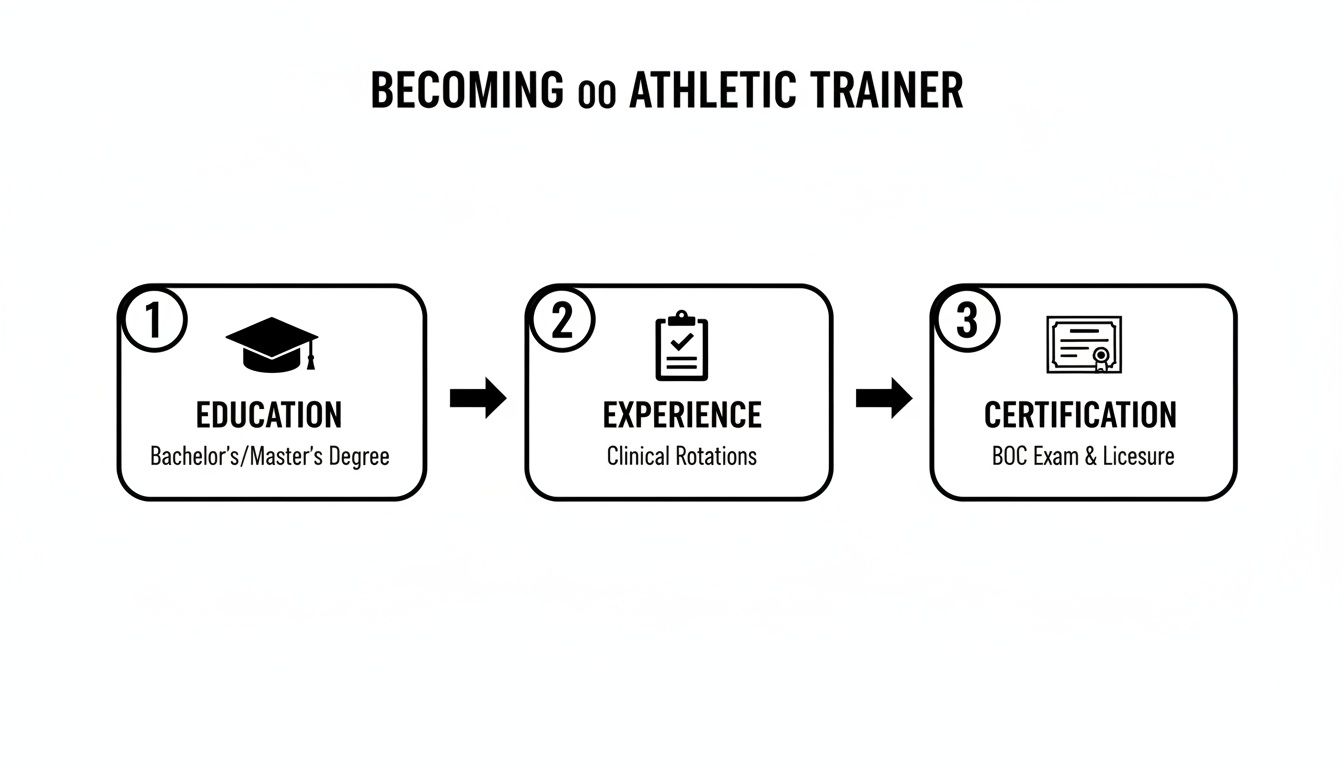
As you can see, these aren't just suggestions; they're sequential stages that build on each other. The whole process is designed to make sure that by the time you're certified, you are thoroughly prepared for whatever comes your way.
The Modern Athletic Trainer's Path
The world of athletic training has changed quite a bit. Not too long ago, a bachelor's degree was enough to get you in the door. Now, the standard is a master's degree from a program accredited by the Commission on Accreditation of Athletic Training Education (CAATE). This isn't just about adding more school; it reflects how much more complex and vital the role has become.
An accredited master’s program is non-negotiable. It guarantees your training meets strict national standards, covering crucial areas like:
- Advanced anatomy and physiology
- Injury assessment and diagnosis
- Therapeutic modalities and rehabilitation techniques
- Emergency care and critical incident management
The demand for skilled athletic trainers is on the rise, with a projected growth of 13% by 2033—way faster than the average for most jobs. This just goes to show how much the profession is valued across sports, healthcare, and even corporate wellness.
Earning your ATC® credential is the final hurdle after you've completed your degree and all your clinical hours. Passing the BOC exam proves you've mastered the five major domains of practice, from injury prevention to the administrative side of healthcare.
After that, you'll need to get licensed in the state where you want to work. Requirements vary, so you have to do your homework. In most states, it’s illegal to practice without a license. This guide will walk you through each phase, giving you the practical advice you need to launch a successful career in this dynamic field.
Navigating Your Educational and Academic Path
So, you want to be an athletic trainer? Your journey starts in the classroom and the clinic, and it’s a path with a very specific, non-negotiable first step: getting into an accredited program.
This isn't a field you can just shadow your way into. It demands a rigorous, standardized education. The gatekeeper for this is the Commission on Accreditation of Athletic Training Education (CAATE). If a program isn't CAATE-accredited, you can't sit for the Board of Certification (BOC) exam—the key that unlocks your entire career. It’s that simple.
A Master's Degree Is the New Standard
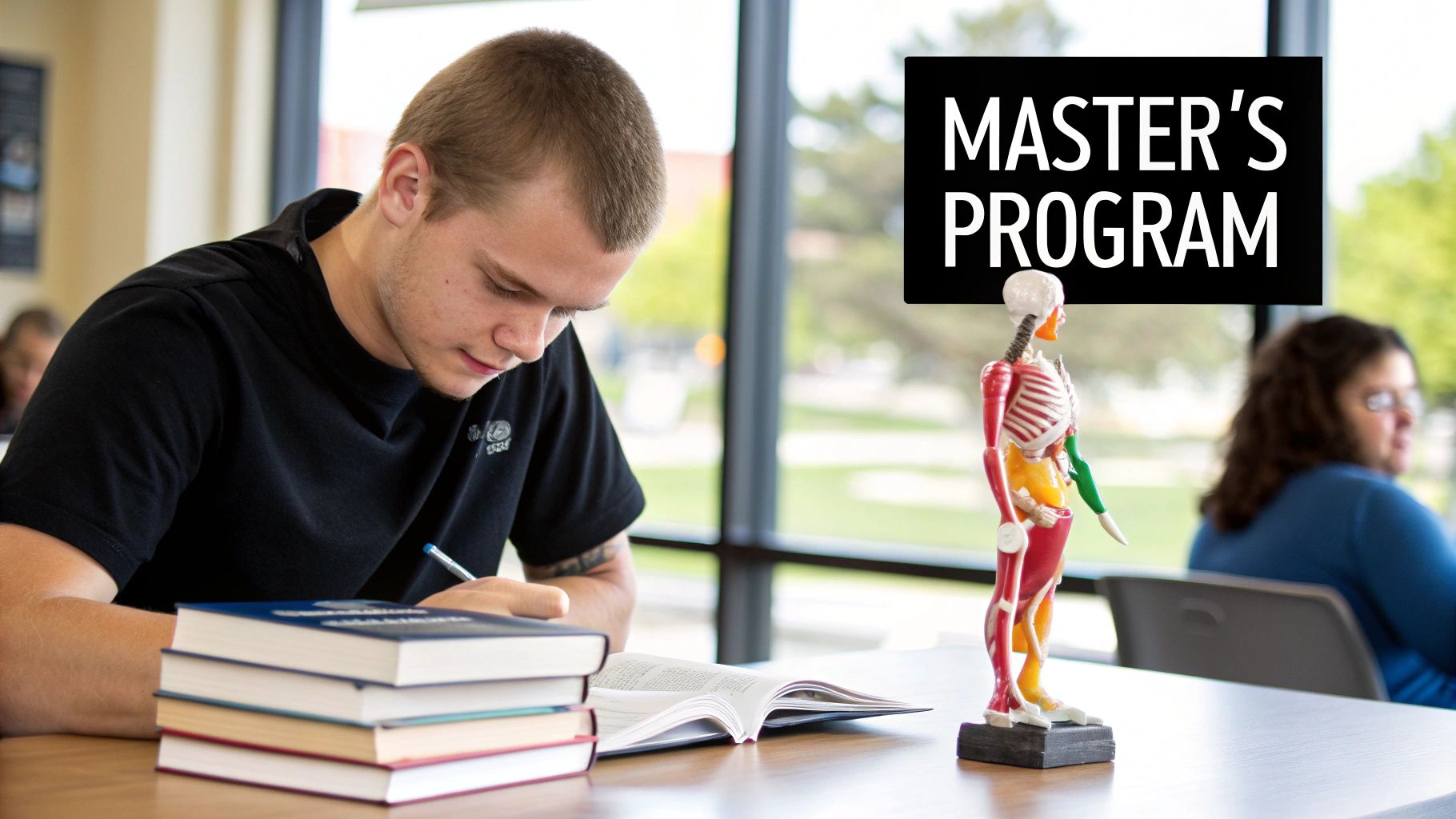
The world of athletic training has made a huge leap forward. Not long ago, a bachelor's degree was enough to get you started, but the industry has raised the bar to match the incredible complexity and responsibility of the role. Today, a master’s degree is the standard entry point for anyone looking to enter the profession.
This shift isn't just about adding another line to your resume; it reflects the advanced clinical skills and deep scientific knowledge needed to manage an athlete's health from start to finish. The numbers back this up. Of the 56,906 certified athletic trainers (ATs) practicing today, nearly 70% hold a master’s degree or higher.
And for new professionals, the trend is even clearer. In the 2022-2023 academic year, the CAATE oversaw 259 professional programs. A whopping 55.6% of those were Master of Science in Athletic Training (MSAT) programs, making it the most common pathway. You can dig deeper into these trends by exploring the latest employment insights for athletic training.
What to Expect in Your Master's Program
Get ready for an immersive, hands-on experience. A CAATE-accredited master’s program is designed to forge you into a confident, competent healthcare professional. The curriculum is a demanding blend of intense classroom theory and absolutely essential clinical practice. You won't just be reading textbooks—you’ll be on your feet, applying what you learn from day one.
The coursework is built to cover every angle of the job. You can expect to dive deep into subjects like:
- Advanced Human Anatomy and Physiology: This is way beyond your high school biology class. Think cadaver labs where you gain a true three-dimensional understanding of how the body is put together.
- Biomechanics and Kinesiology: You'll learn the physics of human movement, breaking down everything from a sprinter's gait to a pitcher's throwing motion to pinpoint injury risks.
- Therapeutic Modalities: This is where you master the tools of the trade—learning the science and application behind ultrasound, electrical stimulation, cryotherapy, and more to manage pain and accelerate healing.
- Injury Assessment and Diagnosis: These are hands-on labs where you'll practice the special tests needed to evaluate everything from a simple ankle sprain to a complex concussion.
- Pharmacology: An AT has to know medications, their effects, and their legality within sports. It’s a critical piece of the puzzle.
- Emergency Care Management: You are the first responder. This training prepares you to take charge in the most critical moments, handling life-threatening situations like spinal injuries or sudden cardiac arrest.
Picture This: A soccer player crumples to the ground with a non-contact knee injury. Your training immediately kicks in. You'll pull from your assessment courses to perform a Lachman or Anterior Drawer test, suspecting an ACL tear. Your knowledge of therapeutic modalities will guide the initial ice and compression to control swelling. And your grasp of rehab principles will be the foundation for designing their entire recovery plan, from the first day post-op to the moment they're cleared to play again.
Choosing the Right Degree: MSAT vs. MAT
As you start looking at schools, you’ll notice two common degree types: the Master of Science in Athletic Training (MSAT) and the Master of Athletic Training (MAT). Both will get you to the BOC exam, but they're designed for slightly different mindsets and career goals.
Thinking about which degree is right for you? It really comes down to what part of athletic training excites you the most.
Comparing Athletic Training Master's Degrees
This table breaks down the core differences to help you decide which path aligns with your interests.
| Degree Type | Typical Focus | Best For | BOC Exam Eligibility |
|---|---|---|---|
| MSAT | Heavily science and research-based, often culminating in a thesis or research project. | Students who love the scientific "why" behind treatments and might want to explore research, academia, or advanced clinical roles in the future. | Yes |
| MAT | Primarily focused on clinical practice and application, emphasizing hands-on skills and patient care over formal research. | Students who want to focus entirely on being clinicians and practitioners in settings like high schools, colleges, or pro sports. | Yes |
Ultimately, there’s no wrong answer here. If you’re fascinated by the evidence behind a treatment and enjoy academic inquiry, an MSAT might be the perfect fit. But if your passion is purely in the hands-on "how" of patient care, an MAT provides a more direct route.
Both degrees will give you the skills and knowledge you need to become a fantastic, well-rounded athletic trainer.
From Classroom Theory to Clinical Practice
The journey to becoming an athletic trainer really comes down to one simple truth: you learn this profession by doing. While your master's program will ground you in the essential sciences, the real learning happens when you step out of the lecture hall and into the fast-paced world of clinical practice.
This is where textbook knowledge morphs into professional instinct. It's where you truly forge your confidence.
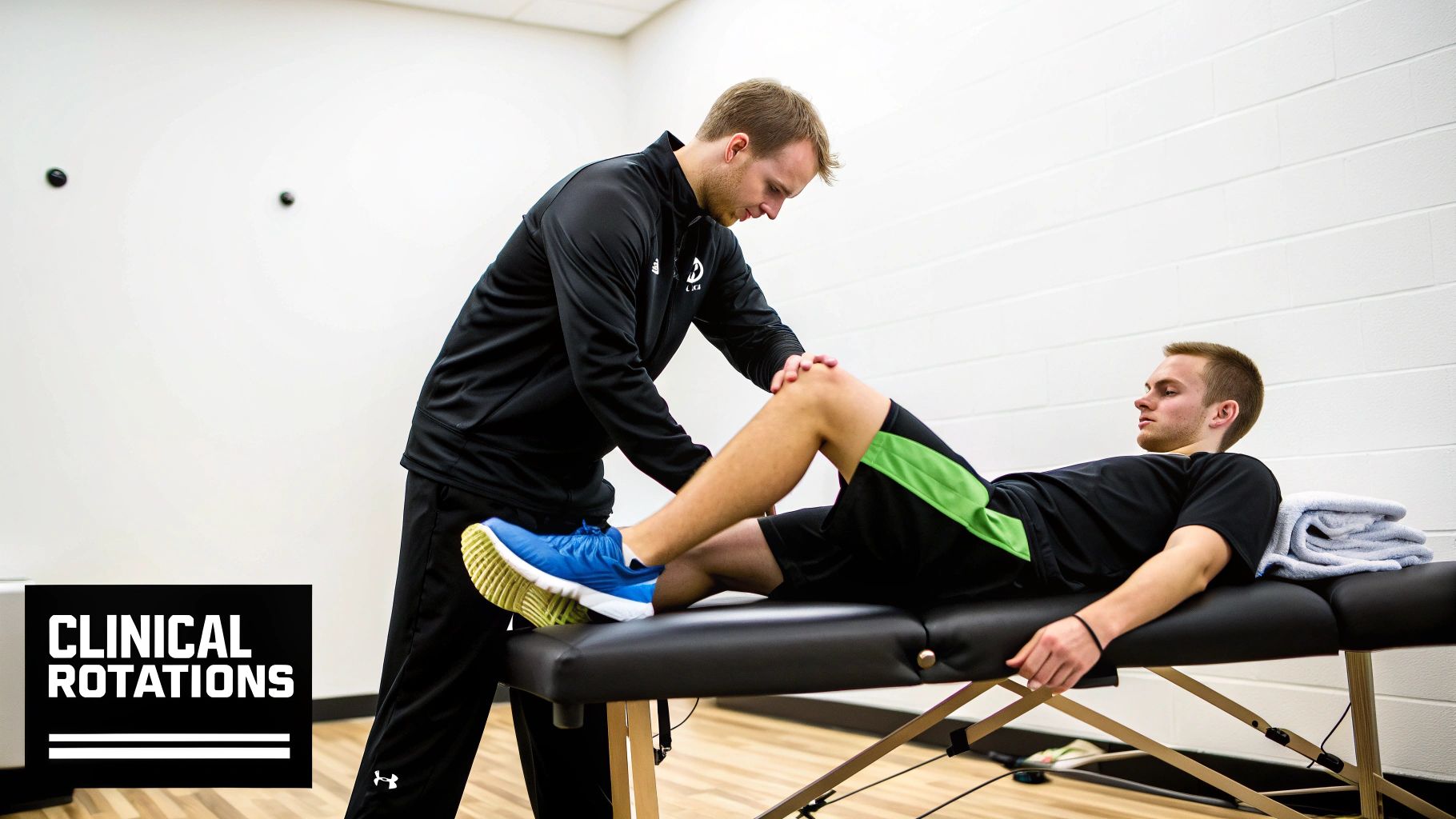
Every single CAATE-accredited program is built around immersive clinical education. These aren't just optional internships you tack on at the end—they are mandatory, structured experiences that throw you right into the heart of the action. You’ll find yourself in a variety of settings, each offering a completely different window into the profession.
The Landscape of Clinical Education
Your program is designed to expose you to a wide range of environments, ensuring you graduate as a well-rounded practitioner. No two days are ever the same. What you learn on a collegiate football sideline is worlds apart from what you'll encounter in an orthopedic clinic.
You can expect your clinical rotations to take place in settings like these:
- Collegiate Athletics: Get a taste of the high-stakes world of Division I, II, or III sports. You'll handle everything from daily treatments in the training room to game-day emergencies on the field.
- High School Sports: Here, you learn to be a versatile, and often the sole, healthcare provider for a huge range of young athletes across many different sports.
- Orthopedic and Sports Medicine Clinics: Work side-by-side with physicians and physical therapists, gaining an incredible depth of knowledge on diagnostic processes and long-term rehab protocols.
- Industrial or Performing Arts Settings: This is where you apply your skills to non-traditional "athletes," like factory workers or professional dancers, focusing on ergonomics and preventing overuse injuries.
These rotations are your golden opportunity to see how different professionals approach patient care. You'll quickly learn to adapt your communication style, documentation methods, and treatment plans to fit the unique population you’re serving.
Your clinical education is arguably the most critical component of your master’s degree. It's where you get hands-on experience under the direct supervision of a certified athletic trainer, apply your knowledge in real-time, and build powerful connections that can launch your career.
Maximizing Your Clinical Experience
Just showing up isn't enough. Your real goal during these rotations is to evolve from a student observer into an active, contributing member of the healthcare team. The certified athletic trainers supervising you—your preceptors—are your single greatest resource. They are there to guide you, challenge you, and mentor you into a competent professional.
To make the most of this time, be proactive. It's that simple. Arrive early, stay late, and always be asking what you can do to help. That kind of initiative gets noticed. Work on building a strong rapport not just with your preceptor, but with the athletes, coaches, and other staff. Trust is the absolute foundation of effective healthcare.
As you start putting classroom theory into practice, you'll need to understand various therapeutic modalities. This includes having a comprehensive guide to recovery equipment for athletes in your back pocket, as it's essential for managing athlete well-being. Don’t ever be afraid to ask insightful questions. Show them you're connecting the dots.
Instead of asking, "What are we doing?" try something like, "I see you're using ultrasound on this hamstring strain. Are you choosing that modality because you're trying to target deeper tissue inflammation?"
A Real-World Clinical Scenario
Picture this: a high school basketball player lands awkwardly and inverts her ankle. Your preceptor is on the other side of the gym. This is your moment.
You calmly approach the athlete, stabilize the injury, and begin your on-court evaluation. You're running through your mental checklist: palpating for point tenderness over the ligaments, checking for deformity, and asking clear questions about her symptoms. Based on your assessment, you suspect a moderate lateral ankle sprain.
Your preceptor arrives, and you confidently relay your findings. Together, you help the athlete off the court and begin the initial treatment—applying compression and ice. For the rest of the game, you monitor her. Afterward, you help develop a plan for the next 24-48 hours, giving her clear instructions on rest, ice, and elevation.
That single experience teaches you more than a dozen lectures ever could. It builds your confidence, hones your communication skills under pressure, and reinforces everything you know about acute injury management. These are the moments that shape you into an athletic trainer.
Earning Your Credentials: The BOC Exam and State Licensure
You’ve made it through years of demanding coursework and countless hours of clinical rotations. Now, you’re at the final gate before you can officially call yourself an athletic trainer. Getting your credentials is a two-part process: first, you have to conquer the Board of Certification (BOC) exam, and second, you need a license for the state where you plan to work.
These aren't just hoops to jump through; they are the bedrock of your professional identity. Passing the BOC proves you have the national-standard knowledge to be effective, while state licensure gives you the legal authority to actually practice.
Demystifying the BOC Exam
The BOC exam is the big one—the national certification test every single athletic trainer has to pass. It’s a comprehensive, computer-based exam that's all about assessing your competence as an entry-level professional. Think of it as the ultimate final exam for everything you learned in your master’s program.
It isn’t just a random assortment of questions. The exam is broken down into five key domains, each weighted to reflect how often you'll encounter these situations in the real world:
- Risk Reduction, Wellness, and Health Literacy: This is the proactive side of our job—designing injury prevention programs and educating athletes on everything from nutrition to proper sleep habits.
- Assessment, Evaluation, and Diagnosis: A huge part of the test. It drills down on your ability to perform a thorough physical exam and figure out exactly what injury you're dealing with.
- Critical Incident Management: Can you handle an emergency? This is where your knowledge of acute care is tested, from managing a potential spinal injury to recognizing the signs of sudden cardiac arrest.
- Therapeutic Intervention: This covers your ability to build and execute a solid rehab plan. You’ll be tested on choosing the right exercises and modalities to get an athlete back in the game.
- Healthcare Administration and Professional Responsibility: This is the "business" side of athletic training. We're talking documentation, insurance, ethics, and your ongoing professional responsibilities.
The BOC isn't about memorizing definitions. It’s a clinical reasoning exam. Most questions are scenario-based, putting you in a situation and asking, "What would you do next?" It forces you to apply your knowledge, not just regurgitate it.
Creating Your Study Framework
You absolutely cannot cram for the BOC exam and expect to pass. A smart, disciplined approach is the only way. I tell all my students to start their dedicated study plan at least three to four months before their test date. The goal isn't just to review, but to systematically build confidence.
Kick things off by taking a full-length practice exam to get a baseline score. This is invaluable because it immediately shows you which of the five domains are your strengths and which need serious work. Then, build your study schedule around those weaker areas while still cycling back to your strong suits to keep them sharp.
Don't just stare at your textbooks. Mix it up! Use your class notes, grab a BOC-specific prep book, and subscribe to an online question bank. Forming a small study group with a few motivated classmates can also be a game-changer for talking through tough concepts. For a deeper dive, our athletic trainer certification requirements guide breaks down the exam in much more detail.
The Critical Next Step: State Licensure
Here’s something that trips up a lot of new grads: passing the BOC earns you the prestigious ATC® credential, but it doesn’t automatically give you the right to work.
Almost every state requires you to obtain a state license to legally practice as an athletic trainer. This is a crucial distinction.
Licensure requirements can vary quite a bit from one state to another. Most will accept your BOC certification as the main qualification, but many have additional rules, such as:
- Passing a separate state jurisprudence exam (a test on state-specific laws and regulations).
- Undergoing a background check.
- Submitting official transcripts and paying a licensing fee.
Let me be clear: It is illegal to practice as an athletic trainer in most states without a valid license. Before you even think about applying for jobs, you need to research the specific requirements for the state where you want to work. Just google "[State Name] Board of Athletic Training," and you’ll find the official source you need.
Maintaining Your Hard-Earned Credentials
Becoming an athletic trainer isn't a "one and done" deal. Your certification and license aren't for life; you have to actively maintain them. The BOC requires you to complete a specific number of Continuing Education Units (CEUs) every two-year reporting period to keep your ATC® credential active.
This isn't just busywork. It ensures you’re staying up-to-date with the latest research, techniques, and best practices in sports medicine. You can earn CEUs in lots of ways, like attending conferences, taking advanced workshops, or even publishing research. This commitment to lifelong learning is what separates the good athletic trainers from the great ones.
Launching Your Career and Finding Your First Job
You’ve earned your ATC® credential and secured your state license. All the long hours of studying and clinical rotations have paid off. Now, it’s time for the exciting part: landing that first athletic trainer role.
This next phase is all about showing employers what you can do. You have the knowledge and the hands-on experience, but the job market is competitive. The trick is to package your skills in a way that makes you the obvious choice for the job.
Building a Resume That Stands Out
Think of your resume as your professional highlight reel, not just a list of things you’ve done. Generic phrases like "assisted with athlete rehabilitation" are forgettable and don't do your skills justice.
To really grab a hiring manager’s attention, you need to use strong action verbs and, most importantly, quantify your accomplishments. Put numbers to your experience.
Instead of a vague statement, try something like: "Designed and implemented post-operative rehabilitation programs for over 40 Division I athletes, focusing on ACL and rotator cuff recovery protocols." See the difference? That single sentence paints a powerful picture of your capabilities and the level you've worked at.
Ask yourself:
- How many athletes did I evaluate during a season?
- What was the size of the teams I covered?
- How many different sports did I get exposure to?
Adding these concrete details provides proof of what you can handle and helps your resume jump to the top of the stack.
The Power of Professional Networking
In the tight-knit community of sports medicine, your connections can be a game-changer. Networking isn’t about collecting business cards; it's about building genuine relationships with people who are already where you want to be.
A great place to start is by getting active in the National Athletic Trainers' Association (NATA). Make it a point to attend their local, district, or national events. These symposiums are invaluable for meeting established ATCs, hearing about jobs that aren't even posted yet, and simply getting your name out there.
Don’t just collect contacts—cultivate relationships. If you meet someone at a conference, follow up with a quick, personalized message on LinkedIn. Ask them about their career path. You’d be surprised how willing people are to share advice if you show genuine interest.
Remember, your clinical preceptors and professors are your initial network. They have deep connections in the field and can provide glowing letters of recommendation. Stay in touch with them well after graduation; they are some of the best advocates you'll ever have.
Mastering the Job Search Strategy
You can scroll through massive job boards, but you'll get much better results by focusing on platforms built for the sports industry. These niche sites cut through the noise and connect you directly with employers who are specifically looking for someone with your skills. For example, you can find a wide range of current athletic training job opportunities on specialized boards designed for professionals like you.
Set up job alerts for the titles and locations you're targeting. And don't limit yourself to the pros! There are fantastic opportunities in colleges, high schools, orthopedic clinics, and even industrial settings that offer incredible foundational experience. With the field projected to grow by 13% by 2033, there are more openings than ever before.
When you find a role you're excited about, customize your application. Every single time. Read the job description and echo its language in your resume and cover letter. If they mention "emergency action planning," make sure you highlight your experience developing and executing EAPs during your clinicals. Once you're ready to apply, focus on crafting a compelling cover letter that tells your story. This focused approach shows that you're serious about that specific job, not just any job, and it will dramatically boost your chances of getting an interview.
Advancing Your Career Beyond Your First Role

Getting your ATC® credential isn't the finish line—it’s the starting block. Most new grads jump into roles at the high school or collegiate level, and that's a fantastic way to build a foundation. But what many don't realize is how those foundational skills open doors to a surprisingly diverse career path.
The truth is, the skills you're developing in injury evaluation, treatment, and rehabilitation are in high demand far beyond the traditional sidelines. Thinking about where else you can apply your expertise is the key to building a long, fulfilling career.
Thinking Outside the Traditional Playbook
The definition of an "athlete" is broader than ever, and that means the opportunities for athletic trainers have exploded. Your expertise in biomechanics, injury prevention, and rehab is incredibly valuable in fields you might never have considered.
Here are a few less-traveled paths that are gaining serious traction:
- The Performing Arts: Dancers, musicians, and even stunt performers are elite athletes in their own right. They face incredible physical demands and are prone to repetitive stress injuries. You could be the one keeping a Broadway cast healthy or a professional ballet company on its toes.
- Industrial and Occupational Settings: Think of factory workers or even Amazon warehouse employees as "industrial athletes." Companies are hiring ATs to improve workplace ergonomics, prevent injuries before they happen, and design wellness programs that keep their workforce safe and productive.
- Public Safety and the Military: Police officers, firefighters, and soldiers need to be in peak physical condition to do their jobs safely. Athletic trainers are increasingly being brought in to run strength and conditioning programs, manage injuries, and ensure these tactical athletes are always ready for duty.
Your ability to analyze movement, identify risk, and provide immediate care is a transferable skill set. Don’t limit your job search to sports teams; your expertise is needed everywhere people are physically active.
Climbing the Ladder: Leadership and Specialization
After a few years in the field, you'll naturally start looking for what's next. Many athletic trainers move into leadership roles like Head Athletic Trainer or Clinical Director. These jobs are a different beast—they’re less about taping ankles and more about managing budgets, supervising staff, and developing healthcare policies for an entire organization.
Another great way to grow is by specializing. Adding certifications to your name can carve out a specific niche and boost your earning potential. For example, becoming a Certified Strength and Conditioning Specialist (CSCS) shows you have a deep understanding of performance enhancement, making you invaluable to competitive teams.
At the end of the day, a successful career is built on lifelong learning. Stay curious, explore different settings, and you'll find your perfect fit within the wide world of sports medicine.
Common Questions About Becoming an Athletic Trainer
As you start mapping out your future, it's completely normal for a bunch of questions to pop up. Getting straight answers to these common hurdles can make planning your education and career path a whole lot smoother. Let's dig into some of the things aspiring ATs ask most often.
What High School Courses Should I Take?
If you want a head start on your master’s program in athletic training, you need to live in the science labs. Seriously. A strong background in anatomy, physiology, biology, and chemistry will put you miles ahead of the game. These aren't just prerequisites; they're the language you'll be speaking every single day.
But don't just stop at the hard sciences. Think about the other skills you'll need when you're working directly with people.
- Psychology: This is huge. You'll need to understand what makes an athlete tick and how to coach them through the mental grind of a long recovery.
- Nutrition: You’ll constantly be advising athletes on how to fuel their bodies for peak performance and effective healing.
Pro tip? Go ahead and get your CPR and First Aid certifications while you're still in high school. It shows initiative and gets a key requirement out of the way early.
How Long Does This Whole Process Take?
Plan on about six years of college after you graduate high school. The typical path is a four-year bachelor’s degree in a relevant field, like kinesiology or exercise science, followed immediately by a two-year master’s program in athletic training. That master's degree is no joke—it’s an intense blend of advanced classes and thousands of hands-on clinical hours.
Don't forget, the clock doesn't stop at graduation. You'll still need to dedicate a few months to buckle down and study for the BOC exam. After you pass, you have to sort out your state license. Only then can you officially start practicing.
Can I Get My Athletic Training Degree Online?
Plain and simple: no. A fully online degree isn't an option for becoming a certified athletic trainer. The reason is that the Commission on Accreditation of Athletic Training Education (CAATE) requires thousands of hours of supervised, hands-on clinical experience.
While you might find a few introductory courses offered in a hybrid format, the real meat of your education—learning how to tape an ankle, assess an injury on the field, and manage emergency situations—has to happen in person. There's just no substitute for that real-world practice.
Ready to find the perfect role to launch your career? GetSportJobs is the leading job board for the sports industry, connecting talented professionals like you with top opportunities in athletic training and beyond. Start your job search today on GetSportJobs