So, you're thinking about a career as an athletic trainer? It's a fantastic path, putting you right on the front lines of athlete health and safety. But getting there isn't just about knowing your anatomy; it's a structured journey with clear, non-negotiable milestones.
Think of it as a three-part climb: you need the right education from an accredited school, you have to conquer a national exam, and then you secure your license to practice in your state. This whole process is designed to make sure every single certified athletic trainer (AT) has the expertise to handle the immense responsibility of patient care. It's a demanding road, but a well-defined one.
Your Roadmap to Becoming a Certified Athletic Trainer
Becoming an athletic trainer means you're stepping into a critical healthcare role. You'll be the expert in preventing, diagnosing, and treating injuries for everyone from high school football players to professional dancers and factory workers. The certification path is intentionally rigorous to build that deep well of knowledge and practical skill you'll need every single day.
This infographic breaks down the journey into those three essential stages.
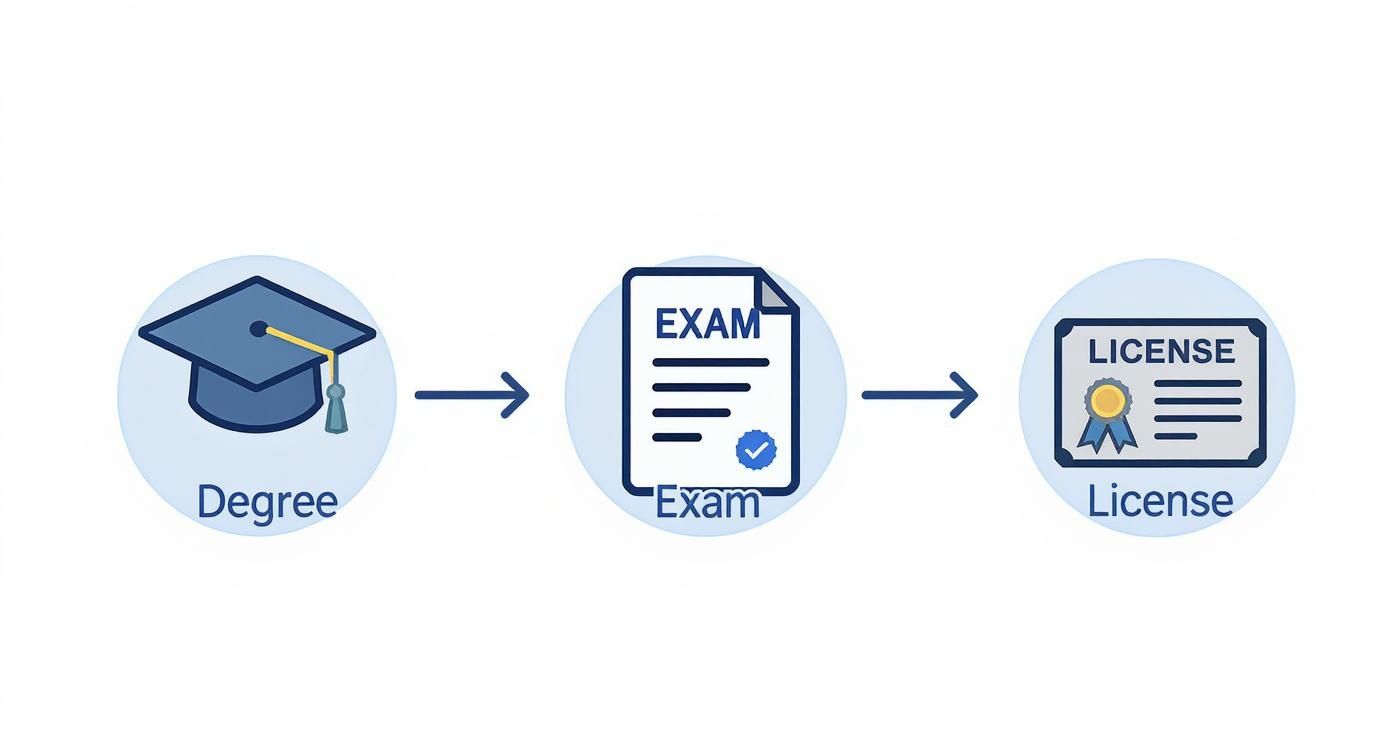
As you can see, each step builds on the last. Your education gives you the foundation, the exam validates your knowledge, and the license gives you the legal authority to put it all into practice.
To give you a bird's-eye view, here's a breakdown of the core pillars you'll need to build your career on.
Core Pillars of Athletic Trainer Certification
| Pillar | Requirement | Key Outcome |
|---|---|---|
| Education | Graduate from a CAATE-accredited program (Master's level). | Foundational knowledge and hands-on clinical skills. |
| Examination | Pass the comprehensive Board of Certification (BOC) exam. | National certification and the "ATC" credential. |
| Licensure | Obtain a license, certification, or registration in your state. | Legal authority to practice athletic training. |
These pillars aren't just suggestions—they are the bedrock of the profession, ensuring a consistent standard of excellence for every practitioner.
The Modern Standard of Care
The athletic training field has come a long way, and the standards for entry have risen to match its vital role in healthcare. The whole system is governed by the Board of Certification for the Athletic Trainer (BOC), the national body that sets the bar for what it means to be a competent AT.
Here's what that looks like in practice:
- Accredited Education: First things first, you have to graduate from a program accredited by the Commission on Accreditation of Athletic Training Education (CAATE). This isn't just a rubber stamp; it guarantees your coursework and clinical training meet strict national standards.
- National Examination: After graduation, it's time for the main event: the BOC exam. This is a comprehensive test covering everything you've learned, from emergency care to rehabilitation. Passing this exam is what earns you the coveted "ATC" credential.
- State Regulation: With your ATC credential in hand, the final step is getting permission to practice from your state. Most states require a license or registration, which is your legal green light to work as an athletic trainer.
This isn't just busywork. It's a system designed to produce top-tier healthcare professionals. The numbers speak for themselves: as of 2023, there were 56,906 certified athletic trainers in the U.S., and a staggering 70% of them hold a master's degree. This highlights the profession's commitment to advanced education and expertise.
The journey to becoming an ATC is a marathon, not a sprint. It demands dedication to rigorous academic coursework, immersive clinical experience, and a commitment to lifelong learning to stay at the forefront of patient care.
Once you've navigated these requirements, you'll find a world of rewarding athletic training job opportunities waiting for you. You'll be ready to make a real difference in the lives of athletes and active people everywhere. Let's dive into what each of these steps really entails.
Building Your Foundation with an Accredited Program
The absolute first step on your journey to becoming a certified athletic trainer is earning a degree from an accredited program. This isn't just a box to check; it's where you build the entire foundation for your career, from intellectual knowledge to practical, hands-on skills. The only name that matters here is the Commission on Accreditation of Athletic Training Education (CAATE).
Think of CAATE accreditation as a stamp of approval that guarantees quality. It means a program's curriculum, its faculty, and its clinical training opportunities all meet strict national standards. Bottom line: graduating from a CAATE-accredited program is the only way you'll be allowed to sit for the Board of Certification (BOC) exam.
The Shift to a Master's Degree Standard
Not too long ago, you could enter the athletic training field with a bachelor's degree. But the profession has grown, and the educational bar has been raised to meet the complex demands of today's healthcare world. Now, a master's degree is the standard for anyone entering the profession.
This change really speaks to the expanding role of athletic trainers. We are vital members of the healthcare team, and that requires advanced knowledge in everything from diagnostic imaging and pharmacology to evidence-based practice. A master's degree gives you the depth of training needed to handle these high-level responsibilities from day one.
This shift ensures that every new athletic trainer enters the workforce with a graduate-level understanding of patient care, putting the profession on par with other respected healthcare fields like physical therapy and occupational therapy.
Picking a program is a huge decision, and your best friend in this process is the CAATE website. They have a searchable database of every accredited program in the country.
You can use the CAATE program finder to narrow down your options by state, degree level, and more to create a shortlist of schools that might be a good fit.
This tool is great because it links you directly to each program's website, shows you their current accreditation status, and gives you all the basic info you need to start comparing.
How to Really Evaluate a CAATE-Accredited Program
Just because a program is accredited doesn't mean it's the right one for you. Once you've got a list of potential schools, it's time to do some real digging. You're looking for a program that not only gets you ready for the BOC exam but also lines up with your personal career goals. A program's real strength often comes down to its student outcomes and the quality of its hands-on training.
Here's what I always tell people to look for:
- First-Time BOC Pass Rate: This is the most straightforward measure of how well a program prepares its students. A high first-time pass rate tells you the curriculum is doing its job. The best programs will proudly advertise pass rates of 85% or higher.
- Clinical Immersion Opportunities: This is where the magic happens. Your clinical education is where you take everything you learned in the classroom and apply it in the real world. Ask pointed questions about their clinical sites. Do they have connections with pro sports teams, major universities, busy hospitals, or even industrial settings?
- Faculty Expertise and Class Size: You want to learn from people who have been there. Look for faculty who are not just great teachers but also experienced clinicians, maybe even active researchers. I'm also a big believer in smaller class sizes, often around 15-20 students, which allow for more one-on-one mentorship. That's priceless in a field like ours.
I can't stress the clinical experience enough. This is where you go from a student to a practitioner, all under the watchful eye of a certified preceptor. These immersive experiences are specifically designed to build your competence and, just as importantly, your confidence.
A top-tier program will offer rotations that expose you to all sorts of different patient populations and work environments. Imagine spending one semester on the sidelines with a Division I football team and the next in an orthopedic clinic, a high school, or even a performing arts company. That kind of variety is what makes you a well-rounded and adaptable athletic trainer, fully prepared for certification and whatever your career throws at you.
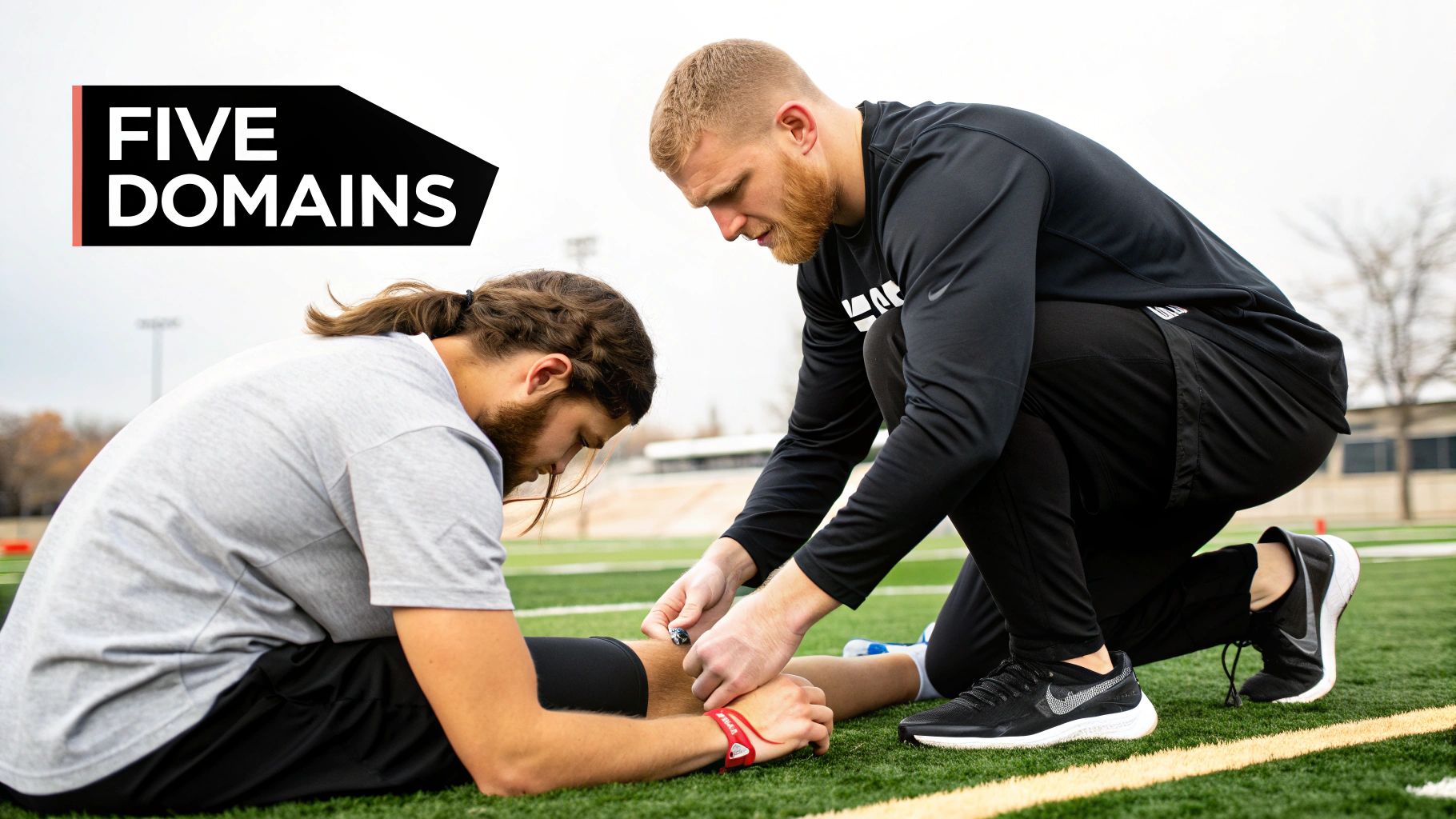
Mastering the Five Domains of Athletic Training
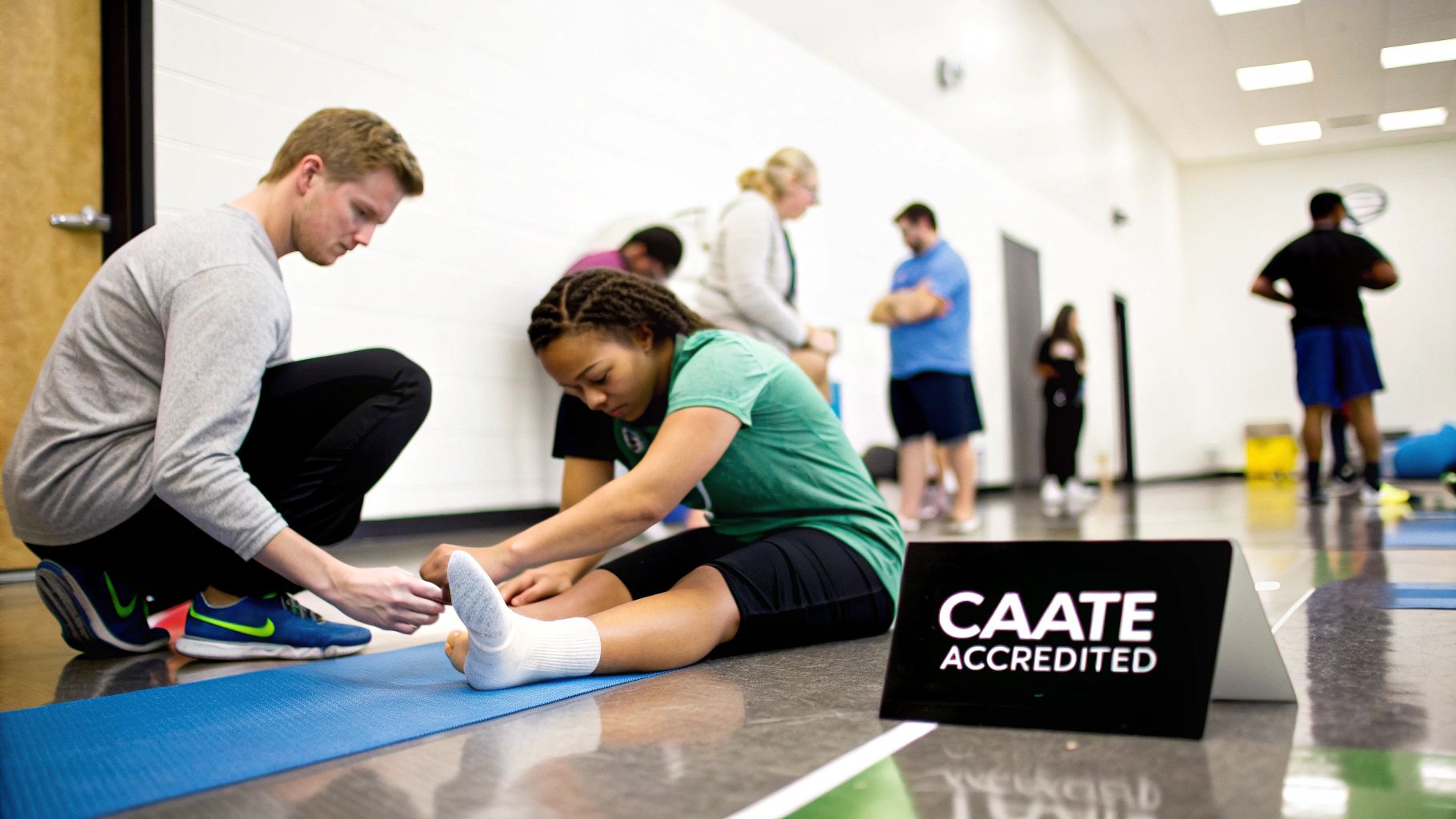
To really get what an athletic trainer does, you need to look past the job title and get into the skills that are the bedrock of the profession. The entire path to certification is built around mastering five key areas of expertise, officially known as the Five Domains of Athletic Training. These aren't just chapters in a textbook; they are the fundamental roles you'll be living and breathing every single day.
Think of these domains like different hats you have to wear, sometimes all in the same hour. One minute you're a strategist, planning to prevent injuries before they even happen. The next, you're a first responder in a crisis. Then, you're a coach and guide, leading an athlete through the long road of rehabilitation. This incredible versatility is what makes the role so vital in any sports medicine team.
Let's break down how these domains actually play out in the real world, so you can see the profound impact you'll have on an athlete's health and career.
Domain 1: Risk Reduction and Wellness
This is where the real work starts, long before an injury ever happens. This first domain is all about playing offense—using your expertise to make environments safer and athletes healthier. It's about prevention, education, and smart, proactive planning.
For example, imagine it's preseason for a college soccer team. As their athletic trainer, your mind is on mitigating risk. You might be designing a conditioning program that specifically targets muscles prone to strain in soccer, or running movement screenings to pinpoint athletes with biomechanical quirks that could spell trouble down the line. It also means educating athletes on proper nutrition and hydration to head off heat illness during those brutal summer two-a-days.
The best athletic trainers prevent injuries that no one ever knows could have happened. This domain is the silent, strategic foundation of effective patient care, stopping problems before they start.
Domain 2: Assessment, Evaluation, and Diagnosis
When an injury does occur, this is where you switch gears and become a detective. Whether it's on the sideline under the stadium lights or in the training room, you are the first healthcare professional to assess the situation. This domain is all about your clinical investigation skills.
Picture this: a basketball player lands awkwardly after a rebound and goes down clutching their knee. You're the one running onto the court, staying calm while everyone else holds their breath. You'll start a systematic evaluation right there, asking targeted questions, performing hands-on tests to check ligament stability, and looking for signs of swelling or deformity. Your expert assessment in those first few critical moments is what determines the severity of the injury and sets the entire course for a proper diagnosis and immediate care plan.
Domain 3: Critical Incident Management
This domain is about being ready for the absolute worst-case scenarios. It's about providing immediate, life-sustaining care when every second is critical. Your accredited education will hammer these skills home, as they are a non-negotiable cornerstone of the athletic trainer certification requirements.
The certification process ensures every AT is prepared for a range of medical emergencies. Students get extensive, hands-on practice in skills like wound care, applying tourniquets, managing heat stroke, stabilizing spinal injuries, and handling cardiac events with CPR and AEDs.
Domain 4: Therapeutic Intervention
Once an injury is diagnosed, your role shifts again. Now, you are a healer, a motivator, and a guide. This domain covers the entire rehabilitation process, from the initial injury all the way until that athlete is cleared to get back in the game. It's about designing and executing a plan to restore function, rebuild strength, and crucially, restore confidence.
For an athlete recovering from something major like ACL surgery, you become their partner on a months-long journey. This involves:
- Manual Therapy: Using hands-on techniques to improve joint mobility and ease pain.
- Therapeutic Exercise: Prescribing a progressive series of exercises to rebuild strength, stability, and control.
- Modalities: Applying treatments like ice, heat, or electrical stimulation to manage inflammation and pain.
Your expertise here is what directly determines how quickly—and safely—an athlete makes their comeback.
Domain 5: Healthcare Administration and Responsibility
Finally, this domain covers the professional, logistical side of being an athletic trainer. You're not just a clinician; you're also a healthcare manager. That means you are responsible for meticulous documentation, clear communication, and unwavering ethical practice.
This is the behind-the-scenes work: keeping detailed medical records, coordinating care with doctors and specialists, managing inventory and supplies, and navigating the complexities of insurance. It's the essential glue that ensures the entire healthcare process runs smoothly and professionally for every single patient you see.
How to Prepare for and Pass the BOC Exam
You've put in the years of demanding coursework and logged countless hours in immersive clinical rotations. Now, only one thing stands between you and earning the "ATC" credential: the Board of Certification (BOC) exam. Passing this test is the ultimate validation of your skills and an absolute must for your career.
Think of the BOC exam as the bridge connecting your academic life to your professional future. It's where you prove you have the competence to meet the high standards of care every athletic trainer is expected to provide. A smart, strategic approach is your best bet for crossing that bridge with confidence.
Decoding the BOC Exam Structure
Before you even crack a textbook, you need to understand how the exam is built. The BOC exam is a computer-based test made up of 175 multiple-choice questions. It's meticulously designed to gauge your proficiency across the five core domains of athletic training that you mastered in your accredited program.
But here's the inside track: not all domains carry the same weight. Knowing where the BOC places its emphasis is the key to focusing your study time where it will have the biggest impact. This insight helps you align your preparation directly with the test's priorities—a critical part of meeting the athletic trainer certification requirements.
To give you a clear roadmap, here's a look at how the exam content breaks down.
BOC Exam Content Breakdown
This table shows the approximate weighting of each domain on the BOC certification exam, helping candidates focus their study efforts.
| Exam Domain | Approximate Percentage of Exam |
|---|---|
| Domain 1: Risk Reduction, Wellness & Health Literacy | 17% |
| Domain 2: Assessment, Evaluation & Diagnosis | 24% |
| Domain 3: Critical Incident Management | 13% |
| Domain 4: Therapeutic Intervention | 29% |
| Domain 5: Healthcare Administration & Professional Responsibility | 17% |
As you can see, Therapeutic Intervention and Assessment, Evaluation, and Diagnosis together make up more than half the entire exam (53%, to be exact). While you absolutely need a solid grasp of all five domains, pouring significant effort into these two high-value areas is a smart and efficient strategy.
Building Your Winning Study Plan
Passing the BOC exam isn't about cramming facts at the last minute. It demands a deep, practical understanding of real-world clinical scenarios. Your study plan needs to reflect that, moving beyond simple memorization and toward critical thinking and application.
The most successful plans usually involve a mix of tactics. Start by honestly identifying your weaker areas based on your coursework and clinical experiences. From there, you can build a schedule that carves out extra time for those domains while still regularly reviewing your stronger subjects.
The goal isn't just to know the information, but to understand how to apply it under pressure. Frame your study sessions around one key question for every concept: "How would I use this to make a clinical decision for a patient?"
Effective preparation is all about using the right tools to turn your knowledge into correct answers when it counts.
- Official BOC Materials: Your first stop should always be the official BOC website. They provide a candidate handbook, detailed content outlines, and practice exams that are pure gold. Taking their official practice exams is the single best way to get a feel for the question format and pacing.
- Form a Study Group: Don't go it alone. Teaming up with peers from your program can be a game-changer. There's no better way to solidify your own understanding of a tricky concept than by trying to explain it to someone else.
- Focus on Scenario-Based Questions: A huge portion of the BOC exam isn't about simple recall. The questions often present a clinical scenario and ask you to choose the best course of action. Practice thinking through these situations step-by-step, just like you would in a real training room.
Navigating Exam Day with Confidence
You've prepared, you've studied, and the big day is finally here. Managing test-day nerves is just as important as knowing the material. Get to the testing center early to avoid any last-minute stress, and double-check that you have all the required identification.
Once the exam starts, manage your time wisely. If you hit a question that stumps you, mark it for review and move on. It's far better to answer all the questions you know first and then circle back to the tougher ones later. Most importantly, trust your training—you've built a solid foundation to succeed. You've got this.
What to Do After You're Certified: A Guide to State Licensure

Passing the BOC exam and earning your ATC® credential feels like crossing the finish line. It's a huge accomplishment that validates years of hard work. But before you can legally start working with patients, there's one more critical step: getting cleared to practice by the state.
The easiest way to think about it is this: your BOC certification is like a passport. It's the nationally recognized document that proves you have the required knowledge and skills. State licensure is your visa—it's what grants you legal permission to actually work in a specific state. Without that "visa," your passport is just a credential on paper. This final hurdle ensures every practicing AT meets the specific legal and professional standards of the state where they work.
Licensure, Certification, or Registration? It's Not All the Same
As you start digging into requirements, you'll see a few terms that sound alike but have very different legal weight. Getting a handle on these is crucial because the type of regulation a state uses directly defines your scope of practice—what you are legally allowed to do as a healthcare provider there.
- Licensure: This is the gold standard and the most protective form of regulation. It legally defines what an athletic trainer can do and, just as importantly, prevents anyone without a license from performing those duties.
- Certification: This is all about title protection. It means you can't call yourself an "athletic trainer" in that state unless you've met its specific requirements. However, it may not be as strict in defining the scope of practice.
- Registration: This is the most basic form of regulation. It usually just means you have to put your name and address on file with a state agency before you can practice.
Thankfully, most states have adopted licensure for athletic trainers, which offers the highest level of protection for both the public and the profession.
Earning your national ATC credential is the prerequisite, but state regulation is what ultimately unlocks your legal authority to provide patient care. This step is a non-negotiable part of your professional journey.
Finding and Fulfilling Your State's Rules
Athletic training is a regulated profession almost everywhere in the U.S., but the rules of the road can change quite a bit when you cross state lines.
Right now, 48 states and the District of Columbia require athletic trainers to hold the BOC credential, and nearly all of them also mandate some form of state regulation to practice legally. The good news is that the rigorous, medical-based education you received was designed to prepare you for these high standards. You can find more details in the profile of athletic trainers on nata.org.
Your go-to resource for this entire process is the official regulatory board for the state you want to work in. Just search for something like "[State Name] Board of Athletic Training" or "[State Name] Board of Medical Examiners," and you should find it.
Once you're on the right website, look for the application section for athletic trainers. While specifics vary, you'll almost always need to complete these core steps:
- Submit an Application: You'll provide all your personal details, proof of your education, and, of course, your BOC certification number.
- Pay an Application Fee: This is a standard part of the process, with fees differing from state to state.
- Pass a Background Check: To ensure patient safety, virtually every state requires a criminal background check.
- Complete a Jurisprudence Exam: Don't let the name scare you. This is usually an open-book test on the state's specific laws and rules for athletic training. It's designed to make sure you know your legal responsibilities in that state.
Completing this final step is what officially transitions you from a certified graduate to a legally recognized healthcare professional, ready to hit the ground running.
Maintaining Your Credentials for Career-Long Success
Getting your ATC® credential is a huge milestone, but it's not a finish line. Think of it less like a diploma you hang on the wall forever and more like a professional license that needs consistent upkeep to stay active and valuable.
This dedication to lifelong learning is a fundamental piece of the athletic trainer certification requirements. It's what ensures you're always providing the highest standard of care to your athletes and patients. To that end, the Board of Certification (BOC) lays out a clear path for keeping your credentials in good standing through continuing education.
Understanding the Continuing Education Cycle
To keep your certification active, you have to complete a specific number of Continuing Education Units (CEUs) every two-year reporting period. The current standard is 50 CEUs—a number that's substantial enough to be meaningful but realistic for a working healthcare professional.
These units aren't just about ticking a box. They are a structured way to keep you plugged into the latest evidence-based practices, master new therapeutic techniques, and sharpen your clinical judgment. Sports medicine evolves constantly, and these requirements make sure your expertise evolves right along with it.
Viewing continuing education as an opportunity rather than an obligation is the mindset shift that separates great athletic trainers from good ones. Each CEU is a chance to sharpen your skills and improve patient outcomes.
Beyond the total CEU count, there's a critical requirement for emergency preparedness. A portion of your 50 units must be used to maintain your Emergency Cardiac Care (ECC) certification. This is non-negotiable. Your ability to act decisively and effectively in a life-or-death situation is one of the most vital skills you possess.
Finding and Tracking Your CEUs
Meeting your CEU requirements is more accessible than you might think, with a ton of approved activities that count toward your total. The BOC breaks these down into categories, which actually encourages a really well-rounded approach to your professional growth.
Approved CE activities often include:
- Attending workshops and seminars put on by groups like the National Athletic Trainers' Association (NATA).
- Completing online courses and webinars on everything from concussion management to new rehab protocols.
- Publishing research or presenting at professional conferences, which helps advance the entire profession.
- Earning another healthcare credential or completing a post-professional degree.
It's crucial to keep detailed records of all the CEUs you complete. The BOC runs random audits, so having your documentation organized will make the recertification process completely stress-free.
This commitment to growth doesn't just keep your certification valid; it also makes you a much stronger candidate in the job market. As you update your resume, highlighting these advanced skills is key. To make sure you're presenting yourself effectively, use our resume analyzer to optimize your qualifications and showcase your dedication to professional excellence. By truly embracing lifelong learning, you're setting yourself up for a successful and impactful career for years to come.
Answering Your Top Questions About Athletic Trainer Certification
It's natural to have questions when you're mapping out a new career path. Whether you're a high school student thinking about the future or a professional looking for a change, getting the right information is key. Let's tackle some of the most common questions people have about becoming a certified athletic trainer.
How Long Does It Really Take to Get Certified?
From the first day of college to your first day as a licensed professional, you're typically looking at a five to six-year journey. The bulk of that time is dedicated to getting the right education.
Here's a realistic breakdown of the timeline:
- Your Bachelor's Degree: This is your foundation. Most people spend four years earning a bachelor's in a related field like kinesiology or exercise science.
- Your Master's Program: The key step is completing a CAATE-accredited master's program, which usually adds another two years. Some schools offer accelerated "3+2" programs, condensing both degrees into a five-year track.
- The Final Stretch: After you graduate, you'll need a few months to buckle down, study for and pass the BOC exam, and then go through the state licensure process.
Can My Physical Therapy or Nursing Degree Count?
This is a fantastic question, and one we hear often from people in other healthcare roles. While your background as a physical therapy assistant, nurse, or kinesiologist gives you a massive head start, you can't skip the main educational requirement.
To even sit for the BOC exam, you have to graduate from a CAATE-accredited athletic training master's program. The good news is your previous coursework in anatomy or physiology will likely cover some prerequisites. But the specialized, hands-on clinical training and coursework in an AT program are essential and can't be substituted.
Think of it this way: your healthcare background is the perfect foundation to build upon, but the accredited master's degree is the non-negotiable cornerstone of your new career as an athletic trainer.
What Does the Job Market Look Like for Athletic Trainers?
The future looks incredibly promising. The U.S. Bureau of Labor Statistics projects a 13% jump in employment by 2033, which is way faster than the average for most jobs.
What's driving this growth? A much broader appreciation for injury prevention that goes far beyond the traditional sports field. While many people picture ATs on the sidelines of college or pro games, over half of all athletic trainers now work in places like:
- Local high schools
- Hospitals and orthopedic clinics
- Industrial workplaces, like manufacturing plants
- The military and with public safety departments
- Performing arts organizations
This isn't just a niche career anymore. The demand is expanding, opening up more diverse, stable, and exciting opportunities for certified professionals.
Ready to find your place in this growing field? GetSportJobs is your go-to source for the latest athletic trainer openings across the country. Start exploring your future today at https://www.getsportjobs.com.