How to Get Into Sports Analytics: A Practical Guide
how to get into sports analytics: A Practical Guide
So, you want to break into sports analytics? It's a fantastic goal, but it's more than just being a sports fan who's good with numbers. The real key is combining rock-solid technical data skills with a genuine, deep understanding of the game. You have to prove you can take raw data and turn it into insights that give a team a real edge.
This journey means getting comfortable with programming languages like Python or R, learning how to make data tell a story through visualization, and applying it all to actual sports datasets. That's what gets you noticed.
Why Sports Analytics Is a Game Changer
Welcome to the new frontier of sports, where data is arguably the most valuable player on the roster. The era of relying solely on a coach's gut feeling or old-school scouting reports is over. Every serious sports organization today, from Premier League giants to NBA champions, is pouring resources into data analysis to unearth their next competitive advantage. This has opened up an incredibly exciting and fast-growing field for people like you.
Sports analytics isn't just about spreadsheets and statistics. It's about crafting a narrative—one that coaches, general managers, and even the players themselves can use to make smarter decisions. It's the art and science of translating raw numbers from player tracking, game results, and even ticket sales into clear strategies that lead to wins.
The Soaring Demand for Data Experts
This isn't just a passing fad; the demand for sharp analysts reflects a fundamental shift in the sports world. The global sports analytics market is expected to explode from USD 4.75 billion in 2024 to an incredible USD 26.31 billion by 2032. That's a compound annual growth rate of nearly 24%. This boom is driven by huge leaps in AI, machine learning, and the ability to capture real-time data, which are now standard operating procedure. If you want a deeper dive, you can find more details about these industry trends and how they're shaping the future.
All that money flowing into the market means one thing: jobs. Teams are building out entire departments for data science, performance analysis, and business intelligence. They need people who can answer the tough questions:
- Which college prospect really offers the best long-term value, according to our models?
- How should we tweak our halftime strategy to exploit a weakness we've identified?
- What's the sweet spot for ticket prices that fills the stadium without alienating our fan base?
The true value of a sports analyst lies in their ability to connect complex data to real-world, on-field decisions. You're not just a number-cruncher; you're a strategist who uses data to change the outcome of the game.
How Analytics Reshapes the Game
Think about the massive impact we've already seen across sports. Basketball's "three-point revolution" was born from analytics, as teams proved the statistical superiority of shooting from deep. In baseball, defensive shifts are no longer a hunch; they're meticulously planned based on detailed spray charts of where a batter is most likely to hit the ball. And in soccer, player-tracking data is crucial for everything from optimizing formations to preventing player burnout.
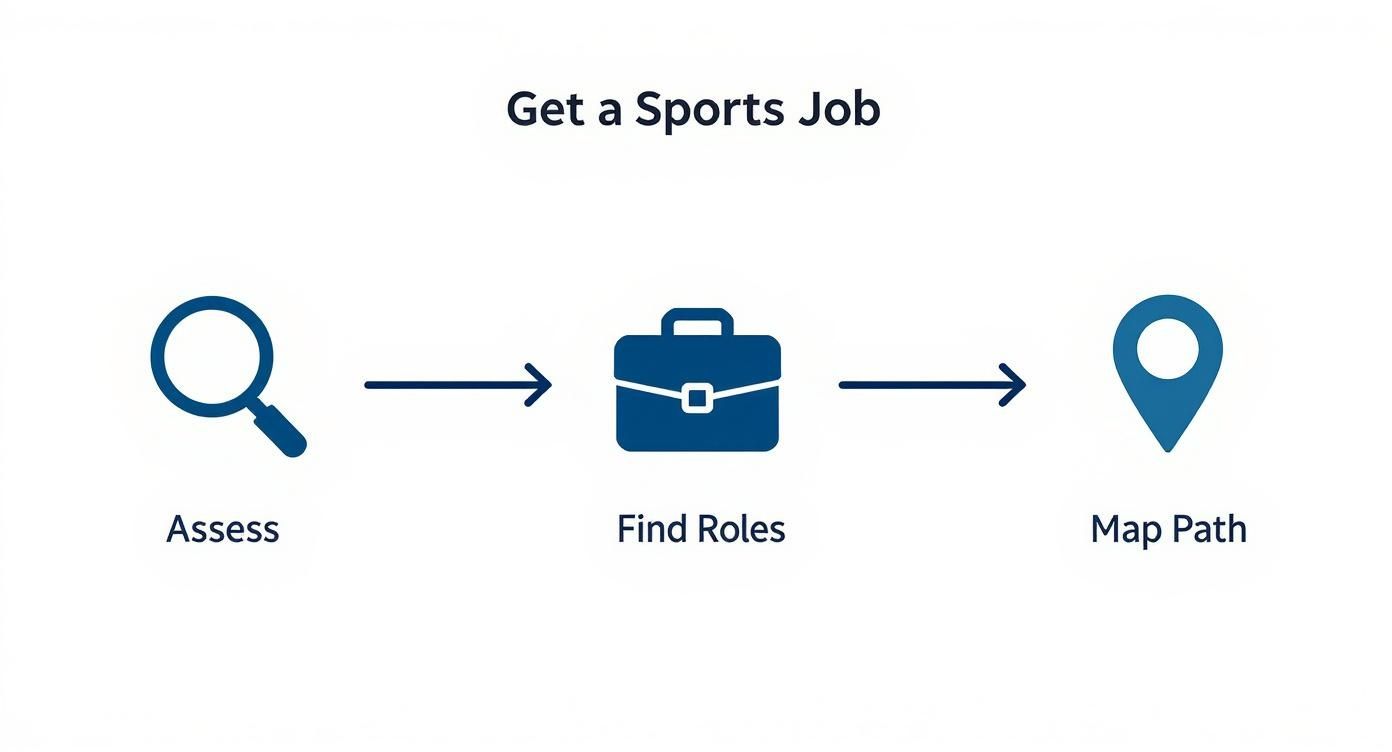
This quick roadmap gives you a high-level view of what it takes to start your career.
Here is a quick overview of the core pillars required to start a career in sports analytics, giving you a clear path forward.
Your Roadmap to a Sports Analytics Career
| Pillar | Focus Area | Key Takeaway |
|---|---|---|
| Technical Foundation | Learn programming (Python/R), SQL, and data visualization tools (Tableau, Power BI). | You must be able to collect, clean, and analyze data effectively. |
| Sports Domain Knowledge | Go beyond fandom. Understand the rules, strategies, and key performance indicators. | Technical skills are useless without the context of the sport. |
| Portfolio of Projects | Create original analyses on public datasets (e.g., player performance, game strategy). | This is your proof of skill and passion, often more important than a degree. |
| Networking & Branding | Engage on platforms like X (Twitter) and LinkedIn. Connect with industry professionals. | Your network can lead to opportunities you'd never find otherwise. |
Breaking into this field is a marathon, not a sprint, but these pillars provide the structure you need to succeed.
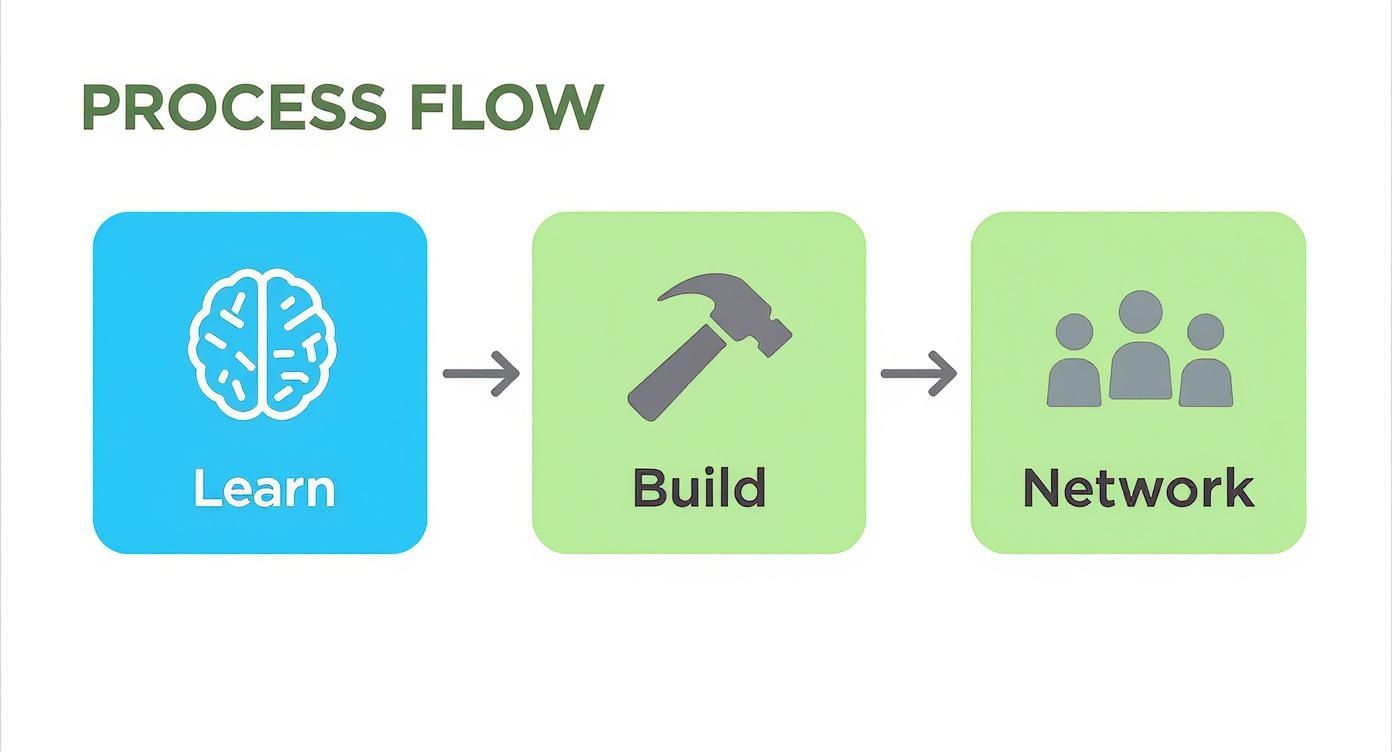
This infographic lays out the simple, three-part process for getting your foot in the door.
As you can see, it all boils down to learning the necessary skills, building a killer portfolio to showcase them, and actively networking to find your opening.
Understanding these market forces and seeing how data directly leads to wins and losses makes it clear: there has never been a better time to figure out how to get into sports analytics. It's one of the few fields where a love for the game and a sharp analytical mind can truly come together to make a difference.
Building Your Technical Toolkit
Passion for the game will get you in the door, but it's your technical skills that will keep you in the room. To really make an impact in sports analytics, you need the right tools to dig into the data and uncover what's really happening on the field or court.
Think of it this way: a great scout has a keen eye, but a great analyst has the tools to prove (or disprove) what that eye is seeing. This section is all about building that workshop—the essential software and skills you'll use every single day. We'll go beyond just listing languages and focus on how they're actually applied in the real world of sports.
Mastering the Core Programming Languages
Your foundation starts with two languages that dominate the data world: Python and R. You'll find die-hard fans of each, but the truth is, being comfortable with both makes you far more valuable.
Python is incredibly popular, and for good reason. It's known for being readable and has a massive ecosystem of libraries ready-made for data science. It's the Swiss Army knife of the analytics world—perfect for everything from cleaning up messy play-by-play data to building sophisticated machine learning models that predict player performance.
R, on the other hand, was built from the ground up by statisticians. If you have a background in academics or research, you might feel right at home here. It's an absolute powerhouse for deep statistical analysis and creating a-grade, publication-ready data visualizations.
My Advice: Don't get stuck trying to become a world-class expert in both languages at once. Pick one to be your go-to, learn its core data science libraries inside and out, and then get a functional understanding of the other. The goal is effectiveness, not just collecting badges.
For whichever one you start with, zero in on these workhorse libraries:
- Pandas (Python): This will be your best friend for data manipulation. You'll use it to handle unruly datasets, merge different sources (like combining play-by-play logs with player tracking data), and get your information ready for analysis.
- NumPy (Python): The backbone for numerical computing in Python. It's essential for working with large arrays of data efficiently and powers many other libraries you'll use.
- dplyr & ggplot2 (R): What Pandas is for Python,
dplyris for R—a grammar for data wrangling that is both powerful and intuitive. Pair it withggplot2, and you can create just about any visualization you can imagine.
Speaking the Language of Databases with SQL
While you'll do your analysis in Python or R, the raw data itself almost never starts there. It lives in a database, and the key to that database is SQL (Structured Query Language).
Knowing SQL is a non-negotiable skill. It's what allows you to bypass the middleman and pull the exact slice of data you need. Without it, you're stuck waiting for someone else to send you a CSV file, which severely limits your ability to explore and ask your own questions.
Imagine a team's database has decades of player stats, contract details, and scouting notes. You'll need to write SQL queries to ask specific questions like, "Show me all left-handed pitchers under 25 with an ERA below 3.50 in home games." That's the power of SQL.
Telling the Story with Data Visualization
Your most brilliant analysis is useless if you can't communicate it to a coach, general manager, or scout. They don't have time to sift through your code or a spreadsheet full of numbers. This is where data visualization turns your findings into actionable strategy.
Tools like Tableau and Power BI are built for this. They let you create interactive dashboards that make complex information easy to digest. You could build a shot chart showing where a basketball player is most effective under defensive pressure or a heat map of a midfielder's movements during a match.
The importance of this software is undeniable. In 2024, the software segment captured the largest market share at 62%, underscoring just how critical these platforms are for sports organizations. And with the industry shifting rapidly to the cloud—projected to be over 80% of the market by 2025—getting comfortable with cloud-based tools is a smart move. You can dig deeper into these trends by reviewing the full sports analytics market research.
This shot from Tableau's gallery is a perfect example of turning raw data into a clear story.
A dashboard like this isn't just a static picture. It's an interactive tool that lets a coach or executive explore the data themselves, spot trends, and find answers visually. That's how you make an impact.
Developing Deep Sports Domain Knowledge
Knowing your way around Python, R, and SQL might get your resume through the first pass, but it's your deep understanding of the sport that will actually land you the job. Technical skills without context are just number crunching. To offer real value, your analysis has to be firmly rooted in the strategic reality of the game.
This is where you make the leap from data scientist to a true sports analyst. Anyone can pull a player's shooting percentage. A real analyst, however, can explain why that percentage changes based on different defensive schemes, offensive sets, or even how much time is left on the clock. It's all about connecting the what (the data) with the why (the action on the field).
Moving Beyond Fandom
Being a die-hard fan is a fantastic starting point, but it isn't enough. You have to learn to watch the game like a strategist, not a spectator. This means you're actively breaking down plays, second-guessing coaching decisions, and spotting the tiny patterns that separate a win from a loss.
A fan sees a stunning goal. An analyst sees the subtle off-ball movement and the defensive lapse that created the opportunity. Getting to that level of insight takes deliberate practice and a whole new way of watching sports.
To start making that shift, dig into these areas:
- Rule Nuances: Go way beyond the basics. Learn the obscure rules that directly impact strategy, like clock management in football or the nuances of substitution limits in soccer.
- Historical Context: Understand how the game has evolved over time. Why did the three-point line completely change basketball? How did sabermetrics transform baseball scouting forever?
- Positional Responsibilities: Get granular on the specific roles for each position. What truly separates an elite center-back from an average one?
How to Cultivate an Analytical Mindset
Building this domain expertise is a constant process of immersion and critical thinking. You have to consume information from the right places and apply an analytical lens to everything you watch. Essentially, you're training your brain to hunt for the underlying drivers of performance.
One of the best ways to do this is to learn the difference between meaningful metrics and "vanity stats." A quarterback throwing for 400 yards looks great in the box score, but if most of those yards came in garbage time when the outcome was already sealed, how much does that stat really tell you about winning?
Your goal is to pinpoint the Key Performance Indicators (KPIs) that have a direct, provable link to winning games. That's the entire point of impactful sports analytics.
To build this expertise, start weaving these habits into your routine:
- Watch Film Like a Scout: Don't just watch the broadcast. Get your hands on "All-22" footage for football or tactical camera views for soccer to see the whole field. Pause, rewind, and break down what players are doing away from the ball.
- Follow Tactical Experts: Find the real experts on platforms like X (formerly Twitter) and in blogs—journalists, former coaches, and niche analysts who offer deep tactical breakdowns. They share insights you'll never hear from a mainstream color commentator.
- Read About Strategy: Dive into books and long-form articles about sports strategy. Understanding concepts like Bill Walsh's "West Coast Offense" or the principles of "Gegenpressing" in soccer gives your data real-world, tactical weight.
Applying Your Knowledge in Practice
As you build this deep sports IQ, immediately start applying it to your portfolio projects. For example, instead of just analyzing a team's overall offensive rating, dig deeper. Analyze their efficiency running specific plays or against certain defensive formations. This is how you prove you can merge technical skill with genuine sports intelligence.
This approach ensures your insights aren't just statistically sound—they're actually useful to a coach or general manager. For more ideas on how analysts are shaping the modern game, check out resources like the GetSportJobs blog for career insights and industry trends. You're not just learning to get a job; you're learning to think like the best in the business.
Creating a Portfolio That Gets You Hired
Your resume might list your skills, but it's your portfolio that proves them. In sports analytics, a strong portfolio is easily the most important asset you can build. It's the tangible evidence that you can take a pile of raw data and turn it into a compelling, insightful story that a front office can actually use.
Think of it this way: a good portfolio moves you from just another name on a list to a serious candidate. It's not just a random collection of projects, either. It should be a curated showcase of your abilities, covering everything from cleaning messy data and running rigorous analyses to creating clear, impactful visualizations. It's your personal highlight reel, designed to catch a recruiter's eye and show them you're ready for the big leagues.
Finding Quality Datasets
Before you can build anything, you need to get your hands on good data. Fortunately, you don't need access to a team's private database to create something impressive. The sports world is full of publicly available datasets just waiting for you to dig in.
Here are a few of my go-to sources for high-quality, free sports data:
- Kaggle: A must for any data scientist. It hosts a massive collection of sports datasets, from NBA player stats to European soccer match events.
- StatsBomb: They offer incredibly detailed event data for multiple soccer seasons for free. This stuff is gold for deep, tactical analysis.
- Basketball-Reference & Pro-Football-Reference: These sites are absolute treasure troves of historical data for the NBA and NFL, perfect for long-term studies.
- GitHub Repositories: You'd be amazed what you can find here. Many analysts and enthusiasts share data scrapers and cleaned datasets. A quick search for something like "[your sport] data GitHub" will often give you exactly what you need.
When you're picking a dataset, think about the story you want to tell. Don't just grab the first one you see. Look for data that's rich enough to let you answer an interesting question and show off multiple skills.
What Makes a Project Stand Out
Simply running a basic analysis and spitting out a few charts won't be enough to get you noticed. A top-tier portfolio project tells a complete story—it has a clear beginning (the question), a middle (the analysis), and an end (the conclusion and visualization).
The best portfolio projects answer a specific, interesting question that a coach, scout, or general manager would actually care about. Instead of "Here are a player's stats," aim for "Here's why this specific metric shows this player is undervalued."
A standout project needs to clearly demonstrate your ability to:
- Clean and Prepare Data: This is a huge part of the real job. Show that you can handle missing values, merge different data sources, and wrestle messy data into a usable format.
- Perform Meaningful Analysis: Use the right statistical tools to uncover genuine insights. Go beyond averages—look for correlations, build predictive models, or find hidden patterns.
- Visualize the Results: Create clean, intuitive charts and dashboards using tools like Tableau, Power BI, or Python/R libraries (like
matplotliborggplot2). - Communicate Your Findings: This is what separates a good analyst from a great one. You have to explain your methodology, what you found, and why it matters in simple, clear language.
Choosing the right project can be tough, but it's all about matching your interests with the skills you want to highlight. Here are a few ideas to get you started.
Sample Portfolio Project Ideas
| Project Type | Core Skills Demonstrated | Potential Sports |
|---|---|---|
| Player Performance Prediction | Machine Learning (Regression), Data Cleaning, Feature Engineering | Basketball, Baseball, Football |
| Interactive Tactical Dashboard | Data Visualization (Tableau/Power BI), UI/UX Design, Data Storytelling | Soccer, Hockey, Basketball |
| Game Outcome Analysis | Statistical Modeling, Hypothesis Testing, Data Exploration | Any team sport |
| Scouting Report Automation | Web Scraping, Data Wrangling (Pandas/dplyr), Reporting | All sports |
No matter which project you pick, remember where the industry is heading. Expertise in AI, machine learning, wearable tech, and real-time video analysis is becoming more and more critical. The steady growth of the sports analytics market signals strong long-term career prospects, making hands-on experience with these tools incredibly valuable.
Presenting Your Work Professionally
Once you've built a few high-quality projects, you can't just throw them in a messy folder of code files. You need to present them professionally, and your main platform for this should be GitHub.
Think of your GitHub profile as your online resume for all things technical. For each project, create its own repository with a detailed README.md file. This file is the project's homepage, and it needs to explain:
- The question you were trying to answer.
- Where you got the data.
- The steps you took in your analysis.
- Your key findings, complete with embedded visualizations.
- A link to any interactive dashboards or web apps you built.
This level of professional presentation makes it incredibly easy for a hiring manager to see your work and, more importantly, understand your thought process. It shows you're not just a coder, but an organized analyst who can communicate effectively. Combining a polished portfolio with a targeted job search on an industry-specific platform is a powerful strategy. A great next step is exploring the latest sports analytics jobs on GetSportJobs to see what roles are out there.
How to Network and Land Your First Role

You've built a solid technical foundation and have a portfolio that proves you can do the work. That's the hard part. Now it's time to shift from building to broadcasting. The final hurdle in breaking into sports analytics is putting yourself out there—marketing yourself, making real connections, and navigating the job market to land that first role.
This isn't just about spamming applications into the void. It's a focused strategy that involves sharpening your professional brand, networking with a purpose, finding the right openings, and absolutely nailing the interview.
Optimize Your Resume and LinkedIn Profile
Before you even think about outreach, you need to get your digital house in order. Your resume and LinkedIn are your storefront, and they need to speak the language of a sports organization, not a computer science class.
The single most powerful change you can make is to shift to a project-first approach. Don't just list your skills; lead with what you've built.
- On Your Resume: Create a dedicated "Projects" section and put it right at the top. For each project, use sharp bullet points to outline the problem you tackled, the tools you used (Python, Tableau, SQL), and the key insight you uncovered.
- On Your LinkedIn: Use the "Featured" section to show, not just tell. Link directly to your best work on GitHub or your personal blog. Your headline shouldn't just be "Data Analyst." Try something like, "Aspiring Sports Analyst | Python, SQL, Tableau | Specializing in Player Performance Modeling."
This small tweak instantly reframes you. You're not just a student; you're an analyst who already delivers results.
Authentic Networking Strategies
Forget about cold-messaging VPs and asking for a job. Real networking in sports analytics is about building genuine relationships by becoming a valuable part of the community. Your goal is to become a familiar name that people associate with smart analysis.
Start by going where the conversations are happening. Platforms like X (formerly Twitter) are massive hubs for the sports analytics world. Follow analysts, data journalists, and front-office folks. But don't just be a bystander—contribute.
The secret to effective networking is to give more than you take. Share your own analyses, add thoughtful comments to other people's work, and ask good questions. That's how you build credibility and make people want to connect with you.
Another great move is attending industry events. Sure, the MIT Sloan Sports Analytics Conference is the big one, but there are dozens of smaller, more accessible conferences and local meetups. Showing up—even virtually—demonstrates your commitment and gives you a priceless chance to meet people face-to-face.
Finding and Applying for Roles
General job boards like LinkedIn and Indeed have their place, but the signal-to-noise ratio can be frustrating. The best opportunities are often on niche platforms that cater specifically to the sports industry, attracting serious employers who are looking for exactly your kind of talent.
One of the most efficient ways to find openings is to use a specialized job board that curates these roles for you. This screenshot, for instance, shows the homepage for GetSportJobs, a platform built to connect talent directly with sports organizations.
Using a focused platform saves you from wading through irrelevant postings. You can also directly view companies hiring in the sports industry on GetSportJobs to build a target list and keep an eye on their open positions.
Acing the Sports Analytics Interview
The interview gauntlet for a sports analytics role is designed to test everything: your technical chops, your sports IQ, and your ability to communicate complex ideas simply. Expect a multi-stage process.
- The Technical Screen: This is the gatekeeper. You'll face a live coding challenge (usually in SQL or Python) or get a take-home assignment. They're just verifying that you can do what your resume says you can do.
- The Case Study: This is where you really get to shine. They'll give you a dataset and a fuzzy problem like, "Analyze our team's defensive efficiency" or "Evaluate this trade target." They're not looking for a single right answer; they're testing your thought process, how you form a hypothesis, and how you present your findings.
- The "Fit" Interview: This is all about your passion and domain knowledge. Be ready to talk about your favorite teams, recent games, and your opinions on industry trends. They need to know you genuinely love the sport and can talk about it intelligently with coaches and scouts.
Honestly, the best prep you can do is to rehearse walking someone through your portfolio projects. If you can clearly explain your methodology and the "so what" of your findings for your own work, you'll be able to do it with confidence when the pressure is on.
Answering Your Top Questions About a Career in Sports Analytics

As you start mapping out your journey into this field, you're bound to have some questions. It's only natural. Getting straight answers to these common queries will help you set realistic expectations and make smarter moves from day one.
Let's dive into some of the most frequent questions I hear from aspiring analysts. Think of this as the practical, no-fluff advice you need to navigate your path with confidence.
Do I Really Need a Specific Degree to Get Hired?
This is easily the most common question, and the answer is probably not what you expect: no, not necessarily. While a degree in a quantitative field like Statistics, Computer Science, or Data Science is a huge plus, it's not a hard-and-fast rule. I've met fantastic analysts who studied economics, business, or something completely unrelated.
What truly matters is your demonstrated ability to work with data. A strong portfolio showcasing your projects will always speak louder than the major listed on your diploma. If you can prove you have the technical chops and a genuine understanding of the sport, hiring managers will pay attention.
That said, a relevant degree provides a structured learning path and a credential that can open doors. Some universities even offer specialized programs, like a dual MBA/MS in Sport Management, that are designed to bridge the gap between the front office and the data science department.
What's a Realistic Starting Salary?
Okay, let's talk money. Your starting salary can swing quite a bit depending on a few key things: where you live, the league you're working for (the NBA pays differently than a minor league baseball team), and your specific skills.
For an entry-level sports analyst job in North America, you can generally expect a starting salary in the $55,000 to $75,000 range. If you're coming in with a master's degree or some serious machine learning skills, you'll likely land on the higher end of that scale. The good news is that as you prove your worth, your earning potential grows fast. Senior analysts at major pro teams can easily command six-figure salaries.
A quick note on this: many people get their first break through an internship, which might be paid hourly or offer a small stipend. The initial pay isn't always glamorous, but the hands-on experience and connections you make are priceless for your long-term career.
Should I Specialize in One Sport or Be a Generalist?
This is the classic specialist vs. generalist debate. When you're just starting, I strongly recommend casting a wide net. Playing around with data from a few different sports builds a broader, more versatile skill set.
For example, the statistical approach for baseball (a game of discrete, individual events) is fundamentally different from analyzing basketball or soccer (fluid, continuous-play sports). Getting experience with both makes you a much more adaptable analyst.
However, as your career moves forward, specializing is where you gain a real competitive advantage. Developing a deep, expert-level knowledge of a single sport allows you to offer insights that are far more nuanced and impactful. Teams aren't just looking for a data scientist; they're looking for a basketball analyst who truly understands the game or a soccer data expert who can see stories in the numbers that others miss.
- Why specialize? You become the go-to expert, your analysis carries more weight, and you build a tight-knit network within that sport's community.
- The downside? It can narrow your job search to one sport, which might be tough if you're tied to a specific location or if jobs in that niche are limited.
A great approach is to start broad to build your core skills, then gradually focus on the sport that you're most passionate about. It really gives you the best of both worlds.
Ready to turn your passion into a profession? GetSportJobs is the premier platform for finding career opportunities in the sports industry, from analytics to operations. Start exploring hundreds of up-to-date job listings from teams, leagues, and brands today by visiting https://www.getsportjobs.com.