Boost Your Job Search: How to Highlight sports in resume Effectively
Let's get straight to it: Should your sports background be on your resume? The answer is a resounding yes, but with a crucial catch—it all comes down to how you frame it. This isn't just about listing your time as a student-athlete or a weekend warrior. It’s about making a strategic move to showcase professional skills like leadership, discipline, and resilience that you honed through sports.
Why Hiring Managers Actually Care About Your Athletic Experience
When a hiring manager scans a resume, they're looking for more than just technical qualifications. They're on the hunt for those intangible traits that signal a great hire: grit, a collaborative spirit, and the ability to stay cool under pressure. Your time on the field, court, or track was a real-world training ground for developing these very qualities.
Think about it. Juggling a demanding training schedule with school or work is a masterclass in time management. If you were a team captain, you weren't just running drills; you were mediating conflicts, boosting morale, and making tough calls in the heat of the moment. These aren't just "sports activities"—they're powerful examples of the leadership and problem-solving skills every company wants.
It's Far More Than a Hobby
Recruiters know that athletes are wired to be coachable, goal-oriented, and incredibly persistent. Through sports, you’ve learned how to take constructive feedback, pivot your strategy after a setback, and grind it out for a long-term goal. These aren't just abstract ideas; they're lived experiences that add up to a killer work ethic.
Think of your athletic career as compelling evidence of your character. It tells a story of dedication, resilience in the face of adversity, and a commitment to a team's success.
Connecting the Dots from the Field to the Office
The trick is to stop thinking of your sports history as a simple pastime. Instead, see it as a unique kind of work experience where you built an arsenal of valuable soft skills.
Here’s how to translate your experience:
- Discipline: Waking up for those 6 a.m. practices isn't just about athletics; it proves you're reliable and committed.
- Teamwork: Executing a complex play with your teammates isn’t just about scoring; it shows you can communicate and collaborate effectively to reach a shared goal.
- Resilience: Shaking off a tough loss and coming back stronger for the next game? That's proof you can handle professional setbacks without losing focus.
When you frame your athletic background this way, you give employers concrete proof of the qualities they're desperate to find. Of course, this is just one piece of the puzzle. It's also smart to understand the full picture of what employers really look for in job candidates, from their skills to their online presence. Taking this holistic view ensures your sports experience enhances, rather than distracts from, your professional story.
Translating Athletic Skills into Business Language
The biggest hurdle isn't just listing your athletic achievements; it's translating them into a language that hiring managers actually speak. Saying you "won the championship" is a great accomplishment, but it doesn't tell a recruiter much about your professional value. The trick is to reframe your sports experience using the vocabulary of the business world.
For example, don't just say you were a "team player." Instead, talk about how you collaborated with a diverse group to hit a common goal under pressure. Juggling team travel, a full course load, and a demanding training schedule? That’s not just being an athlete—that’s project coordination and advanced time management. The hours spent breaking down game film to dissect an opponent's strategy? That’s a perfect example of competitive analysis.
Connect Actions to Corporate Skills
Every single thing you did on the field, court, or track has a direct parallel in the professional world. You just have to connect the dots. The key is to identify the core skill and then use powerful, action-oriented verbs that catch an employer's eye. This is how you close the gap between your life as an athlete and the job you want.
This concept map really brings it home, showing how core traits from sports—leadership, teamwork, discipline—are the foundation for high performance anywhere.
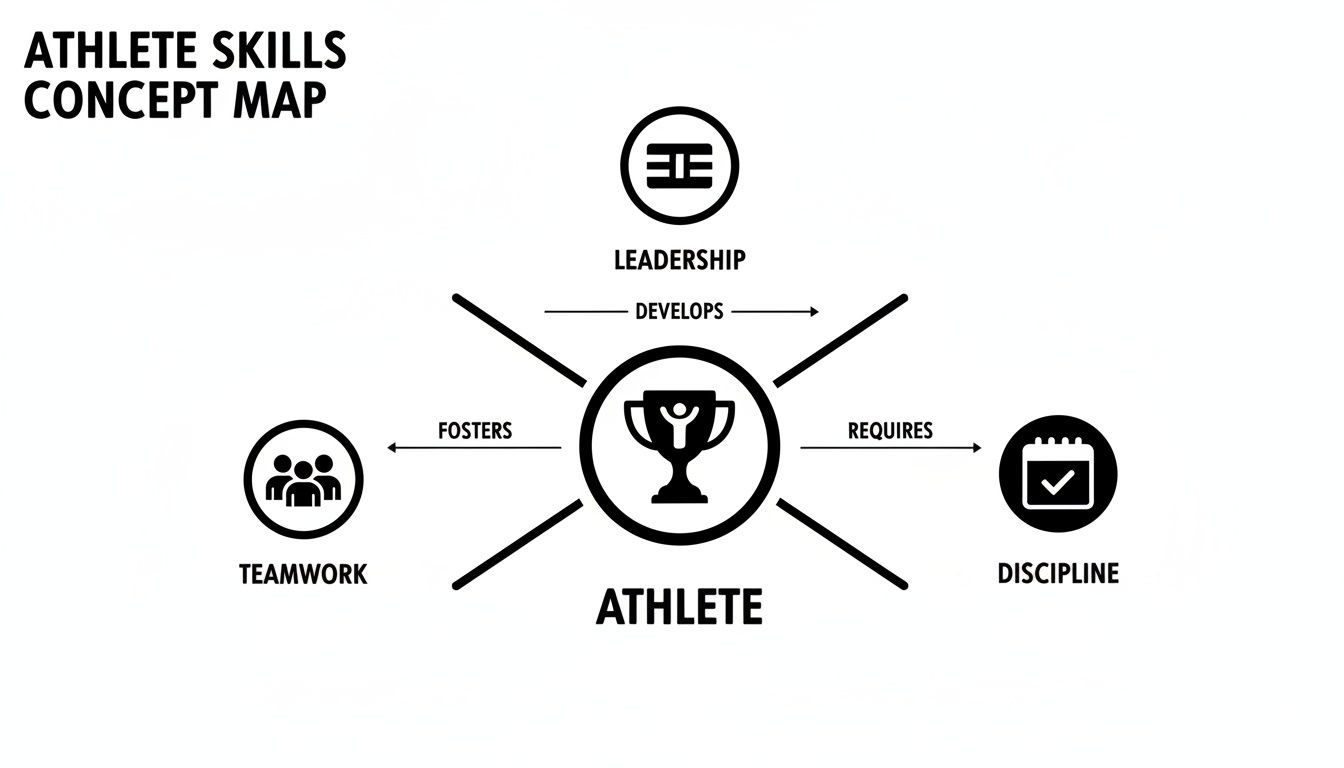
These aren't just personal qualities. They're the building blocks for success in any competitive environment, especially the workplace.
To help you with this translation, I've put together a table that directly maps common athletic roles to professional skills and the exact keywords you should be using.
Mapping Sports Experience to Professional Skills
| Athletic Role / Activity | Demonstrated Professional Skill | Resume Keywords to Use |
|---|---|---|
| Team Captain | Leadership, Motivation, Conflict Resolution | Coordinated, Mentored, Led, Motivated, Mediated |
| Analyzing Game Film | Data Analysis, Strategic Planning | Analyzed, Assessed, Forecasted, Strategized |
| Coordinating Team Travel | Logistics, Project Management, Budgeting | Organized, Scheduled, Managed, Budgeted |
| Scouting Opponents | Competitive Analysis, Research | Researched, Identified, Evaluated, Reported |
| Daily Training Regimen | Discipline, Goal Setting, Time Management | Disciplined, Goal-Oriented, Prioritized, Managed |
| On-Field Communication | Interpersonal Communication, Collaboration | Communicated, Collaborated, Directed, Aligned |
Think of this as your cheat sheet for turning your athletic history into a language that resonates with recruiters. It’s all about showing them you’ve been building these skills for years, just in a different arena.
From the Playbook to the Resume
Alright, let's get practical. How do you actually write this on your resume? It’s all about moving from simply stating what you did to showing the impact you had.
Instead of: "Point guard for the basketball team for four years."
Try this: "Directed on-court strategy and communication for a 15-member team, leading to a 20% improvement in offensive efficiency over two seasons."
Instead of: "Member of the cross-country team."
Try this: "Maintained a rigorous six-day-a-week training regimen, demonstrating exceptional self-discipline and goal-setting that culminated in a top-10 regional finish."
See the difference? The second versions are packed with impact. They use numbers and business-focused language to show a hiring manager exactly what you bring to the table. This is all part of a bigger picture; you can learn more about why tailoring your resume is key to landing your dream job.
Pro Tip: Read the job description carefully and pull out keywords like "collaboration," "leadership," "project management," or "data analysis." Then, mine your sports experience for direct parallels and sprinkle those exact words into your resume. This is crucial for getting past automated Applicant Tracking Systems (ATS).
This strategic translation is what makes your athletic background a secret weapon. In fact, some career analyses show that highlighting these skills can result in a 25% higher hire rate in sports-related fields like coaching and marketing. If you're targeting a role inside the sports industry, it helps to know the landscape. Check out this great resource on https://getsportjobs.com/blog/what-does-a-sports-marketer-do to see how these skills apply directly. This isn't just a nice-to-have; it's a critical step in turning your sports background into a powerful professional asset.
Where to Put Sports on Your Resume
Deciding where to list your athletic background on a resume isn’t a one-size-fits-all call. Where you place it is everything. The right spot ensures your sports experience amplifies your qualifications, rather than feeling like a random, confusing addition. The two biggest factors? Your career stage and the specific job you're chasing.

For recent grads or students just starting out, athletic experience is prime resume real estate. Frankly, it often demonstrates more leadership, discipline, and teamwork than a typical part-time summer job. In that case, your sports background deserves a prominent spot.
For Students and Recent Graduates
If you're at the beginning of your career, your time as an athlete might just be your strongest asset. Don't bury it at the bottom. Give it its own dedicated section to signal its importance.
You could title this section a few different ways:
- Leadership Experience: This is a fantastic option if you were a team captain or held a similar leadership role. It immediately frames your athletic history in a professional context.
- Extracurricular Activities: This is the classic choice, but you can make it punchier by writing achievement-focused bullet points, just like you would for a job.
- Athletic Experience: A simple, direct heading that works perfectly, especially for collegiate athletes applying to companies that recognize the immense dedication involved.
By positioning this section near the top—right after your education—you're telling hiring managers that the skills you honed on the field are core to who you are as a professional. This strategy is especially powerful when you don’t have a long list of internships to fill the page.
For Mid-Career and Experienced Professionals
Once you’ve got a few years of solid, relevant work experience, your strategy needs to change. Your professional accomplishments are now the main event. Your athletic background transitions into a supporting role, adding a layer of depth and personality to your profile.
Featuring it too high up on the page can look like you're resting on old laurels. A more subtle touch is needed here.
For a seasoned professional, sports experience should showcase well-roundedness and timeless traits like grit and teamwork—without overshadowing your hard-earned career wins.
At this stage, you’ll want to weave your sports in resume details into a section near the bottom of the document:
- Additional Information: A great, clean spot for a concise mention. One line is often enough: "Collegiate track and field athlete (long-distance)" or "Completed 5 full marathons."
- Awards and Recognition: If you earned significant honors, like "NCAA Academic All-American," this is the perfect section to give them the weight they deserve.
- Personal Interests: A brief mention here can be a fantastic icebreaker in an interview, showing you have passions and drive outside the office.
For Applicants to Sports Industry Roles
Now, if you're targeting a job within the sports industry, the game changes entirely. Here, your direct experience as an athlete is incredibly relevant and should be featured prominently, no matter where you are in your career.
Hiring managers in sports-related fields get it. They understand the firsthand knowledge and sheer commitment that comes from competing. For these roles, you should almost always create a dedicated "Athletic Experience" section to immediately show you're an insider. If you're looking for inspiration, checking out sports management resume examples can show you how others in the field have done it successfully.
Writing Bullet Points That Showcase Real Impact
Just saying you "Played college soccer for four years" on your resume is a massive missed opportunity. It tells a recruiter what you did, but it says absolutely nothing about the value you brought to the table. If you want your sports experience to actually mean something, you have to turn those simple descriptions into powerful, achievement-focused bullet points.
Think of it like this: a passive statement is just a job duty. An achievement is a result. You weren't just on the team; you were a key part of its success. Your job is to show a hiring manager the real-world impact you had, and the best way to do that is with numbers.
The STAR Method: Your Secret Weapon
A great way to build these impactful bullet points is by using the STAR method. It's a simple framework that forces you to dig deeper and tell the full story behind your contributions.
Here’s the breakdown:
- Situation: What was the challenge or goal? Set the scene quickly.
- Task: What was your specific responsibility in that moment?
- Action: What, exactly, did you do? Start these with strong action verbs.
- Result: What happened because of your actions? This is where you bring in the numbers and make your point.
Let’s walk through a real-world example. Say you were captain of your university's tennis team, and you hit a rough patch mid-season.
- Situation: Our team lost four straight matches, and morale was in the gutter.
- Task: As captain, I needed to get the team fired up again and turn our performance around.
- Action: I set up weekly peer-mentoring sessions, introduced a new pre-match goal-setting routine, and held open meetings so everyone could voice their concerns.
- Result: You could feel the energy shift. We went on to a 5-match winning streak and made it to the conference playoffs for the first time in three years.
Now, let's see how that translates to a resume.
Before: Team Captain for the university tennis team.
After: Mentored and motivated a 12-person team during a critical slump, implementing new goal-setting strategies that directly contributed to a 5-match winning streak and a conference playoff berth.
See the difference? The "After" version screams leadership, strategic thinking, and a clear, impressive outcome. That’s what gets a recruiter’s attention.
How to Find Your Numbers
I get it—finding quantifiable results can feel like the hardest part. But trust me, data is everywhere in sports. For 2025 resumes, it's becoming standard to see athletes integrating performance analytics. You might see a forward listing a "1.9 goals per game average" or a track athlete noting a "10.92s personal best." This trend is even showing up in professional templates on top career sites like MyCVcreator.com.
Even if your stats aren't about direct on-field performance, you can still find metrics. Did you organize a team fundraiser? Mention how much you raised ($5,000). Did you streamline a process? Talk about the efficiency gain (reduced equipment setup time by 20%). Did your new defensive scheme work? Point to the proof (contributed to a 15% reduction in points conceded).
If you’re stuck trying to find the right words or quantify your impact, getting an outside perspective can make all the difference. Tools built for the industry can be a huge help. Try running your resume through a resume analyzer designed for sports professionals to make sure your bullet points are as competitive as possible. Every single bullet point is a new chance to prove you’re the right person for the job.
Common Mistakes to Avoid When Adding Sports
Adding your sports background to a resume can give you a serious edge, but only if you do it right. A few common missteps can easily make what should be a strength look like a distraction. Let's walk through what not to do so your athletic experience helps, not hurts, your chances.

The number one mistake I see is using hyper-specific sports jargon. Trust me, the recruiter reading your resume probably has no idea what a "personal best erg score" in rowing is or why a "double-in, single-out" finish in darts is impressive. Your job is to translate those niche accomplishments into the universal language of business.
Overlooking the "So What" Factor
Another classic pitfall is just listing your achievements without explaining why they matter for the job. Stating you were "MVP in 2022" is great, but it leaves the hiring manager wondering, "So what?" You have to connect the dots for them.
- Before: Named Team MVP for the 2022 season.
- After: Awarded Team MVP for consistently motivating teammates and exceeding performance goals by 25%, demonstrating a commitment to driving results.
See the difference? The second version doesn't just state the award; it highlights the qualities that earned it—motivation and a drive to over-perform. That’s what a sales manager wants to see.
Your resume is a marketing document, not a personal scrapbook. Every single line item, including your sports experience, must answer the recruiter's silent question "So what does this mean for my company?"
Including Irrelevant or Outdated Information
Finally, be ruthless about relevance. That state championship you won in high school was an incredible moment, but if you're a decade into your professional career, it's time to let it go. Focus on recent and significant experiences that show who you are now.
Collegiate sports, coaching roles, or even major recent accomplishments—like training for and finishing a marathon—demonstrate current dedication and discipline. Those are the experiences that still resonate.
As more athletes transition into the corporate world, knowing how to frame your experience is critical. The Bureau of Labor Statistics actually projects a 9% increase in employment for athletes and sports competitors through 2032—way faster than average. By avoiding these common slip-ups, the sports in resume section becomes a powerful asset that makes you stand out. You can learn more about how to position yourself for these opportunities from ResumeBuilder.com.
Answering Your Lingering Questions About Sports on Resumes
Even after you've mapped out a strategy, a few specific questions always seem to come up. It's totally normal. Let's walk through some of the most common sticking points I see, so you can feel completely confident about how you're presenting your athletic background.
Are My High School Sports Still Relevant?
This is probably the number one question I get. If you're a recent high school grad or a college freshman, the answer is a resounding yes. At that stage, your high school sports career is likely one of the most significant, long-term commitments you can show.
But once you have college-level experience—whether that's NCAA sports, internships, or significant projects—it’s time to let the high school glory days go. The focus should shift to more recent and relevant accomplishments.
A good rule of thumb is to stick to your collegiate career and any serious athletic pursuits you've taken on since, like coaching a youth team or running a marathon. For anyone who's been in the workforce for a while, anything older than 10 years probably doesn't belong unless it's uniquely impressive or directly tied to the job you want now.
How Do I Frame This for a Corporate or Tech Job?
Okay, so what if you're not applying for a job in the sports industry? How do you connect your time on the field to a role as a software developer or a financial analyst? It might feel like a stretch, but it's all in the translation.
You can't just list "Varsity Soccer" and expect a hiring manager in finance to get it. You have to connect the dots for them.
- Applying for a tech role? Talk about problem-solving under pressure. Breaking down a complex play is a lot like debugging code—it requires analytical thinking and intense collaboration.
- Aiming for a corporate job? Focus on things like discipline, goal-setting, and pure grit. Frame your experience around hitting targets and, just as importantly, bouncing back when you didn't.
Your athletic background isn't just a hobby or a fun fact. It's the bedrock of your work ethic. It’s hard proof that you have the soft skills—the resilience, the teamwork, the leadership—that are invaluable in any professional setting.
Quick Answers to Last-Minute Doubts
Let's clear up a couple of final details that often trip people up.
Should I list my stats?
Yes, but with context. Don't just throw numbers out there. Show achievement. For example, "Improved free-throw accuracy from 70% to 85% over one season through disciplined, targeted practice." That tells a story of dedication and results.
Should I mention being a team captain?
Always. 100% of the time. "Captain" is a universally understood word for leadership, responsibility, and initiative. It’s one of the clearest and most powerful signals you can send to an employer.
Ready to turn your passion for sports into a career? GetSportJobs is the leading job board connecting talented professionals like you with top opportunities in the sports industry. Find your next role in coaching, marketing, analytics, and more by visiting the GetSportJobs website today.