What Does a Sports Marketer Do? A Guide to Roles and Skills
In a nutshell, a sports marketer is the architect behind the unbreakable bond that ties fans to their favorite teams, leagues, and athletes. They are the ultimate storytellers and business drivers, tasked with transforming raw passion into tangible loyalty and, ultimately, profit. Their mission is a powerful one: create unforgettable experiences, build thriving communities, and keep the revenue flowing.
The Fan Amplifier: What a Sports Marketer Really Does
Think of a sports marketer as a "fan amplifier." Their job is to take the electric energy of a last-second touchdown or a championship win and channel it into measurable business results. It’s about so much more than just selling tickets and jerseys; it's about building a brand that fans feel a deep, personal stake in.
They are the crucial link between the action on the field and the business strategy off it. Every sports organization, from a major league franchise to a college athletics department, is a complex business. They need a steady stream of income from sponsorships, ticket sales, media rights, and merchandise to survive and thrive. The marketer sits right at the center of making that happen.
Core Responsibilities and Objectives
The life of a sports marketer is a dynamic blend of creative energy and sharp analytical thinking. They are always digging into what makes fans tick and figuring out how to turn that emotional connection into real engagement.
This means their day-to-day work often revolves around a few key areas:
- Brand Promotion: Shaping and sharing the team's or athlete's public image across every platform imaginable.
- Sponsorship Acquisition: Finding and securing corporate partners whose dollars are essential for the organization's financial health.
- Event Marketing: Packing the stands and getting eyes on screens for every game and special event through smart, targeted campaigns.
- Fan Engagement: Creating and nurturing a loyal community through social media, fan clubs, exclusive events, and other loyalty initiatives.
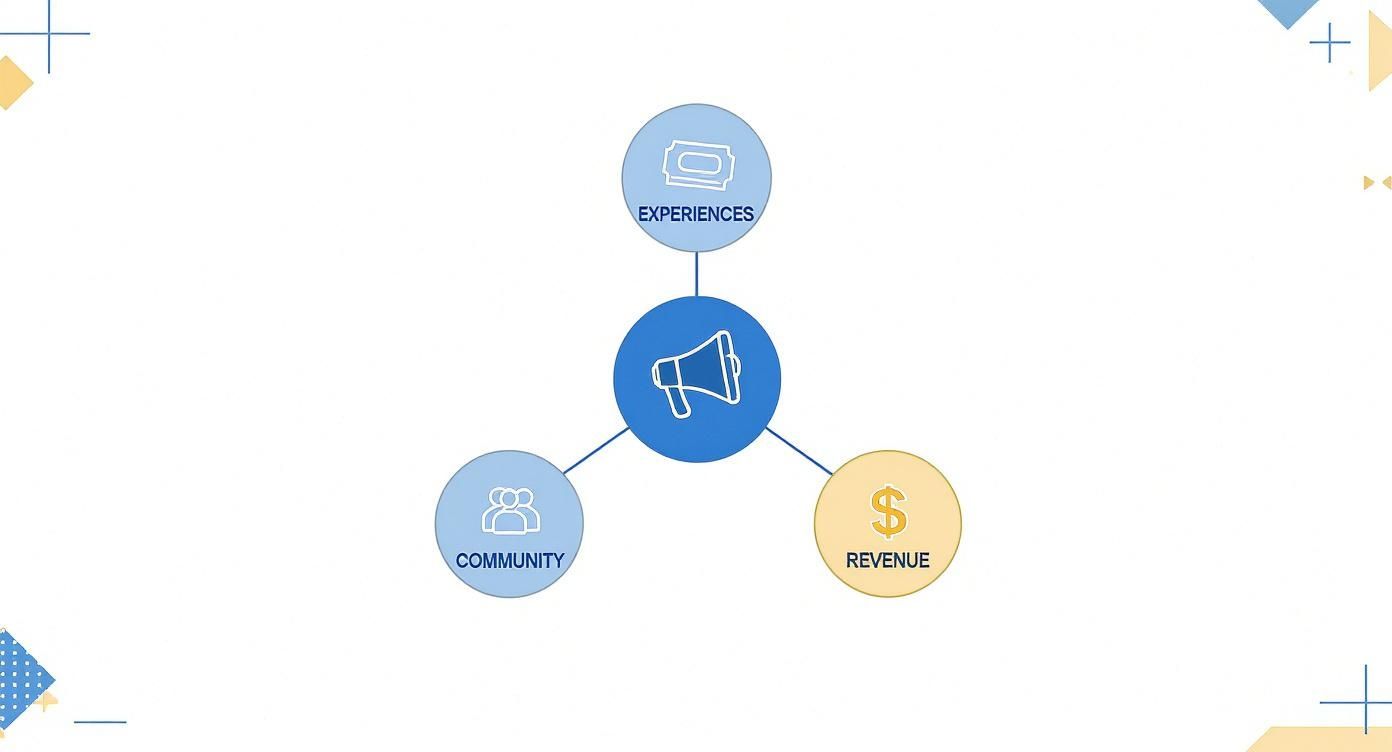
As you can see, every marketing activity ultimately drives toward one of three goals: creating better fan experiences, fostering a stronger sense of community, or increasing revenue. A huge piece of this puzzle is getting to know the fanbase on a deep level. Mastering the art of identifying target audiences is a critical first step that informs every single marketing decision that follows.
To put it all together, here’s a quick overview of what a sports marketer is responsible for.
Core Functions of a Sports Marketer at a Glance
| Core Function | Primary Objective | Key Activities |
|---|---|---|
| Brand Management | Build a strong, positive public image | Creating ad campaigns, managing social media, content creation |
| Fan Engagement | Foster a loyal and active community | Running loyalty programs, organizing fan events, interacting on social media |
| Revenue Generation | Drive income through multiple streams | Selling sponsorships, promoting ticket sales, launching merchandise |
| Event Promotion | Maximize attendance and viewership | Marketing game days, creating promotional events, media buying |
Ultimately, these functions all work together, creating a cycle where exciting fan experiences lead to a stronger community, which in turn drives the revenue needed to keep the whole operation going.
A Look Inside a Sports Marketer's Playbook
So, what does a sports marketer actually do all day? To get a real sense of the job, we need to peek behind the curtain and move past the big-picture ideas. The role isn't just about coming up with flashy promotions; it’s about the nitty-gritty of planning, executing, and analyzing every move to turn raw fan passion into tangible results for the business.
Think about a marketer for a major league team whose big project is the annual season ticket drive. This is way more than just sending out a "buy now" email blast. It's a full-scale operation, planned out months in advance. Their playbook involves slicing up the audience—from the die-hard fans who renew every year without fail to the casual followers who only come to a few games—and hitting each group with a message that speaks directly to them.

Planning and Executing Campaigns
At its heart, a sports marketer's job is all about campaign management. This is the process of taking a clear goal, like "boost attendance by 10%," and building a step-by-step strategy to make it happen.
Every successful campaign follows a few key stages:
- Defining the Goal: First things first, what's the objective? Is it selling tickets, moving more merchandise, or getting more eyes on TV for a specific game?
- Segmenting the Audience: Who are we trying to reach? You have to know if you're targeting families looking for a weekend outing, college students on a budget, or corporate clients needing to entertain.
- Choosing the Channels: Once you know who you're talking to, you have to figure out where to find them. This could mean running social media ads, buying local radio spots, sending targeted emails, or creating fun in-stadium promotions.
- Developing the Creative: This is where you work with designers and writers to create ads, videos, and slogans that grab a fan's attention and make them feel something.
- Launching and Monitoring: Finally, you push the campaign live and watch the data like a hawk, ready to make adjustments on the fly to get the best results.
A campaign to hype up a championship game is going to feel completely different from one promoting a standard mid-season matchup. A great marketer has to be nimble enough to switch gears and think strategically for both.
Managing Budgets and Media Buys
A huge piece of the puzzle is managing some seriously big advertising budgets. A sports marketer is responsible for planning and buying media placements that get the most bang for the buck. The numbers are staggering—in the first quarter of 2025 alone, sports media ad spend jumped by 14.7% compared to the previous year.
Four major players—the NFL, NCAA Basketball, the NBA, and NCAA Football—ate up 87.4% of that spending, which shows you just how much marketers have to focus on the major leagues. While TV still dominates, capturing 84.1% of the ad budget, digital is catching up fast. College sports, for example, saw a +29.9% explosion in digital ad spending. You can dig deeper into these 2025 sports media spending trends on Guideline.ai.
A sports marketer must be both a creative visionary and a shrewd financial steward. They decide how to allocate millions of dollars, balancing the broad reach of traditional TV with the targeted precision of digital advertising to ensure every dollar works as hard as possible.
Activating Sponsorships and Creating Content
Getting a company to sign a sponsorship deal is just the start. The real magic happens in sponsorship activation—the art of turning a simple logo on a jersey into an experience that fans actually remember and enjoy. This is where a marketer’s creativity really gets to shine.
Let's say a local car dealership sponsors the team. A savvy marketer might:
- Set up a "Test Drive for Tickets" event right at the stadium.
- Create a "Fan of the Game" segment on the jumbotron, presented by the dealership.
- Launch a social media contest where fans share photos with their cars to win cool prizes.
Activations like these make the partnership feel genuine and add real value for the fans. On top of that, marketers are non-stop content machines. They're always churning out videos, graphics, and stories to keep fans hooked all year long, even when the final whistle has blown and the off-season begins.
The Skills That Set Great Sports Marketers Apart
To truly succeed as a sports marketer, you need a special blend of sharp, analytical skills and pure creative firepower. It’s one thing to love the game, but it's another thing entirely to understand the business that fuels the passion on the field or court. The best in this business have a balanced toolkit, mixing technical know-how with the kind of strategic thinking that builds real connections.
You have the "hard skills" on one side—the tangible, teachable abilities that let you run a campaign and prove it worked. Think of these as the fundamental plays in your playbook. Without them, even the most brilliant idea is just an idea.

Then there are the "soft skills." If hard skills are the engine, these are the steering wheel and the driver's intuition. These are the qualities that help you navigate the high-stakes, emotional, and often unpredictable world of sports.
Here’s a breakdown of the skills that really matter when you're building a career in this field.
Essential Skills for a Career in Sports Marketing
| Skill Category | Specific Skill | Why It's Important |
|---|---|---|
| Technical (Hard Skills) | Data Analysis | You need to read the story the numbers are telling—from fan engagement metrics to sponsorship ROI—to make smart, data-backed decisions. |
| Technical (Hard Skills) | Digital Marketing | SEO, social media ads, and email campaigns are your direct lines to the fans. Knowing how to run a targeted Instagram campaign is just as vital as a TV spot. |
| Technical (Hard Skills) | Budget Management | Managing promotional budgets, often in the millions, requires a steady hand. You have to make every dollar count to maximize impact and prove value. |
| Technical (Hard Skills) | Content Creation | From a compelling tweet to a press release or video script, your writing and communication must be clear, sharp, and perfectly on-brand. |
| Strategic (Soft Skills) | Storytelling | This is the magic. It's the ability to weave a narrative around a team or player that pulls fans in emotionally and gives them a reason to believe. |
| Strategic (Soft Skills) | Negotiation | Securing major sponsorship deals is all about building relationships and finding that perfect win-win for your organization and its partners. |
| Strategic (Soft Skills) | Adaptability | The sports world changes in a heartbeat. A star player's injury or a viral social media moment means you have to pivot your entire strategy on a dime. |
| Strategic (Soft Skills) | Creativity | In a world saturated with content, you have to think differently. The best campaigns are the ones that break through the noise and create genuine buzz. |
As you can see, it's the combination of these skills that truly defines a top-tier sports marketer. One side without the other just doesn't work.
"A great sports marketer connects with fans on an emotional level. They don't just sell tickets; they sell belonging, excitement, and identity. This requires a deep understanding of human psychology and storytelling."
This ability to build that emotional bridge is what separates the good from the great. It’s what turns a casual viewer into a lifelong, die-hard fan.
Mastering both sides of this equation is the key to a long and successful career. If you want to get a more detailed look at what employers are searching for right now, check out these in-depth sports marketing job requirements for 2025 and get ready for your next big move.
How Sports Marketers Drive Revenue with Partnerships
Sponsorships are the lifeblood of the sports industry, and sports marketers are the ones who make those deals happen. They’re responsible for building and managing the lucrative partnerships that keep teams, leagues, and events running. This isn't just about slapping a logo on a jersey; it’s about forging powerful business relationships that benefit everyone involved.
The first step is playing matchmaker. A sharp sports marketer hunts for brands whose audience and values mirror their own. A family-focused team, for instance, isn’t going to partner with a hard liquor brand. Likewise, a league built around an edgy, youth-centric sport probably won’t team up with a stuffy, old-school bank. Authenticity is everything.
From Pitch to Partnership
Once they’ve found a potential match, the marketer gets to work crafting a killer pitch. This is way more than a simple sales deck. It's a full-blown business proposal showing exactly how a partnership will deliver a real return on investment. They'll use hard data to prove how the brand can connect with a passionate, dedicated fanbase and hit its own targets, whether that's driving sales or just building a better public image.
Getting these deals across the finish line is a tough negotiation, often involving multi-year contracts, long lists of assets, and major financial stakes. The marketer has to lock in terms that are great for their organization while making sure the partner feels like they’ve made a brilliant investment. The financial side of these partnerships is a massive part of the sports business, which we dive into in our guide to understanding finance in sports.
Activating the Sponsorship for Maximum Impact
Signing the contract is really just the beginning. The real creativity kicks in during sponsorship activation, which is where a marketer brings the partnership to life for the fans. This is the work that turns a simple logo on a banner into a memorable, engaging experience.
A great sponsorship activation doesn't feel like an advertisement. It adds value to the fan's day, making the sponsoring brand an organic part of the excitement and community of the sport.
For example, a marketer might come up with ideas like:
- An interactive fan zone at the stadium sponsored by a tech company, where fans can try out new gadgets.
- A "Hero of the Game" segment presented by a local hospital, shining a spotlight on community leaders.
- A viral social media challenge where a snack brand gives away freebies every time the home team scores.
These activations create positive feelings and ensure the partnership is a win for the team, the sponsor, and most importantly, the fans. Managing this constantly expanding sponsorship market is a core part of what a sports marketer does. In North America alone, PwC projects sports sponsorship will hit $115 billion in 2025, as marketers cook up new ways to integrate partners, like the NFL’s ‘Watch & Bet’ feature.
Building Fan Communities in the Digital Age
Let's be real: today’s game doesn't end with the final buzzer. It lives on in social media feeds, group chats, and forums where fans debate every play. The roar of the crowd has gone digital, and a huge part of a sports marketer's job is to be the architect of that online world, keeping the energy going 24/7.
The goal is to turn someone who just watches the game into a true member of the tribe. It's about creating a non-stop conversation that makes every single fan feel like they're part of the team, long after the lights go out in the stadium.
From Content Creation to Conversation
To pull this off, a sports marketer's toolkit has to be diverse. They're the ones crafting the content that speaks the unique language of their fanbase, making sure the team’s voice feels genuine and exciting on every platform.
This isn't just about posting scores. It's a full-on strategy that includes:
- Real-Time Engagement: When the game is on, they’re in the trenches—live-tweeting highlights, dropping instant reactions on Instagram, and stoking the fire of the conversation. They turn a passive viewing experience into a massive, interactive watch party.
- Exclusive App Content: The team app is a direct line to your most die-hard supporters. Marketers load it up with behind-the-scenes videos, early ticket access, and exclusive stories you can't get anywhere else. It’s the ultimate insider pass.
- Viral Campaigns: They’re the masterminds behind those clever social media challenges, memes, and hashtag campaigns that get everyone talking and sharing. This is how a team’s brand explodes beyond its existing followers.
A core part of this work involves deploying smart strategies for building online communities that build true loyalty and keep fans coming back for more.
Using Data to Personalize the Fan Experience
Data is the modern sports marketer’s secret weapon. By tracking how fans interact with the team's website, app, and social media, they can ditch the one-size-fits-all approach. Instead, they craft personalized messages that make every supporter feel like a VIP.
This isn’t just for fun; it’s a massive revenue driver. The market for these digital fan experiences and related e-commerce is set to grow at a compound annual growth rate of 5.2% through 2030. Marketers use analytics to fine-tune everything from suggesting the perfect jersey in the online store to sending a targeted offer for upcoming tickets.
They also have to stay on top of how people watch sports. For example, the number of fans over 50 using streaming services jumped by 21% in just two years. That's a huge shift, proving that marketers have to design experiences for every fan, on every platform. You can learn more about the latest sports marketing trends from Taboola.
By making digital engagement a cornerstone of the business, sports marketers create a powerful, profitable connection with fans that drives everything from merchandise sales to season ticket renewals.
How to Launch Your Sports Marketing Career
Ready to turn your love of the game into a full-time career? Fantastic. But breaking into the competitive world of sports marketing isn't just about being a fan; it takes a smart game plan. You need to combine the right education with the kind of hands-on experience that makes a resume impossible to ignore.
Your journey starts with a solid educational foundation. A degree in marketing, communications, or business is a great place to start. But if you really want an edge, look into a specialized degree in sports management. These programs are built to teach you the specific business principles that make the sports world go 'round, from ticket sales and sponsorships to fan engagement strategies.

Gain Hands-On Experience
Textbooks teach you the theory, but the real learning happens in the trenches. In this industry, internships aren't just a nice-to-have; they're your ticket to the show. This is where you apply what you've learned, build your network, and prove you have what it takes to thrive in a fast-paced environment.
Look for opportunities everywhere you can.
- Professional Teams: Getting inside a major or minor league team gives you a front-row seat to a large-scale marketing machine.
- Collegiate Athletic Departments: Don't sleep on college sports. They're a massive business and a perfect place to learn everything from digital media to event management.
- Sports Marketing Agencies: Working at an agency exposes you to a wide range of clients and campaigns, which rapidly broadens your skillset.
And don't just wait for a paid internship to appear. Volunteer to help out at a local marathon, a youth sports tournament, or a charity golf outing. Any experience is good experience, and it all helps you get your foot in the door and start making connections.
Build a Portfolio That Shines
Think of your portfolio as your personal highlight reel. It's tangible proof that you have the skills to deliver results. Even if you're just starting out, you can build a collection of work that showcases your drive and creativity.
Your portfolio should tell a story of your passion and creativity. It’s your chance to show a hiring manager what you can do before you even sit down for an interview.
Start creating your own projects right now.
- Develop Spec Campaigns: Pick your favorite team and build a complete marketing campaign for them. Mock up social media graphics, write compelling ad copy, and outline a full promotional strategy.
- Launch a Sports Blog or Social Channel: Start a blog or an Instagram account dedicated to the business of sports. Analyze marketing campaigns you see or create engaging content for a team you follow. This shows off your writing chops, industry knowledge, and creative thinking.
- Offer Your Skills Locally: Find a small local club or team and offer to run their social media or help with game-day promotions for free. This gives you real-world results you can point to.
The path to a career in sports is a marathon, not a sprint. For a more detailed playbook, check out our guide on how to get into sports and learn the essential steps for breaking into the industry.
Ready to make your move? GetSportJobs is your dedicated resource for finding the perfect role. We connect talented professionals like you with top opportunities at teams, leagues, and brands across the industry. Start browsing hundreds of job listings today and land your dream job at https://www.getsportjobs.com.