How to Showcase sports on resume to land your next job

Tossing your sports background onto your resume can be a total game-changer, but only if it actually makes sense for the job you want. If you're fresh out of college or aiming for a career in the sports industry, your athletic experience can be a goldmine of soft skills. But if you're a seasoned pro in an unrelated field? It might just be noise.
Deciding if Sports Belong on Your Resume
The real question isn't can you list sports on your resume—it's should you. And the answer is always: it depends. You have to think strategically about where you are in your career, the specific role you're targeting, and what your time on the field or court actually says about you as a professional.
For a recent grad with a thin work history, being a college soccer captain is a fantastic way to showcase leadership, discipline, and time management. It fills a potential experience gap with solid proof of your abilities. We're not just guessing here; global data backs this up, showing that athletes often develop top-tier workplace skills. For instance, a meta-analysis covering 47 countries identified soccer as the world's most popular team sport, known for building the exact collaboration and leadership traits that employers hunt for. You can dig into the global popularity of sports from this research if you're curious.
Team Sports Versus Individual Pursuits
The type of sport you played also sends a distinct message. Team sports—think basketball, volleyball, or hockey—are a dead giveaway that you know how to collaborate, communicate, and work towards a shared objective. To a hiring manager, that’s compelling evidence you’ll be a great fit in a team-oriented office.
On the flip side, individual sports like marathon running, swimming, or tennis tell a different, yet equally powerful, story. They scream self-discipline, resilience, and a powerful internal drive to hit your goals. For a job that requires a lot of autonomy and grit, this can be an incredibly effective way to make your case.
Key Takeaway: Don't just list the sport. Think about what it says about you. Are you a team player from your soccer days? A resilient problem-solver from your marathon training? Match those traits directly to the skills the job description is calling for.
This quick decision tree can help you figure out if your athletic background is a good fit for the specific job you're chasing.
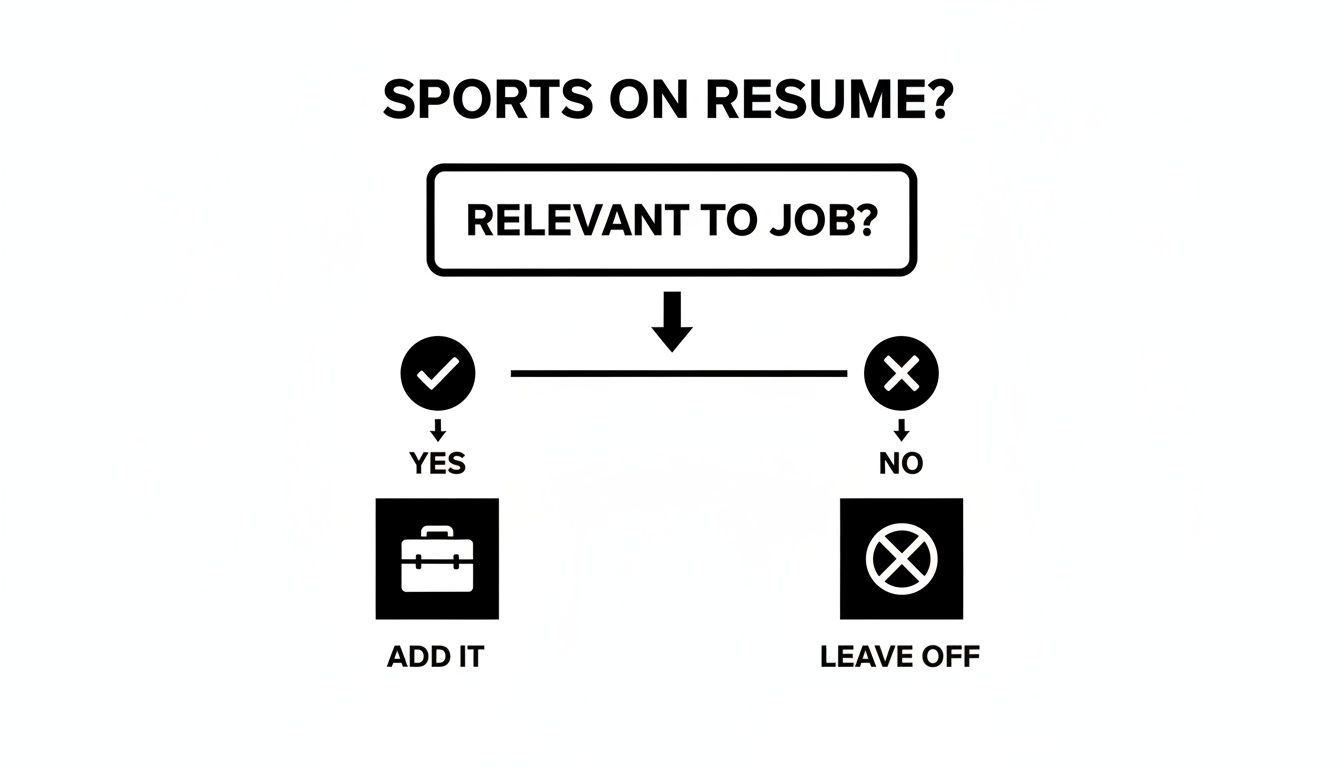
Ultimately, it boils down to this simple rule: if your sports experience provides concrete evidence of skills the employer values, put it on. If not, save the space for something more relevant.
Use this quick-reference table to help you decide if including sports is the right move for your specific situation.
Quick Guide: When to Add Sports to Your Resume
| Your Career Stage or Situation | Our Recommendation | The Strategic Advantage |
|---|---|---|
| Recent Graduate | Absolutely. Place it in an "Activities" or "Leadership" section. | Fills experience gaps by showcasing key soft skills like teamwork, discipline, and leadership that you haven't yet demonstrated in a professional setting. |
| Career Changer | Maybe. Include it if the skills directly transfer to the new industry. | Helps bridge the gap between your old career and new one by highlighting versatile skills like perseverance, strategic thinking, or coaching abilities. |
| Experienced Professional (Unrelated Field) | Probably not. Unless the company culture is very sport-centric. | Your professional achievements should speak for themselves. Adding sports can feel irrelevant and take up valuable space. |
| Applying to a Sports-Related Job | Yes, definitely. Feature it prominently in your experience or a dedicated section. | It shows genuine passion and firsthand knowledge of the industry, whether it’s in marketing, management, or sports medicine. It's a non-negotiable. |
| Minimal Work Experience | Yes. It acts as a substitute for professional experience. | Much like for a recent graduate, it's your best proof of responsibility, commitment, and your ability to work with others. |
Deciding what to include on a resume is all about making strategic choices that paint the best possible picture of you as a candidate. Think of your athletic history as just one more tool in your toolbox to get that done.
So, Where Does Your Athletic Experience Actually Go?

Okay, you’ve decided to put your sports background on your resume. Smart move. But now for the tricky part: where does it belong? Don't just slap it on anywhere. Where you place this information tells a recruiter a lot about how you see its value in a professional setting.
Think of it like this: the best spot depends entirely on your career stage, the specific job you're chasing, and how closely your on-field skills match the job description. The goal is to make it feel like a natural, essential part of your story, not an afterthought.
As Part of Your Professional Experience
This is a power move, but it’s not for everyone. You should only list your athletic career under "Professional Experience" if you're targeting a role directly within the sports industry. Think coaching, sports marketing, team operations, or athletic administration.
In these cases, your time as a serious athlete isn't just a hobby—it's highly relevant work experience. A former college basketball captain applying to be an assistant coach? Absolutely. That experience should be front and center, framed with achievements and responsibilities just like any other job. You'd focus on leadership, strategic planning, and mentoring—all core coaching duties.
In a Dedicated "Leadership" or "Activities" Section
This is the go-to strategy for most people, especially recent grads or anyone whose professional work history is still a bit light. Creating a separate section with a title like “Leadership & Activities,” “Athletic Achievements,” or even “Competitive Experience” works beautifully.
Why is this often the best approach? It gives your athletic accomplishments the spotlight they deserve without making them compete with your paid work experience. It’s a clean, organized way to show recruiters you’re a well-rounded candidate who has honed skills like teamwork, discipline, and grit outside a typical 9-to-5.
Here's what that might look like:
- Leadership & Activities
- NCAA Division I Soccer, Team Captain | 2020–2024
- Led a team of 25 athletes, cultivating a collaborative culture that led to a conference championship appearance.
- Coordinated with coaching staff and the athletic department to manage complex training schedules and team logistics.
- NCAA Division I Soccer, Team Captain | 2020–2024
In Your Summary or an "Interests" Section
A third, more understated option is to weave your athletic background into other areas of your resume. If that competitive fire is a core part of who you are professionally, a quick mention in your resume summary can set a powerful tone from the very top. Something like, "Former collegiate athlete with a proven history of exceeding aggressive sales targets."
For seasoned professionals where sports are less central to their career narrative, a simple line in an "Interests" or "Additional Information" section at the bottom works just fine. "Interests: Marathon Running, Competitive Cycling" can be a fantastic icebreaker in an interview and subtly communicates your drive and high-energy personality.
Before you hit send, it's always a good idea to get a second opinion. Running your resume through a purpose-built tool like a sports on resume analyzer can give you critical feedback, ensuring every section is polished and positioned for maximum impact.
Placement Pro Tip: A simple rule of thumb: the more relevant your athletic skills are to the job, the higher up they go. For a sales role valuing grit and competition, a prominent “Athletic Achievements” section is a huge asset. For a software engineering role, a quick mention under “Interests” is probably all you need.
Turning On-Field Wins into Professional Value

Here’s a hard truth: simply putting “Varsity Soccer Player” on your resume doesn’t cut it. To a recruiter sifting through a pile of applications, that title is just noise. It doesn't tell them anything about what you can actually do for their company.
Your job is to connect the dots for them. You need to translate your athletic achievements into the language of business—showing how the skills you learned on the field directly apply to the professional world. It’s about moving beyond just participating and focusing on the impact you made. Every bullet point should answer the hiring manager's silent question: "So what?"
From Generic Titles to Compelling Accomplishments
Think like a hiring manager for a moment. They're on the hunt for specific traits: leadership, discipline, strategic thinking, teamwork, and the ability to perform under intense pressure. Your resume is the perfect place to provide cold, hard evidence that you have them.
A great way to structure this is to adapt the classic STAR method (Situation, Task, Action, Result) to your sports background. It’s a bulletproof framework for adding real substance to your experience.
- Situation: What was the context? (e.g., "Our team’s defensive line consistently struggled with communication.")
- Task: What was your role in fixing it? (e.g., "As team captain, I took charge of improving our on-field coordination.")
- Action: What did you actually do? (e.g., "I organized weekly film reviews and led new drills focused on defensive formations.")
- Result: What was the measurable outcome? (e.g., "This led to a 20% drop in goals allowed per game for the season.")
See how that transforms a vague claim into a powerful example of leadership and problem-solving? You're giving the recruiter a tangible story of your capabilities. For more ideas on how to frame these points, these sports management resume examples are a fantastic resource for showcasing transferable skills.
Put Numbers on the Board
Numbers are your best friend on a resume. They’re eye-catching, they add instant credibility, and they prove you’re results-oriented. You don’t need a degree in analytics to do this—just think about the tangible impact you had.
Here are a few ways to quantify your athletic experience:
- Team Performance: "Key contributor to a 15-win season, marking the program's best record in over a decade."
- Leadership & Mentorship: "Mentored 5 rookie players, which contributed to a 10% increase in team retention from the previous year."
- Discipline & Time Management: "Balanced a demanding 20+ hour weekly training schedule with a full course load to maintain a 3.5 GPA."
- Initiative & Fundraising: "Spearheaded a team fundraiser that brought in over $5,000 for new training equipment."
This isn’t just for team sports, either. Individual pursuits speak volumes about your character. Listing fitness activities like running can signal to an employer that you’re a disciplined, health-conscious person. With sports like pickleball exploding by 51.8% in 2023, there's a growing awareness of the dedication these activities require. In fact, a 2022 study showed that athletic experience on a resume can even lead to 22% higher salaries in sales jobs because it signals grit and endurance.
Instead of a generic "Dedicated runner," try something like, "Completed 5 half-marathons, demonstrating a commitment to long-term goal setting and personal discipline." For a deeper look at what's trending, the latest sports participation trends from SFIA are worth a read.
The Bottom Line: Frame your athletic career as a story of professional growth. Use strong action verbs, back up your claims with numbers, and always focus on the results. Show them you weren't just playing a sport—you were building the skills to succeed.
Tailoring Your Sports Experience for Different Industries
Your time as an athlete isn't just one static fact on your resume. Think of it as a multi-faceted asset you can shape to fit the job you’re chasing. The way you describe your experience on the field should change dramatically whether you're applying to a corporate sales team, a fast-paced tech startup, or a front-office job with a pro team.
The secret is to stop thinking about what you did and start focusing on what it means to that specific employer.
A generic, one-size-fits-all approach is a recipe for getting your resume tossed. You have to tailor your resume to the job posting if you want to stand out. This means digging into the job description, identifying the skills they’re really looking for, and then connecting the dots back to your athletic career.
For Roles Within the Sports Industry
When your goal is a job in sports, your athletic background is no longer just a source of transferable skills—it's direct, hands-on industry experience. This is your home turf, and your resume needs to show it. Hiring managers here want people who get the game, the locker-room culture, and the relentless pressure to win.
- What to emphasize: Your deep, practical knowledge of the sport, tactical insights, and any direct involvement in team operations, logistics, or management.
- Example for a Team Operations role: "Collaborated directly with coaching staff to break down game film and build weekly strategic plans, contributing to a 12-win season and a conference championship appearance."
This is the place to let your expertise shine. Use the right terminology and highlight achievements that prove you're not just a fan, but an insider. To get a better feel for the opportunities out there, take a look at our guide on careers with sports teams.
For Corporate and Sales Positions
In competitive fields like sales, finance, or business development, recruiters are on the hunt for people with grit, resilience, and a fire to hit their targets. Your sports career is a goldmine of evidence for exactly these traits. The trick is to translate your on-field performance into the language of business results.
- What to emphasize: Goal-setting, mental fortitude, performing under pressure, and—most importantly—quantifiable results. Metrics are your best friend here.
- Example for a Sales role: "Consistently surpassed personal performance goals, finishing in the top 10% of conference athletes for scoring average by committing to a rigorous, data-driven training regimen."
For Tech and Creative Fields
It might seem like a stretch to connect your time on the basketball court to a software development job, but the links are stronger than you think. Industries like tech and creative marketing are built on intense collaboration, quick problem-solving, and disciplined project execution. Sound familiar?
The key is to frame your experience around teamwork, process, and adaptation.
- What to emphasize: Agile thinking, working within a team to execute a shared strategy, and adjusting the game plan on the fly.
- Example for a Project Manager role: "As team captain, communicated and adapted offensive plays in real-time based on competitor positioning, leading to a 15% increase in successful possessions over the season."
To make this translation process easier, you need to speak the recruiter's language. Your raw athletic skills need to be rephrased as the professional competencies they're looking for.
Translating Sports Skills to Professional Keywords
| Athletic Skill or Experience | Professional Competency | Suggested Resume Keyword |
|---|---|---|
| Serving as Team Captain | Leadership & Management | Leadership, Mentorship, Team Building |
| Analyzing Game Film | Strategic Planning & Analysis | Data Analysis, Strategy, Performance Metrics |
| Enduring a Long Season | Resilience & Perseverance | Tenacity, Goal-Oriented, Time Management |
| Juggling Academics & Athletics | Discipline & Prioritization | Disciplined, Work Ethic, Organizational Skills |
| Competing Under Pressure | Grace Under Fire | High-Stakes Performance, Problem-Solving |
| Working with Teammates | Collaboration & Teamwork | Collaborative, Cross-Functional, Communication |
By mapping your experiences to these keywords, you help both the hiring manager and the Applicant Tracking System (ATS) see your value immediately.
The Big Picture: Your sports experience is a narrative, and you are the storyteller. By carefully choosing which parts of your story to tell, you can make your background resonate powerfully with any industry, turning your athletic history into your biggest professional advantage.
Common Mistakes to Avoid When Listing Sports on Your Resume

Putting your sports background on a resume can be a game-changer, but it’s easy to fumble. A few common missteps can turn what should be a major asset into a liability that gets your resume tossed aside. Let's make sure your athletic experience helps, not hurts, your chances.
The single biggest mistake I see is a failure to translate. Just listing "Team Captain" on your resume tells a recruiter very little. You have to be the one to connect the dots for them. How did being captain translate to leadership, strategic planning, or elite time management?
Another classic error is using sports jargon. A hiring manager has no idea what "executed a 4-3 defense" means. Instead, focus on the result. Try something like, "Coordinated a defensive strategy that cut points against by 15%." That’s a language they understand.
Exaggerating Your Role or Wasting Space
It can be tempting to puff up your achievements, but don’t do it. Honesty is everything. If you claim you were a star player but mostly warmed the bench, a quick Google search by a curious recruiter could instantly disqualify you. Stick to what you actually did and what you can prove.
Also, be mindful of resume real estate. Your athletic history should be a supporting character, not the main star—unless, of course, you're well into your professional career. A few sharp, impactful bullet points are way more effective than a long-winded paragraph that overshadows your work experience.
Crucial Takeaway: Think of your sports experience as a powerful footnote, not the headline. Keep it tight, relevant, and packed with measurable wins that echo the skills the job description is asking for.
If you sidestep these common errors, your athletic background will come across as polished, professional, and genuinely valuable. If you're ever in doubt, getting a second pair of eyes on your draft from a professional resume review service can make all the difference.
A Quick Checklist of What Not to Do
To keep your resume clean and focused, make sure you avoid these common pitfalls:
- Listing casual hobbies. Your weekly pickup basketball game probably doesn't belong here unless you can draw a direct, compelling line to a required skill.
- Keeping high school sports on your resume. Once you have your first job or two under your belt, it's time to let high school glories fade into the past.
- Using generic, empty phrases. "Team player" is a classic example. It means nothing without a specific story or metric to back it up.
- Forgetting to add numbers. Quantify everything you can. Mentioning your team's size, performance improvements, or hours of training per week adds instant credibility.
Your Top Questions About Sports on a Resume, Answered
Figuring out the finer points of adding sports to your resume can get tricky. What if your glory days were back in high school? Or your sport is a bit off the beaten path? Let's clear up some of the most common questions I hear from job seekers.
Is My High School Athletic Career Still Relevant?
As a general rule, once you've got your first post-college job under your belt, it's time to let high school activities go. Your resume should focus on your more recent professional wins.
But there's a big "what if" here. Did you compete at an elite level? If you were a state champion, a national qualifier, or achieved a similar high honor, that's a different story. That kind of achievement demonstrates a level of drive and dedication that never goes out of style.
In that case, don't list it under "Activities." Frame it in an "Awards & Achievements" section to highlight the accomplishment itself, not just the participation.
What About My "Weird" Sport?
Go for it! Listing an unconventional sport—whether it's rock climbing, fencing, or competitive esports—can actually be a brilliant move. It makes you memorable and can be a great icebreaker in an interview.
The trick is to connect it to real-world skills without getting bogged down in jargon. Think about what the sport says about you.
- Rock Climbing: Shows you’re a methodical problem-solver who can stay focused under pressure.
- Esports: Highlights strategic thinking, rapid decision-making, and teamwork in a fast-paced setting.
- Fencing: Demonstrates precision, incredible discipline, and the ability to anticipate an opponent's next move.
If the skills aren't a perfect match for the job description, you can still include it. Just tuck it into a brief "Interests" section at the end of your resume. It adds personality without distracting from your main qualifications.
How Do I Make Sure This Doesn't Just Look Like Fluff?
This is the most important question. The line between a powerful addition and pointless filler comes down to one thing: relevance. Your athletic experience is there to support your professional story, not overshadow it.
To avoid looking like you're just filling space, keep your sports entry short and sharp. Two or three bullet points focused on achievements are all you need. Any more is overkill.
Tuck your athletic experience near the bottom of your resume, perhaps in a section titled "Leadership Experience" or "Additional Information." Every single point you make must tie back to a skill the employer wants—leadership, resilience, time management, you name it.
If you can't draw a straight line from your sport to the job's requirements, that’s a red flag. It’s probably better to leave it off. The goal is strategic enhancement, not just filling a blank spot. Remember, every word on your resume has to earn its place.
Ready to find a career where your competitive spirit is not just valued, but required? At GetSportJobs, we specialize in connecting people like you with incredible employers in the sports industry. Find your next big play on our sports job board.