How to Get Into Sports Management and Launch Your Career
So you want to break into sports management? It’s a competitive field, no doubt, but getting your foot in the door is absolutely achievable with the right game plan. It’s not just about loving sports; it's about understanding the business behind the game. A successful career hinges on a powerful combination of three things: solid education, real-world experience, and a network you can rely on.
Let's get this straight from the start: you have to work on all three simultaneously. Think of it less like climbing a ladder and more like building a foundation—each part supports the others.
Charting Your Course in the Sports Industry
A career in sports is about the complex machinery that keeps teams, leagues, and major events running. Moving from the stands to the front office is a deliberate journey, one that requires a clear strategy.
This guide is your playbook. We're going to break down the essential components you need to focus on to not just enter the field, but to actually build a career and thrive. The path is challenging, but a smart approach will make you stand out. If you're looking for a more personalized roadmap, professional career consulting services can offer tailored guidance.
The Three Pillars of a Sports Management Career
Your entire career journey will rest on what I call the three core pillars. Get these right, and you're well on your way.
Education: This is your base. A degree in sports management, business, or marketing gives you the essential language and concepts—from sports finance and law to event operations and marketing strategy.
Experience: This is where the theory gets real. Internships, volunteer gigs, and entry-level jobs are non-negotiable. They prove you can apply what you've learned and deliver results when it counts.
Networking: This is your key to opportunity. The sports world is built on relationships. Genuine connections with peers, mentors, and industry leaders open doors that a polished resume simply can't.
This isn't a one-two-three process. You need to be juggling all three at once.
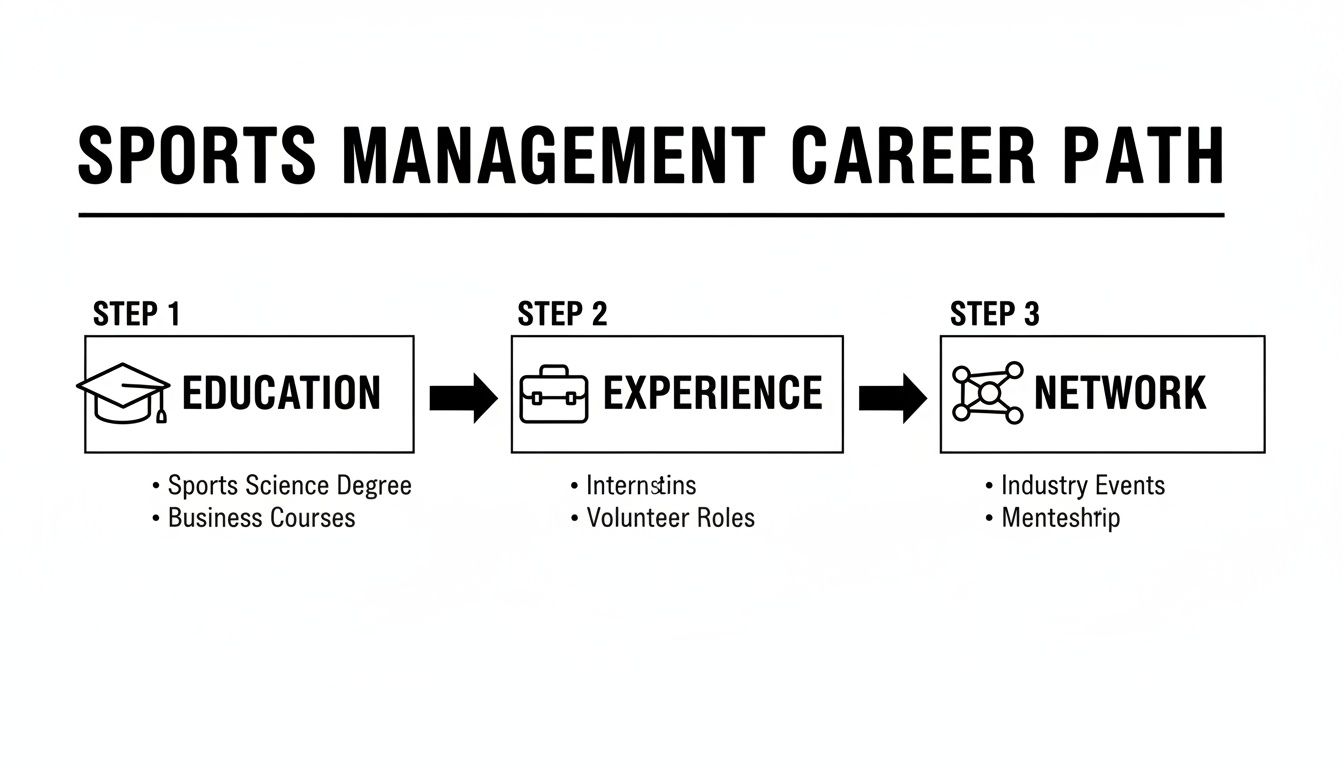
As you can see, these elements are interconnected. Your education makes you a more valuable intern, and your internship is where you build your first professional network. They all feed into each other.
To help you visualize this, here's a quick breakdown of how these pillars work together.
Core Pillars for a Sports Management Career
| Pillar | Why It's Critical | First Actionable Step |
|---|---|---|
| Education | Provides the foundational business and industry knowledge. It's the "why" behind the decisions made in a front office. | Research and select a degree program (sports management, business, marketing) that aligns with your career goals. |
| Experience | Translates academic knowledge into practical, hirable skills. This is your proof that you can do the job. | Seek out a volunteer position with a local sports team or a campus athletics department to start building your resume. |
| Networking | Opens doors to unlisted jobs and mentorship opportunities. The sports industry is notoriously relationship-driven. | Create a LinkedIn profile and start connecting with alumni from your school who work in the sports industry. |
These pillars are your roadmap. Consistently putting effort into each one will build the momentum you need to break in and move up.
Why a Business-First Mindset is Crucial
Let's be clear: today’s sports industry is a massive global business. It's projected to grow from $506.93 billion in 2024 to $629.81 billion by 2028. That’s serious money. Even billion-dollar franchises can struggle without sharp business leadership.
The U.S. Bureau of Labor Statistics expects entertainment and sports jobs to grow faster than average through 2033, creating around 108,900 new openings each year. This boom creates huge opportunities for managers who can navigate commercial rights, build athlete brands, and engage a global fanbase.
Your passion for sports gets you in the door. Your business acumen is what allows you to build a career in the room.
While a love for the game is a great starting point, your success will be defined by your ability to think like a strategist, a marketer, and a financial analyst. The most valuable professionals are those who know how to drive revenue, build brands, and manage complex operations within the unique ecosystem of sports.
In the sections that follow, we'll dive deeper into each pillar, giving you the practical, actionable steps you need to build your credentials and launch a career you're passionate about.
Laying the Groundwork: Education That Actually Matters
Sure, your love for the game gets your foot in the door, but a solid education is what lets you build a career in the front office. A degree isn't just a piece of paper—it's where you learn to speak the language of the sports business. But let's be clear: not all degrees are created equal. Knowing which classes and skills really count will give you a serious leg up.
Forget about just getting a generic diploma. The courses you take need to prepare you for the real-world grind of the industry. That means focusing on a curriculum that gives you the hard and soft skills every team, league, and agency is looking for.
The Must-Have Courses for Your Playbook
To really make an impact, you need a versatile skill set that blends sharp business strategy with deep industry knowledge. When you're picking a program or choosing electives, make sure you're getting a strong dose of these subjects:
- Sports Finance and Economics: This is the absolute bedrock. You'll get into the nitty-gritty of managing budgets, analyzing where the money comes from (tickets, media rights, sponsorships), and understanding the financial models that keep teams afloat.
- Sports Law and Ethics: From player contracts and tricky collective bargaining agreements to protecting a team's brand, a solid grasp of the legal landscape is non-negotiable. You have to know the rules of the game off the field.
- Sports Marketing and Promotions: This is all about building a loyal fanbase, cooking up campaigns that get people talking, and landing those big-money sponsorship deals. It’s the art of connecting a team with its community and the science of turning that connection into revenue.
- Event and Facility Management: Game day is a massive logistical puzzle. This coursework teaches you how to manage everything from stadium security and staffing to concessions and creating an unforgettable fan experience. It’s about making sure the whole operation runs like a well-oiled machine.
These are the subjects hiring managers zero in on. They need people who can walk in, understand the business challenges, and start contributing right away.
Data Is the New MVP
In today's sports world, gut feelings aren't enough. Decisions are now driven by data, and it's completely changed how teams scout talent, connect with fans, and run their operations. Being good with analytics isn't just a "nice-to-have" anymore—it's a core requirement.
Just look at how teams like Liverpool FC use advanced analytics to guide everything from player signings to on-field tactics. That level of data-driven strategy is the new standard. As industry trends for 2025 show, AI and analytics are a game-changer for everything from scouting to personalized fan experiences. With the industry projected to hit over $600 billion by 2030, getting comfortable with data is non-negotiable. For a deeper dive, check out the Deloitte sports industry outlook to see where things are headed.
A degree might get you the interview, but showing you can use data to drive revenue or boost performance is what will get you the job.
This means you should be actively looking for courses in statistics, data analysis, or even sports-specific analytics programs. Simply knowing your way around a spreadsheet and understanding basic statistical models can make you stand out in a sea of applicants.
Beyond the Classroom: The Skills and Certs That Make a Difference
Your degree gives you the framework, but it's your soft skills that will help you execute your vision. These are the abilities that don't always show up on a transcript but are absolutely critical in a relationship-driven business like sports.
- Communication: Can you present a marketing plan to executives, negotiate a contract with a tough agent, or rally a team of event staff? Your ability to communicate clearly and persuasively is everything.
- Negotiation: From locking in vendor contracts to hammering out athlete endorsement deals, being able to find common ground and secure a win is a priceless skill.
- Leadership: You’ll be leading teams, whether it's a small marketing group or a massive game-day crew. You have to know how to motivate people, delegate tasks, and manage different personalities effectively.
- Problem-Solving: Things go wrong. It's a fact of life. A major sponsor could pull out, a star player gets injured right before a big game, or a logistical nightmare threatens an event. Teams need people who can think on their feet and find smart solutions under pressure.
Want to give your resume an extra edge? Add some relevant certifications. A certification in a tool like Google Analytics, sports analytics, or digital marketing shows you have tangible skills and are committed to staying current. Those credentials can be the final nudge that moves your resume to the top of the pile.
To see how these skills fit into different jobs, take a look at our guide on the variety of careers in sports management.
Gaining Real-World Industry Experience
Let's be blunt: your degree gets you in the door, but your experience gets you the job. A great GPA shows you can learn the playbook, but real-world experience proves you can execute under pressure. This is the single most important step that separates the students from the professionals in the competitive world of sports management. It’s where you stop talking theory and start delivering tangible results.
Every single opportunity, no matter how small it seems, is a stepping stone. Working in a pro team’s marketing department, volunteering at a local 5K, or even managing the equipment for your college team—it all counts. The trick is to be smart about the roles you chase and to squeeze every bit of value out of them once you’re in.

Uncovering Opportunities Beyond the Job Boards
The best internships and entry-level gigs aren't always posted on the big job sites. You have to be hungry and look where others aren’t. Your university’s career services office is a fantastic place to start; they often have established relationships with local teams and athletic departments looking specifically for students like you.
And don't sleep on the power of a well-crafted cold email. Identify smaller local teams—think minor league affiliates, semi-pro clubs, or even powerhouse high school athletic programs. Find the email for the general manager or marketing director and reach out. Show your passion, explain what you can offer (even if it’s just your time), and attach your resume. That kind of initiative gets noticed.
Proving your value is about more than just showing up. It's about taking initiative, anticipating needs, and consistently asking, "What else can I help with?" Be the person who makes their manager's job easier.
From Day One, Make Yourself Indispensable
Once you land a role, your mission is to become essential. Don’t just check boxes and complete assigned tasks. Actively look for ways to add more value. If you're an intern in ticket sales, don't just make calls—track your success rate and suggest a tweak to the script. If you're helping with game-day operations, create a simple checklist that makes a chaotic process just a little bit smoother.
Most importantly, document every single accomplishment. Keep a running list of your contributions with hard numbers. Instead of saying you "helped with social media," you can now say you "increased post engagement by 15% over three months by introducing video highlights." Those specific, data-backed achievements are resume gold.
Comparing Experience-Building Opportunities
Not all entry-level experiences are created equal. Each one offers a unique set of skills and opens different doors. Understanding what each type of role can offer will help you make strategic choices that align with your long-term career goals.
| Opportunity Type | Potential Responsibilities | Key Skills Gained | Best For... |
|---|---|---|---|
| University Athletic Dept. | Game-day ops, social media, ticketing, compliance paperwork | Operations, marketing, NCAA regulations, event coordination | Aspiring college athletics administrators or those wanting a broad overview. |
| Minor League Team | A bit of everything: sales, promotions, community relations | Versatility, sales, grassroots marketing, time management | Someone who wants to wear multiple hats and get a ton of responsibility fast. |
| Sports Agency | Player research, social media management, client services | Negotiation basics, client relations, brand management, market research | Future agents or those interested in the talent representation side of the business. |
| Event Volunteering | Registration, crowd control, sponsor assistance, setup/teardown | Logistics, customer service, problem-solving, networking | Gaining on-the-ground event experience and making initial industry contacts. |
Ultimately, any experience is good experience when you're starting out. The key is to find a role, dive in, and start building your track record.
How Volunteering Can Open Paid Doors
Volunteering is often the most accessible way to get your foot in the door. Major events like marathons, golf tournaments, and community sports festivals are always looking for reliable help. These roles put you right in the thick of it, letting you see how large-scale events are run from the inside.
A weekend volunteering at a PGA TOUR event, for instance, could expose you to everything from crowd management and sponsor relations to media coordination. You can learn more about what it takes by checking out our guide to working at events. Show up early, stay late, and prove you're reliable. That's how a volunteer gig turns into a reference, and often, a paid opportunity down the line.
Build Your Brand and Your Network
In the close-knit world of sports, who you know can be just as important as what you know. But it's not just about collecting contacts. It’s about building a professional brand that signals your value and a network that can unlock doors for you. Think of it this way: your skills get you in the room, but your reputation and relationships get you the invitation.
This all starts with how you present yourself. Your resume isn't just a history of jobs; it's your #1 marketing tool. It needs to scream "sports industry professional," not just "recent grad."
Craft a Resume That Shows Results
Hiring managers in sports are laser-focused on one thing: results. They don’t want a laundry list of your duties; they want to see the impact you made. The trick is to shift from describing responsibilities to showcasing tangible achievements.
Here’s how to reframe typical entry-level tasks to pack a punch:
Instead of: "Managed the team's social media accounts."
Try: "Grew Instagram follower count by 20% in one season by launching a new content strategy with player Q&As and behind-the-scenes video."
Instead of: "Helped with ticket sales."
Try: "Boosted student ticket package sales by 15% through targeted on-campus promotional events and a new email campaign."
See the difference? This approach proves you understand the business of sports—driving revenue, boosting engagement, and solving real problems. Every bullet point should tell a quick story of your success.
Master the Art of Networking
Networking isn't a one-time event; it’s an ongoing process. It's about building genuine relationships long before you need to ask for a job. Your goal is simple: become a known, trusted, and respected person in the industry.
LinkedIn is your digital home base for this. It's far more than an online resume.
- Fine-Tune Your Profile: Get a professional headshot. Write a headline that clearly states your ambition, like "Aspiring Sports Marketing Coordinator | Passionate About Fan Engagement & Data Analytics."
- Connect with Purpose: Ditch the generic connection requests. When you reach out to an alum, a hiring manager, or an industry pro you admire, add a personal note. Mention a project they worked on or a shared connection. It shows you've done your homework.
- Join the Conversation: Don't just be a lurker. Like, comment on, and share posts from sports organizations and industry leaders. This keeps your name on their radar and proves you're plugged into what's happening.
Pro Tip: The best networking isn't about asking for a job. It's about asking for advice. This simple shift turns a transaction into a relationship.
When you do get to meet people in person at conferences or local events, you have to be ready. Crafting an effective elevator speech is your secret weapon for making a sharp first impression.
The Underused Power of Informational Interviews
One of the best networking tools almost no one uses is the informational interview. This is just a brief, 15-20 minute chat where you ask a professional for insights about their career, their role, and the industry. It's a low-pressure way to get priceless advice and make a real connection.
Find someone in a role you aspire to, reach out, and ask for a quick chat. Come prepared with smart questions about their journey and the challenges they face. Always end with this question: "Is there anyone else you think I should connect with?" That one question can turn a single contact into a whole new branch of your network.
Finding Your Place and Mapping Your Career
Alright, you've done the foundational work. You have the education, you've got some real-world experience under your belt, and you're starting to build a solid network. Now comes the exciting part: actually landing the job and thinking about your long-term future in this industry. This is where all that prep work pays off.
The job hunt in sports is more than just blindly scrolling through job boards. It's about knowing where the real opportunities are, how to make a killer impression, and what the path forward actually looks like.
Let's not forget, the global sports industry is an absolute powerhouse. It's on track to be worth $507.7 billion in 2025 and is projected to surge to $635.4 billion by 2029. With sponsorships alone expected to hit $115 billion in 2025, the opportunities in operations, marketing, and event management are massive. Understanding this scale helps you see just how much potential there is.

Where to Find the Best Sports Management Openings
Sure, you can look at the big, general job boards, but the prime opportunities are almost always on platforms that live and breathe sports. These are the places where teams, leagues, and top agencies post the roles that really matter.
- Go Niche with Industry-Specific Boards: I always tell people to start with sites like TeamWork Online and Jobs in Sports. They are the industry standard and where hiring managers are actively looking for talent.
- Go Straight to the Source: Don't forget to check the "Careers" pages on the official websites of teams (think NFL, NBA, MLB), leagues (like the NCAA), and national governing bodies (like USA Track & Field). Many jobs are posted there first—or exclusively.
- Use a Curated Platform: Here at GetSportJobs, we pull together hundreds of listings, from coaching gigs to marketing roles. It's a great way to simplify your search. You can check out our constantly updated list of sports management job openings to get started.
Using these targeted resources means less time sifting through irrelevant posts and more time connecting with the employers you actually want to work for.
Nailing the Sports Industry Interview
Interviews in the sports world just hit different. Hiring managers aren't just ticking boxes on business skills; they’re trying to figure out if you have genuine passion, deep industry knowledge, and if you’ll fit into their unique culture. You have to prove you get it.
Expect questions that test your real-world understanding of the sports business.
Here’s a classic interview scenario: "Our ticket sales for weeknight games are down 10% year-over-year. Walk me through three creative marketing ideas you'd pitch to turn that around."
This is where you shine. A question like this isn't just theoretical—it’s testing your problem-solving chops and practical sports marketing instincts. Research is your best friend here. Before you walk into any interview, you need to be a temporary expert on that organization. Know their recent wins and losses (on and off the field), their community programs, and their latest campaigns. Know their star players, their biggest rivals, and their newest business ventures.
Mapping Your Career Trajectory
Part of breaking into sports management is knowing where you're going. The career path isn't always a straight line, but there's a pretty common progression that takes you from hands-on work to high-level strategy.
Think of it in these stages:
- The Coordinator (Entry-Level): This is where you get your hands dirty. You might be a Marketing Coordinator, an Operations Assistant, or a Ticket Sales Rep. Your job is to execute plans and soak up everything you can about how the business works.
- The Manager: After a few years of grinding, you can move up to a manager role. Now you're overseeing specific projects or even a small team. You're responsible for planning and delivering results, whether that’s a sponsorship activation or a digital marketing campaign.
- The Director: At this level, you’re making the big strategic decisions. A Director of Marketing or Director of Operations sets the vision for their entire department, manages a hefty budget, and answers to the C-suite. It's a role that demands a potent mix of seasoned industry experience and sharp business acumen.
Each step requires you to level up your skills. As a coordinator, it’s all about reliability and a strong work ethic. As a director, your ability to lead, strategize, and manage a P&L is what will set you apart.
Staying Ahead of Industry Trends
The sports world moves fast. The best pros are the ones who can see what's coming around the corner. If you want to be positioned for the jobs of tomorrow, you have to stay plugged into the trends that are fundamentally changing the game.
- The Esports Explosion: This isn't just a niche hobby anymore. Competitive gaming is a global force with a massive, dialed-in audience. Skills in event management, marketing, and sponsorships are directly transferable to this booming sector.
- Sustainability in Sports: There's a growing pressure on teams and leagues to be green. Professionals who understand sustainable facility management, waste reduction, and eco-friendly supply chains are becoming incredibly valuable.
- The Data Revolution: Analytics isn't just for player stats anymore. Teams are using data to do everything from optimizing ticket prices and personalizing the fan experience to proving the ROI on major sponsorships.
Keep these trends on your radar. Developing specialized skills in these areas will make you an indispensable asset as the industry evolves. Your ability to adapt and innovate isn't just a bonus—it's what will define your success in the long run.
Your Top Questions About a Sports Management Career, Answered
Breaking into the sports industry can feel like a maze. It’s a competitive field, and it’s completely normal to have a ton of questions swirling around as you try to map out your path.
Let's clear the air. I'm going to tackle some of the most common questions I hear from people trying to get their start. Think of this as a straight-to-the-point FAQ session designed to give you the clarity you need to make your next move with confidence.
Do I Really Need a Master's Degree to Succeed in Sports Management?
This is the big one, and the honest answer is: it depends entirely on where you want to go. For most entry-level roles, a master's degree is definitely not a requirement. What gets you in the door is your drive, your hands-on experience, and a solid bachelor's degree.
However, once you're in, a master’s can be a serious career booster, especially if you have your sights set on the C-suite. An MBA or a Master’s in Sports Management gives you specialized skills in areas like finance and analytics, and just as importantly, it opens doors to high-level networks that are tough to build otherwise.
A smart play? Get a few years of real-world experience under your belt first. That way, you go into a master's program with context, ready to apply what you're learning to actual challenges you've faced. It makes the degree that much more powerful.
What Are Some Common Entry-Level Jobs in Sports Management?
Your first job isn't about glory; it's about getting in the building and learning the business from the ground up. You want to immerse yourself, build practical skills, and prove you're reliable. Some of the best places to start are:
- Ticket Sales Representative: This is the lifeblood of many organizations. You'll learn the art of sales, how to manage customer relationships, and what it takes to generate revenue.
- Marketing Coordinator: Often with college athletic departments or minor league teams, you'll be executing promotional campaigns, running social media, and learning what makes fans tick.
- Operations Assistant: Get your hands dirty at a stadium or arena. This role is all about the logistics of game day, event setup, and keeping the facility running smoothly.
- Social Media Coordinator: For a team or an agency, you’ll be the voice of the brand, creating content, engaging directly with the fan base, and tracking what works.
These jobs are your foundation. They expose you to the daily grind and let you build a track record one small win at a time.
Is Being a Former Athlete a Must-Have for This Career?
Absolutely not. It's a common myth. While being a former athlete can give you a certain perspective, it is by no means a prerequisite for a successful career on the business side.
What the industry truly values is strong business acumen. Passion is crucial, but you show it through your work ethic and industry knowledge—not your playing history. Your ability to drive revenue, manage operations, and market a brand is what will set you apart.
Focus on demonstrating how your expertise in finance, marketing, or logistics can help an organization win off the field. That’s what hiring managers are looking for.
Can I Break In with a Business or Marketing Degree?
Yes, and in fact, these degrees are often the perfect launchpad. A traditional background in business, marketing, finance, or communications provides you with a versatile and highly relevant skill set. Many of the most successful people in sports started exactly this way.
The trick is to intentionally connect your general business knowledge to the sports world. You can't just rely on the degree alone. You have to actively pursue sports-specific experience—intern with a team, volunteer at the Final Four, network with people in the industry. You have to tailor your resume and cover letter to show how your business skills solve the unique problems of a sports organization.
Ready to find your opening in the sports world? GetSportJobs is the go-to job board built just for sports professionals. We list hundreds of current openings from pro teams, college athletic departments, and major sports brands. Start your search and land your dream job at https://www.getsportjobs.com.