How to Negotiate Salary Offer: Pro Tips to Maximize Your Offer
Negotiating a salary isn't some awkward, confrontational showdown. It’s simply a professional conversation to land on a number that works for both you and your new employer. It’s a completely normal part of the hiring game, and frankly, it’s almost always expected.
The whole point is to come prepared. You need to know your market value, build a solid case for why you're worth it, and then clearly communicate that number.
Why You Should Always Negotiate Your Job Offer

Finally getting that job offer in the sports world can feel like hitting a walk-off home run. You’ve been through rounds of interviews, done your homework, and now the finish line is in sight. It’s so tempting to just grab the first number they throw at you and celebrate.
But hold on. Accepting the first offer is a classic rookie mistake, and it can cost you big time over the long haul.
Think of their initial figure as an opening bid, not their final word. Most organizations, especially in a fast-moving industry like sports, have a negotiation buffer built right into their initial offers. They fully expect their top choice—that’s you—to come back with a counter.
Negotiation Signals Confidence
Countering an offer doesn't make you look greedy or difficult. A well-researched counter actually does the opposite: it signals that you’re confident and you know your worth. It tells the hiring manager that you understand the market and you believe in the value you're about to bring to their team.
Shifting your mindset is key. You are not asking for a favor. You are entering a business partnership and ensuring the terms are equitable for the contributions you are contracted to deliver.
This is your first chance to show them the same strategic thinking and assertiveness you’ll use on the job. Whether you're joining a team, an agency, or a major sports brand, having someone who can advocate for value is a huge asset.
The Long-Term Financial Impact
The ripple effects of a good negotiation go way beyond your first paycheck. Your starting salary is the bedrock for all your future earnings at that company. Every raise, every percentage-based bonus, and every cost-of-living adjustment will be calculated off that initial base.
A "small" $5,000 bump you negotiate now can easily compound into tens of thousands of dollars over just a few years. It's a 15-minute conversation that can literally change your financial future.
The numbers don't lie. An incredible 78% of new hires who negotiated their starting pay ended up with a better offer. For anyone hunting for roles on platforms like GetSportJobs, that's a clear signal that pushing back on the first number is a smart move. You can find more data on why this works and how professionals benefit from it.
When you step up to the plate and negotiate, you're taking control of your career and making sure you get paid what you're truly worth from day one.
To help you get organized, we've broken down the entire process into a simple, four-phase game plan. This is your roadmap from getting the offer to signing on the dotted line.
Your 4-Phase Salary Negotiation Game Plan
| Phase | Key Action | Goal |
|---|---|---|
| 1. Research & Prep | Gather market data and build your value case. | Enter the conversation with a clear, data-backed salary target and a compelling "why." |
| 2. Initial Offer | Receive the offer and express enthusiasm. | Acknowledge the offer positively but avoid accepting on the spot. Set the stage for a follow-up. |
| 3. The Counter | Present your counteroffer, supported by your research. | Clearly state your desired number and connect it directly to the value you bring to the role. |
| 4. Finalizing | Handle objections and negotiate the total package. | Reach a final, mutually agreeable number and get the updated offer in writing. |
Following these phases will give you a repeatable process you can use for any job offer, ensuring you approach the conversation with confidence and a clear strategy.
Know Your Market Value, Down to the Dollar

Walking into a negotiation without solid data is like showing up to the championship without a playbook. Sure, you have the talent, but you've got no strategy. To get what you're worth, you need a crystal-clear, objective understanding of your market value.
This research isn't just about finding a number; it’s about turning your “ask” from a hopeful wish into a data-backed business proposal. You're building a defensible salary range that’s both ambitious and realistic. This range becomes your anchor, giving you the confidence to counter an offer and explain exactly why you deserve it.
Go Deeper Than National Averages
Grabbing the first salary you find for a job title is a rookie mistake. A "Marketing Manager" in sports can mean a dozen different things, and the pay will reflect that. Your research has to be granular.
To get a real-world number, you need to slice the data by the variables that actually matter:
- Location, Location, Location: A role with the Knicks in New York City is going to pay more than the same job with the Pacers in Indianapolis. Cost of living is a massive factor.
- Company Size and Type: The New York Yankees and a new sports tech startup operate in different financial universes. Their compensation structures will be worlds apart.
- Your Niche: An analytics role for an NBA team has a different pay scale than a similar job in a university athletic department. Highly specialized fields have their own market rates, as seen in guides like this F1 Mechanic Salary Guide.
- Your Track Record: Your years of experience, unique skills, and proven wins are direct drivers of your value. A fresh college grad and a 10-year veteran aren't in the same bracket.
Triangulate Your Data for an Accurate Target
Don't hang your hat on a single website. The smartest move is to triangulate data from several reputable sources to find a realistic consensus. Think of it as getting a second and third opinion.
Here are the go-to tools for your research:
- Glassdoor: This is your inside look. It’s great for company-specific salary data, often reported anonymously by current and former employees. It helps you see what a specific organization actually pays.
- LinkedIn Salary: Excellent for establishing a broad baseline. It aggregates data by job title and location, giving you a solid starting point for your research.
- Payscale: This one gets personal. You can plug in your specific skills, years in the field, and education to generate a much more customized salary report.
By pulling numbers from all three, you can spot the outliers and zero in on a credible range. This multi-source approach gives your argument serious weight, allowing you to say, "Based on my research across multiple platforms..."
The real goal here isn't just to find a number—it's to understand the story behind it. Knowing why a role in a big city pays more, or why a startup might offer equity instead of cash, makes you a far sharper negotiator.
Look at the Bigger Picture: Industry Trends
Your personal value is also tied to the broader trends in the sports world. Is your skill set in high demand? If you’re in a hot field like sports analytics or digital media, you have more leverage than you think.
Understanding the current landscape helps you position your ask strategically. For a closer look at where the industry is headed, checking out the sports management job outlook can give you incredible context. This big-picture view confirms whether your skills align with what teams and brands need right now, making your case for top dollar even stronger.
Crafting and Delivering Your Counteroffer

Alright, you've done the homework. The market data is in, and you have a solid, data-backed number in mind. Now it's time to turn that prep work into a confident, professional counteroffer. This is the moment you step up and clearly state your value.
How you deliver this message is just as critical as the message itself. The key is to keep the tone positive and collaborative. You're not making demands—you're opening a business discussion to find a number that makes sense for the immense value you’re about to bring to their team.
Choosing Your Channel: Phone or Email
Your first move is deciding how to communicate your counter. Both a phone call and an email have their own strategic advantages, and the right choice really depends on the situation and what feels most comfortable for you. There isn't one "right" way, but knowing the pros and cons will help you make a smart decision.
A live phone call lets you build rapport and convey genuine enthusiasm. It’s dynamic, making it easier to read the hiring manager’s tone and adjust your approach on the fly. This is often the better route for more complex negotiations that involve several moving parts, like a performance bonus structure on top of a signing bonus.
On the other hand, an email gives you total control over the message. You can take all the time you need to draft and polish every single word, ensuring your case is clear, concise, and backed by your research. It also provides an instant paper trail of your counteroffer, which is always a good thing.
My Two Cents: If you do negotiate over the phone, always—and I mean always—follow up with a polite email summarizing what you discussed. This simple step prevents any misunderstandings and gives you a written record of the proposed new terms.
To help you decide which path to take, let's break down when each method really shines.
Phone Call vs Email for Your Counteroffer
Deciding between a call and an email can feel like a big deal, but this table should make it easier to pick the right channel for your counteroffer.
| Consideration | Phone Call | |
|---|---|---|
| Immediacy & Tone | Great for real-time conversation and showing your personality. | Gives you time to craft the perfect response; less risk of saying the wrong thing. |
| Complexity | Best for tricky negotiations with multiple components (bonuses, incentives, etc.). | Perfect for a straightforward salary request with clear justification. |
| Documentation | You'll need to send a follow-up email to confirm everything discussed. | Creates an automatic written record of the entire negotiation. |
| Best For | Building rapport, senior-level roles, and navigating complex compensation packages. | Keeping things documented, making initial counters, and remote hiring situations. |
Ultimately, go with the channel where you feel you can present your case most confidently.
Structuring Your Strong Ask
Whether you're firing off an email or prepping for a call, your counteroffer should always follow a simple, four-part framework. This approach ensures you come across as appreciative, confident, and, most importantly, logical.
- Lead with Gratitude: Always start by thanking them for the offer. Reiterate how excited you are about the role, the team, and the organization. This immediately sets a positive and collaborative tone.
- State Your Counter and Anchor It to Value: This is the heart of it. Clearly state your desired salary. The crucial part? Immediately tie that number to the value you bring, referencing your specific experience, unique skills, or the market data you found.
- Justify the "Why": Briefly explain why your request is fair. This isn't about what you need; it's about what the role and your skills are worth. You can point to your research on industry benchmarks in your city or highlight a key accomplishment that perfectly aligns with a major team goal. To get a better handle on your unique strengths, you can run your resume through a resume analyzer designed for your industry to see what stands out.
- Close on a Collaborative Note: End the conversation by looking forward. Phrases like, "I'm really confident we can find a number that works for both of us" or "I'm looking forward to discussing this further" signal that you see this as a partnership, not a battle.
This structure transforms a simple ask for more money into a compelling business case. You’re no longer just asking for a higher salary for yourself; you're framing it as a fair investment for the talent and results you're bringing to the table. And that makes it a whole lot harder for a hiring manager to just say "no."
Don't Just Negotiate Salary—Negotiate Your Package
An offer is a lot more than just a number on a page. The base salary might be the headliner, but the real value is often buried in the total compensation package. Getting good at this means looking at the whole picture, especially when you run into a company with rigid pay bands that can’t budge on the base.
Fixating only on salary is like a scout judging a player on one stat alone—you miss the bigger story. Benefits, bonuses, and other perks can have a massive impact on your finances, your career path, and your life outside of work. Learning to negotiate these other elements is how you land an offer that truly works for you.
So when a hiring manager tells you their hands are tied on salary, don’t take it as a final no. It's a pivot. This is your cue to explore other areas where they do have flexibility. You’d be surprised how often things like signing bonuses or professional development funds are pulled from completely different budgets.
Expanding the Conversation to Total Compensation
Once you’ve made your counter on salary, or if the employer has made it clear their number is firm, it's time to shift the conversation. Your mission is to build a complete package that meets your needs, even if that base salary is a little shy of your ideal number.
Before you jump in, think about what really matters to you beyond a paycheck. Are you trying to fast-track your career? Do you need more time off? Is a cross-country move going to be a huge financial hit? Get your priorities straight first.
Here are some of the most common and valuable non-salary items to put on the table:
- Signing Bonus: This is a one-time payment when you start. It's often the easiest "get" after a salary negotiation stalls because it’s a one-off expense for the company, not a recurring hit to their payroll.
- Performance Bonuses: If a bonus is part of the deal, can the target percentage be bumped up? Make sure you ask for details on how bonuses are calculated and what the payout history looks like for top performers.
- Relocation Package: This is non-negotiable if you’re moving for the job. A basic package might just cover the movers, but you can push for more—think temporary housing, a budget for house-hunting trips, or even help selling your current place.
- More Paid Time Off (PTO): An extra week of vacation is priceless. If you’re coming in with significant experience, it's perfectly reasonable to ask for more than the standard two or three weeks they offer to junior staff.
A great compensation package shows an employer is investing in you as a person, not just a line item on a spreadsheet. Often, it's in these non-salary benefits that you get a real sense of a company's culture.
Negotiating for Your Future and Your Flexibility
Some of the best benefits you can negotiate aren't about immediate cash but are really investments in your future and well-being. These can be powerful negotiating tools because they often cost the company less than a straight salary increase but provide immense value to you.
Think about asking for these kinds of growth-focused perks:
- Professional Development Stipend: Ask for an annual budget to cover conferences, certifications, or coursework. You can frame this as a win-win, explaining how you'll bring those new skills right back to the team. It shows you’re serious about your growth.
- Flexible Work Arrangements: Can you lock in a hybrid schedule or more flexible start and end times? The value of cutting down your commute and having a better work-life balance can't be overstated.
- A Better Title: If the job description has you taking on senior-level responsibilities but the title doesn't match, ask for it to be changed. A stronger title is a huge asset for your next career move.
Thinking about the full scope of your career also means understanding what happens at the end of an employment relationship. Knowing how to negotiate a severance package, for example, gives you a broader perspective on protecting your interests from start to finish.
Ultimately, having a solid grasp of how sports teams and leagues handle their money provides powerful context for your negotiation. Understanding the world of finance in the sports industry can give you a behind-the-scenes look at where they allocate their budgets, helping you make smarter, more strategic asks. It helps you figure out what’s a reasonable request versus what’s likely a non-starter.
Handling Pushback and Closing the Deal
You’ve done your research, built your case, and confidently presented your counteroffer. Then you hear it: "I'm sorry, but we can't meet that number." It's easy to feel deflated, but don't panic. This isn't the end of the road—it’s where the real negotiation often begins.
A flat "no" is rarely the final word. Think of it as an invitation to get creative and understand their side of the story. The key is to stay cool, professional, and curious. Your goal is to pivot from what feels like a dead end into a collaborative problem-solving session.
Responding to Common Objections
When a hiring manager pushes back, it’s usually for a handful of common reasons. If you can anticipate these, you can respond with grace and keep the conversation moving forward. Rushing to accept their "final" offer is a rookie mistake that can leave a lot on the table.
Here’s a look at what you might hear and how to steer the conversation.
When they say: "This is the top of the budget for this role."
- You can say: "I understand there might be a firm cap on the base salary. I'm still very excited about the role, so I'd love to explore other parts of the compensation package. Could we look at a signing bonus or a more aggressive performance bonus structure to help bridge the gap?"
When they say: "We have to maintain internal equity with other team members at this level."
- You can say: "I completely respect the need for internal pay equity. Given my specific experience with [mention a unique skill or achievement], I believe I bring a unique value that aligns with the higher end of the scale. Is there any flexibility on the leveling for this role, or could we perhaps discuss a one-time bonus?"
Remember, the person you’re negotiating with is often working within company policies. By asking thoughtful questions instead of making demands, you turn them into a collaborator. You're now working with them to find a solution, not against them.
If the salary truly is set in stone, it’s time to pivot. This is your chance to negotiate other valuable perks.
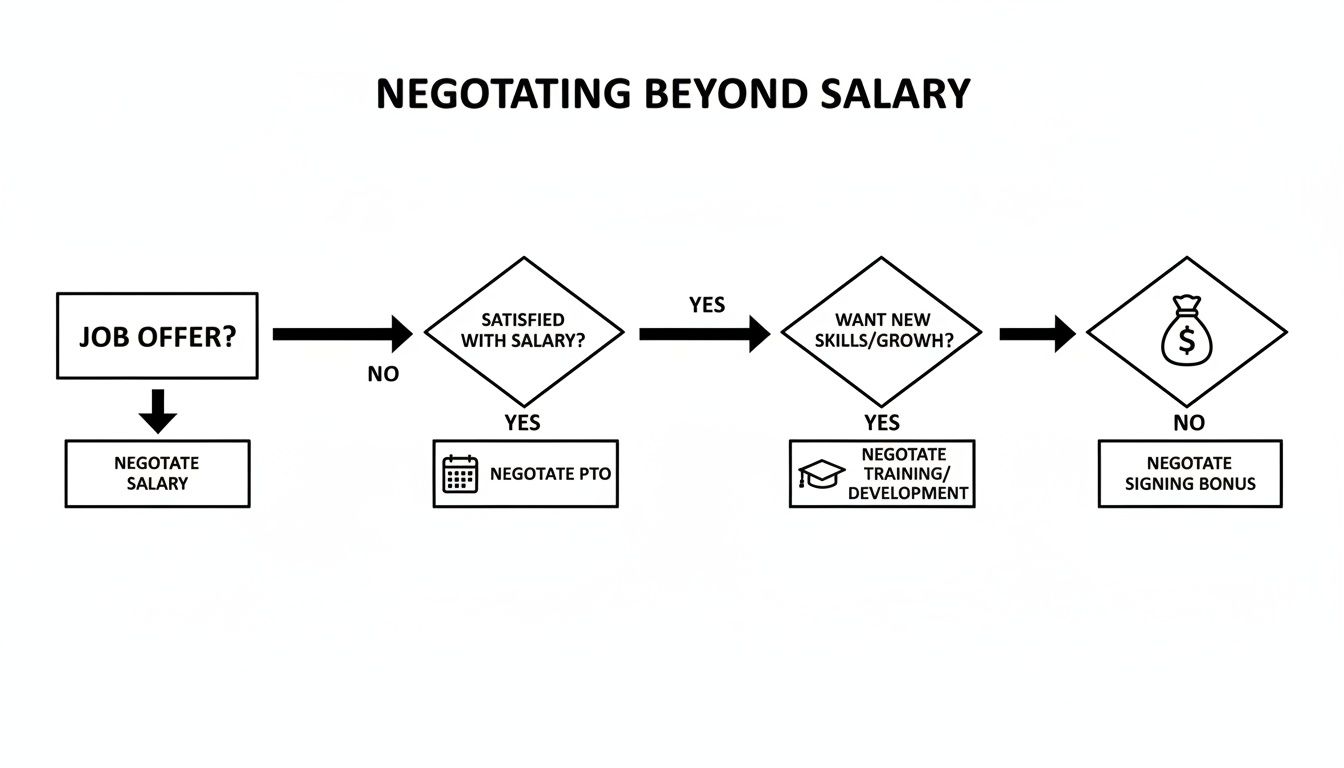
As the flowchart shows, hitting a salary wall is an opportunity to shift focus. You can push for a signing bonus for an immediate cash infusion, more PTO for better work-life balance, or a professional development budget to invest in your career.
Proposing Creative Solutions
Sometimes the best way to get past a budget hurdle is to offer a creative, future-focused compromise. This shows you’re not just flexible but also confident in your ability to deliver results. It gives the employer a lower-risk way to get you to your target number.
One of my favorite strategies is to propose a performance-based review.
For example: *"I'm confident I can hit the ground running and make a significant impact in my first few months. Would you be open to scheduling a formal performance and compensation review at the six-month mark? We could pre-agree on a salary increase to my target of [Your Number] if I achieve [Specific, Measurable Goal 1] and [Specific, Measurable Goal 2]."*
This approach shows you're willing to bet on yourself—a quality every team in the sports industry values.
Locking It In The Right Way
Once you’ve shaken hands (or verbally agreed over the phone) on a final package, there’s one last critical step. Do not resign from your current job or post anything on LinkedIn until you have the revised offer in writing.
This isn't about being cynical; it's simply smart business. Verbal agreements are prone to misunderstandings and forgotten details. A written offer letter is your official record, protecting both you and your new employer.
You just need to send a simple, polite email to lock it down.
- The final base salary
- Details of any signing or performance bonuses
- The exact amount of paid time off
- Any agreed-upon professional development stipends or relocation assistance
Something as simple as this works perfectly: "Thank you so much for working with me on this. I am thrilled to accept! Could you please send over a revised offer letter reflecting the new terms we discussed?"
Once that updated document is signed, sealed, and delivered, you can finally pop the champagne. This final step ensures you start your exciting new role on solid, clearly defined ground.
Answering Your Burning Salary Negotiation Questions
Even with the best game plan, it's natural to have those last-minute "what if" questions pop into your head. Walking into a salary talk can feel like stepping onto the field for the championship game—you've prepared, but the nerves are still there.
Let's tackle some of the most common questions and tricky situations that come up. Think of this as your pre-game huddle, giving you the clarity and confidence to handle whatever comes your way.
When Is the Right Time to Start Talking Money?
Timing is absolutely crucial. The sweet spot for negotiating your salary is after you’ve received a formal, written job offer but before you've officially accepted it. This is when you have the most leverage.
Bring up money too early, and you risk looking like you only care about the paycheck, not the role or the team. Wait until after you’ve accepted, and you’ve lost your chance—it’s unprofessional to try and renegotiate a deal you’ve already agreed to.
When the offer comes through, your first move should be to show genuine excitement. Thank them for the offer, then simply say you'd like a day or two to review everything in detail. This buys you time and perfectly sets the stage for a follow-up conversation where you can present your counteroffer.
What if They Ask for My Salary Expectations Up Front?
This is a classic screening move. Hiring managers want to make sure you're in their ballpark before they invest more time in the interview process. Your goal here is to politely sidestep the question until you have an offer in hand.
A great way to handle this is to deflect and pivot back to the role itself.
Try this: "Right now, my main focus is on learning more about the role and your team to see if this is a great fit for both of us. I'm confident that if we agree I'm the right person for the job, we can land on a compensation package that feels fair."
If they push you for a number, don't get boxed in. Give them a wide, well-researched range. For example: "Based on my research for similar roles in this market, the compensation typically falls somewhere between $X and $Y. I'm open to discussing how my specific skills and experience fit within that range once we know this is the right match."
This shows you've done your homework but keeps you from being anchored to a lower number before you even have a full picture of the job.
Can a Company Take Back a Job Offer if I Try to Negotiate?
This is a huge fear for many people, but let me put your mind at ease: it's extremely rare for a reputable company to pull an offer just because you tried to negotiate. In the sports world, as in any professional industry, a polite counteroffer is a standard part of the hiring game.
A well-reasoned negotiation can actually reinforce their decision to hire you. It shows you’re:
- Confident: You understand your market value.
- A Strong Communicator: You can navigate a sensitive business discussion with professionalism.
- Business-Savvy: You know how to build a case and advocate for yourself.
The only time an offer gets rescinded is in extreme situations—like if a candidate is rude, makes completely unrealistic demands, or reveals a major red flag. As long as you keep it respectful and back up your request with solid reasoning, you're not jeopardizing the offer; you're proving you were the right choice.
Should I Negotiate Things Besides the Base Salary?
Absolutely. Thinking beyond the base salary is one of the smartest moves you can make, especially if the employer says their budget is tight. Your total compensation is what really matters, and perks like extra vacation or a development stipend can add significant value to your life.
If you hit a wall on the salary discussion, pivot the conversation.
Here are a few things you can ask for instead:
- More Vacation Time: "I understand the salary band is firm. Given my level of experience, would you be open to starting with three weeks of vacation time instead of the standard two?"
- Professional Development: "If there's no flexibility on the base salary, could we talk about an annual professional development budget of $2,000? This would help me attend key industry conferences and bring new insights back to the team."
- Flexible Schedule: "One of the things that excites me about your culture is the focus on results. Would it be possible to formalize a hybrid work arrangement with two days remote per week?"
These items often come from different departmental budgets, making them an easier "yes" for a hiring manager. It’s a fantastic way to boost the overall value of your offer, even if that salary number won't budge.
Ready to find that next big opportunity in the sports world? At GetSportJobs, we connect talented professionals like you with the best teams, leagues, and brands in the industry. Start your search and land the job you deserve.