Your Guide to Jobs in Sports and Entertainment
When you think of a career in sports and entertainment, what comes to mind? Is it the star quarterback or the A-list actor on the red carpet? That’s what most people see, but it's only a tiny fraction of the picture.
Behind every game-winning touchdown and blockbuster film is a massive team of professionals—the marketers, event coordinators, data analysts, and salespeople who make it all happen. If you have a passion for this world, the real opportunities aren't just on the field or stage; they're in the front office, the control room, and the boardroom.
Exploring the World of Sports and Entertainment Careers
That electric feeling in a stadium on game day? The buzz of a sold-out concert? That doesn't happen by accident. It's the result of countless hours of work by thousands of people whose names you'll probably never know.
For every household name, there are hundreds of other professionals running the show. Thinking the industry is only about athletes and performers is like looking at an iceberg and ignoring the 90% that lies beneath the water. The most exciting and stable career paths are often found in that hidden part—in roles that drive ticket sales, manage sponsorships, produce content, and build legendary brands.
Beyond the Field and the Stage
This industry isn't just big; it's a global economic force. The sports market alone is valued at $521 billion and is growing at a staggering 8% annually. Forecasters expect it to hit $635.42 billion by 2029. All that money translates directly into job growth and new opportunities for people with the right skills and drive. If you want a deeper look at the numbers, you can read more about these global employment trends and see just how fast things are expanding.
This guide is designed to be your playbook. We're going to pull back the curtain and show you a world of professional roles you might not even know exist, turning your passion into a practical career plan.
The most successful professionals in this field are those who understand that sports and entertainment are businesses first. Passion is the fuel, but a solid understanding of marketing, finance, and operations is the engine that drives a successful career.
To get you started, we'll break down exactly what you need to know:
- Key Industry Sectors: We'll explore the different arenas where you can build a career, from pro teams and college athletics to media giants.
- Essential Skills: You'll learn what specific hard and soft skills hiring managers are desperately looking for right now.
- Application Strategies: We’ll cover how to craft a resume and cover letter that actually stand out in a pile of hundreds.
- Networking and Internships: I'll give you real-world advice on making connections and getting the hands-on experience that truly matters.
By the time you're done here, you won't just be a fan anymore. You'll have a clear roadmap to find your spot and start building a real career in sports and entertainment.
Breaking Down The Key Sectors In The Industry
Before you can land the right job in sports and entertainment, you have to know the playing field. This industry isn't one giant monolith. It’s actually a dynamic ecosystem of interconnected sectors, each with its own culture, lingo, and career paths.
Most people see the teams, the leagues, and the star athletes. But they're just the tip of the iceberg. The real action—and the vast majority of jobs—happens behind the scenes in media, event management, corporate sponsorships, and brand marketing. Once you understand how these pieces fit together, you can stop just being a fan and start building a real career strategy.
This chart gives you a bird's-eye view, splitting the industry between the highly visible on-field talent and the massive off-field business operations that make it all possible.
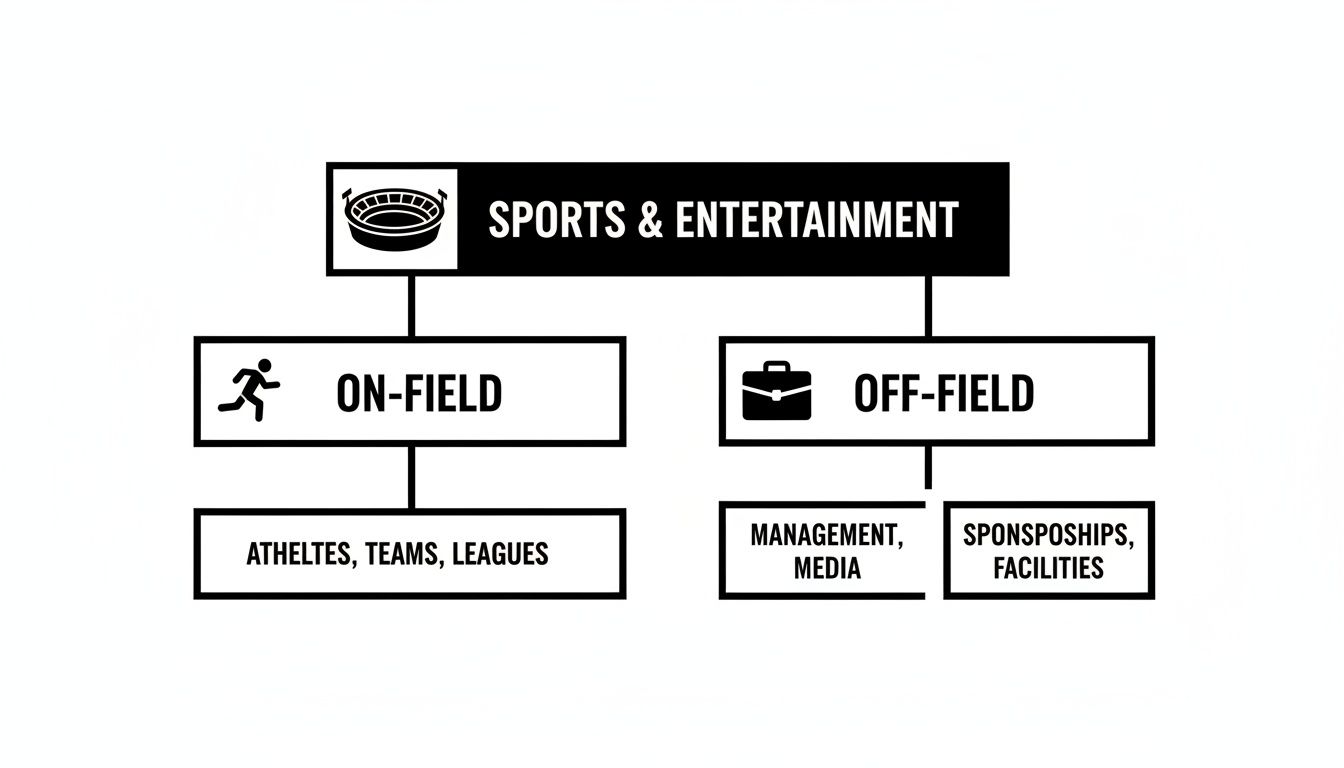
The key takeaway? The business side of sports offers a far wider and more accessible range of opportunities than the performance side. Let’s dig into these sectors to see where you might find your perfect fit.
Professional And Collegiate Sports Organizations
This is the heart of it all—the teams and leagues that create the product we're all obsessed with. We're talking about everything from behemoths like the NFL and NBA to individual pro franchises and bustling collegiate athletic departments at schools like Ohio State or USC.
Sure, there are coaches and athletic trainers, but the real career engine is in business operations. These are the people who make sure the organization is profitable and runs like a well-oiled machine.
- Marketing and Sales: Their mission is simple: put butts in seats. They drive ticket sales, dream up promotions, and build an unbreakable bond with the community.
- Operations and Logistics: Think of them as the wizards behind the curtain. They handle everything from team travel and stadium upkeep to game-day security, making sure the entire fan and athlete experience is seamless.
- Player Personnel and Analytics: This is the "Moneyball" side of things. These teams scout talent, negotiate contracts, and crunch data to assemble a winning roster.
Media And Broadcasting
If teams make the product, media companies are the storytellers who beam it to billions of fans around the world. This sector takes the live-action drama and turns it into must-see TV, podcasts, articles, and viral social media moments. It's home to giants like ESPN but also includes countless regional sports networks and digital-first outlets.
The jobs here are a fantastic blend of creative vision and technical savvy. One day you could be breaking down game film, the next you're writing a feature story or managing a team’s Instagram feed. Understanding how to engage fans is critical, which often means using tools like real-time social media walls to bring the stadium's energy to life on screen.
Sports media isn't just about reporting scores. It's about building narratives that forge an emotional connection between fans and their heroes. Great storytelling is what transforms a simple game into a legendary event.
Brands And Corporate Partnerships
Brands are the financial lifeblood of the sports world. Companies like Nike, Gatorade, and Anheuser-Busch pour billions into sponsorships to tap into the fierce loyalty of sports fans. This relationship has created a huge job market for professionals who can speak both "corporate" and "sports."
You can work on either side of the deal. You might be at a brand like Pepsi, shaping its entire sports marketing strategy, or you could work for a team, hustling to sign and manage those lucrative sponsorship agreements. Success here is all about building strong relationships and proving that the investment paid off. For a closer look at these business-focused roles, our guide to careers in sports breaks down the specific functions in detail.
Event Management And Venues
Every single game, from a local high school championship to the Super Bowl, is a massive logistical puzzle. The event and venue management sector is filled with the pros who put all those pieces together flawlessly. They run the stadiums, arenas, and convention centers, and they coordinate the thousands of people needed to pull off a major live event.
These jobs are made for hyper-organized people who thrive under pressure and have an almost obsessive attention to detail. Whether it's mapping out security for the World Cup or managing the concession stands for a college football Saturday, these are the unsung heroes who create safe, fun, and unforgettable experiences for everyone in attendance.
The table below summarizes the kinds of roles you can find across these core sectors, helping you pinpoint where your skills might be the best match.
Career Opportunities Across Sports Industry Sectors
| Industry Sector | Primary Function | Example Job Titles |
|---|---|---|
| Pro/Collegiate Orgs | Team and League Operations | Ticket Sales Rep, Operations Coordinator, Data Analyst |
| Media & Broadcasting | Content Creation & Distribution | Production Assistant, Social Media Manager, On-Air Talent |
| Brands & Partnerships | Sponsorship & Marketing Activation | Sponsorship Coordinator, Brand Manager, Account Executive |
| Event & Venue Mgmt | Live Experience Execution | Event Coordinator, Guest Services Manager, Facilities Director |
As you can see, a "job in sports" can mean a hundred different things. The key is to look beyond the field and find the business function that truly excites you.
Developing the Skills for a Winning Career
So, you’ve pinpointed the part of the industry that excites you most. Think of that as choosing a destination on a map. Now, you need to build the vehicle that will get you there. In the world of sports and entertainment, your "vehicle" is your unique toolkit of skills—a mix of technical expertise and personal qualities that will make you a go-to person on any team.

Breaking into this industry isn't just about what you know; it’s about how you apply it. We can break down the must-have skills into two key categories. First, you have the hard skills: specific, teachable abilities that you can clearly list on your resume. Then there are the soft skills, those crucial personality traits and communication habits that dictate how well you work with others to get things done.
Mastering the Technical Hard Skills
Hard skills are the functional tools in your professional belt—the concrete, measurable abilities you need to perform specific tasks. Think of them as your core competencies, the fundamental know-how required for the vast majority of jobs in sports and entertainment.
For example, a modern sports marketing manager can't just operate on a gut feeling. They need to be fluent in data analytics to understand fan demographics, spot trends in ticket sales, and accurately measure the return on investment (ROI) of a new digital ad campaign. That data-driven approach is what separates a good idea from a profitable strategy.
Here are some of the most sought-after hard skills across the industry:
- Data Analytics and Business Intelligence: The ability to pull meaningful insights from ticket sales, social media engagement, and broadcast ratings to drive smarter business decisions.
- Digital Marketing and SEO: Knowing how to build and run online campaigns, manage social media communities, and use search engine optimization to expand a team's or league's digital presence.
- Video Production and Graphic Design: The creative and technical skills needed to produce eye-catching content for social media feeds, in-arena jumbotrons, and broadcast partners.
- Sales and CRM Software: Proficiency with Customer Relationship Management (CRM) platforms like Salesforce to manage sales leads, track client conversations, and ultimately close sponsorship deals.
- Contract Law and Negotiation: Especially critical for roles in agent representation, player personnel, or corporate partnerships, where understanding the fine print is everything.
Building these skills usually involves a blend of formal education, online certifications, and, most importantly, hands-on practice. The goal is to show tangible proof of what you can do, whether that's through a project portfolio or specific qualifications on your resume.
Cultivating Essential Soft Skills
If hard skills land you the interview, soft skills are what get you the job—and, more importantly, help you build a career. These interpersonal traits are harder to measure but are arguably the secret sauce in a relationship-driven industry like sports and entertainment. This is a world built on teamwork, impossible deadlines, and high-pressure moments.
This industry runs on passion, but it’s built on relationships. Your ability to communicate, collaborate, and persevere under pressure will ultimately define your career trajectory far more than any single technical skill.
Picture a team's event coordinator on game day. The ticketing system crashes, a key staffer calls in sick, and a sudden thunderstorm threatens the outdoor fan festival. It’s their resilience, problem-solving instincts, and clear communication that will turn a potential disaster into a seamless experience for thousands of fans. That’s the power of soft skills in action.
You'll want to focus on developing these critical areas:
- Communication: This is more than just talking. It's about active listening, writing concise emails, and persuasively presenting ideas to vastly different audiences, from professional athletes to C-suite executives.
- Resilience and Adaptability: Things will go wrong. Games are lost, sponsorship deals fall through, and plans change at a moment's notice. The ability to bounce back from a setback and pivot without panic is absolutely essential.
- Networking and Relationship Building: Your network is your net worth. The ability to build genuine, lasting connections with colleagues, clients, and industry contacts is one of your most powerful assets. People hire and promote those they know, like, and trust.
- Leadership and Teamwork: Even in your first entry-level role, you need to be a stellar teammate. That means being reliable, collaborative, and having the confidence to step up and help the team get across the finish line.
Unlike learning a software program, you can’t earn a certificate in resilience. You build these abilities through real-world experience—volunteering at events, taking on leadership roles in student groups, and intentionally putting yourself in challenging situations during internships. By actively developing both your technical and interpersonal toolkits, you become the kind of well-rounded candidate who is ready to thrive from day one.
Crafting Your All-Star Application and Interview
Having the right skills gets you in the game, but knowing how to sell them is what wins you the job. This is where the application and interview come in. It’s your chance to turn your experience and passion into a story that makes a hiring manager think, “This is the person we need.”
In a field as competitive as sports, sending a generic resume is the fastest way to get your application tossed in the “no” pile. You have to treat each application like a team creating a specific game plan for a new opponent—your approach has to be custom-built for the role you want.
Tailoring Your Resume and Cover Letter
First things first, you need to get past the robots. Many companies use Applicant Tracking Systems (ATS) to scan resumes for keywords before a human ever sees them. If your resume doesn't have the right words from the job description, it's game over before it even starts.
This means you absolutely must customize your resume every single time. Read the job description like you’re scouting a rival team. Pick out the key skills and responsibilities, then weave those exact phrases into your bullet points. If the posting asks for "sponsorship activation," you better make sure that phrase is in there.
To see how your resume stacks up, you can get a detailed breakdown with a specialized https://getsportjobs.com/tools/resume-analyzer built for the sports industry.
Beyond just using the right words, you need to show your impact with numbers. Don't just say you "managed social media." Instead, say you "grew Instagram followers by 25% in six months." Numbers are your proof.
Your cover letter is where you make a personal connection. Don't just repeat your resume. Tell a story that connects your passion for sports or entertainment to what that specific organization is all about.
A great cover letter answers the question, "Why us?" It shows you've done your homework and have a genuine enthusiasm that a list of skills can't convey. Think of it as your highlight reel, not just your stat sheet.
Nailing the Interview Process
If your resume and cover letter do their job, you’ll get the interview. Now it’s time to bring your story to life. Preparation is everything. Dig into the organization’s recent wins, its current challenges, and who the key players are. Be ready for classic industry questions about teamwork, performing under pressure, and where you see yourself in five years.
When you're answering questions, use the STAR method to keep your stories clear and powerful.
- Situation: Briefly set the scene. What was the challenge?
- Task: What was your specific job in that situation?
- Action: What exact steps did you take to get it done?
- Result: What was the outcome? Use numbers to prove your success.
This simple framework stops you from giving vague answers and instead lets you present a mini-case study where you’re the hero who delivered real results. To walk in feeling confident, mastering your job interview with a structured plan can be a total game-changer.
Finally, remember the interview is a two-way street. Prepare your own thoughtful questions about the team culture, how they measure success, and what growth looks like in that role. It shows you’re serious and helps you decide if it’s truly the right place for you.
Building Your Network: Internships and Connections

In the world of sports and entertainment, who you know often opens the door for what you know. But let’s be honest—the word "networking" can make you think of awkward small talk and a pocket full of business cards. It's time to reframe that. You’re not just collecting contacts; you’re building genuine, professional relationships.
Think of these connections as your personal intelligence network. They’re the people who can offer real-world advice, give you a heads-up on jobs that never get posted publicly, and vouch for you when it counts. In an industry built on reputation, a strong network is your most valuable asset.
The Power of Internships
Internships are, without a doubt, the single best way to fast-track your career. They are far more than just another line on your resume. An internship is your all-access pass to see how the industry really works, letting you get your hands dirty while building your professional circle from the inside out.
This kind of experience is what separates you from the crowd. The U.S. Bureau of Labor Statistics projects that entertainment and sports will add about 99,700 new jobs each year through 2034. That growth means fierce competition, making the practical skills you gain from an internship absolutely essential. You can read more about these job projections on BLS.gov.
An internship is essentially a months-long job interview. It’s your chance to show the very people who can hire you that you’re reliable, a quick learner, and someone they want on their team.
When you treat every task with professionalism—no matter how small it seems—you're proving you’re a valuable addition. This approach turns a temporary gig into a powerful audition for a full-time role, giving you a massive head start over everyone else applying from the outside.
Strategies for Making Real Connections
Beyond internships, you need to be proactive about building your network. This isn't about asking for favors; it's about creating opportunities for authentic conversations.
Here are a few practical ways to make meaningful connections:
- Ask for an "Informational Interview." Reach out to people in roles you find interesting and ask for just 15 minutes of their time to hear about their career journey. It’s a low-pressure way to get fantastic advice and make a memorable impression.
- Volunteer at Events. Big games, music festivals, and industry conferences always need an army of volunteers. It’s a great way to get behind the scenes, see how things run, and meet key players in a natural setting.
- Be Smart on LinkedIn. Ditch the generic connection requests. Instead, send a personalized note mentioning a recent company win, a project they worked on, or a shared connection. This shows you’ve done your homework and kicks off a real conversation.
Of course, the first step is finding the right opportunity. If you're looking to get your foot in the door, our guide on how to find and land great sports internships near you is the perfect place to start.
Making Your Internship Count
Once you’ve landed that internship, your goal is to become indispensable. Don't just do what you're told. Ask what else you can help with, listen intently in meetings, and actively ask for feedback on your work. Show them you're there to learn and contribute.
Take the initiative to set up short coffee chats with people in other departments. Understanding how the whole organization works together not only broadens your knowledge but also grows your internal network. By the time your internship is over, you won’t just be "the intern"—you'll be a recognized and respected professional they want to keep around.
Your Top Questions About Sports and Entertainment Jobs, Answered
Thinking about a career in sports and entertainment? You probably have a few questions. Let's tackle some of the most common ones that come up when people are trying to find their footing in this exciting field.
What Kind of Salary Can I Really Expect?
Let's be real: pay can be all over the map. It really depends on the role, the organization, and how much experience you bring to the table. If you're just starting out in a role like ticket sales or helping coordinate events, you're likely looking at a starting salary in the $40,000 to $55,000 range.
But if you've got specialized skills in areas like data analytics, digital marketing, or corporate partnerships, you can expect a much higher starting number. Once you climb the ladder into management, six-figure salaries are definitely the norm. For context, the median pay across all sports and entertainment gigs was $54,870 in May 2024—that’s a good bit higher than the median for most other industries.
Do I Actually Need a Sports Management Degree to Get Hired?
Not at all. While a sports management degree can give you a leg up, it's definitely not a deal-breaker. I've seen countless successful people break into this world with degrees in business, marketing, communications, finance, and even law.
Here's the inside scoop: employers hire for skills, not just for what your diploma says. Can you sell? Can you crunch the numbers? Can you run a project from start to finish? That's what they really care about.
Your best bet is to build a rock-solid portfolio. Get internships, volunteer, or even do some freelance work. That hands-on experience is what will truly prove you've got the passion and the skills to make it.
I Have Zero Experience. What's the Best Way to Break In?
Internships. Period. They are, without a doubt, the single best way to get your foot in the door. You get real-world experience and meet people who can actually hire you—something you just can't get from a textbook. A huge number of full-time jobs are filled by former interns who proved their worth.
Another fantastic move is to volunteer. Sign up to help at a major tournament, a local 10K, or a music festival. It’s a great way to see how things work behind the curtain and to start building your network. Every handshake and conversation is a seed you're planting for your future career.
Ready to find your place on the team? GetSportJobs is the go-to job board for the sports industry, connecting talented people with the best organizations out there. Start exploring hundreds of opportunities today at https://www.getsportjobs.com.