How to Reduce Employee Turnover in the Sports Industry
Before you can build a winning retention strategy, you have to understand the score. If you don't know why people are leaving, you're just guessing at how to make them stay. It’s like treating an injury without an MRI—a total shot in the dark.
This diagnostic phase is about moving from assumptions to evidence. It means getting real numbers and then digging into the human stories behind them.
Diagnosing Turnover in Your Sports Organization
In the fast-paced, high-pressure world of sports, the reasons people head for the exit are often unique. It could be burnout after a grueling championship season, a lack of a clear career path, or frustration with unpredictable schedules.
To get started, you need to get a firm grasp on the numbers. You need to know not just how many people are leaving, but also who is leaving and when. This data provides the foundation for every single retention effort that follows.
This process flow shows you how to tackle the diagnosis systematically.
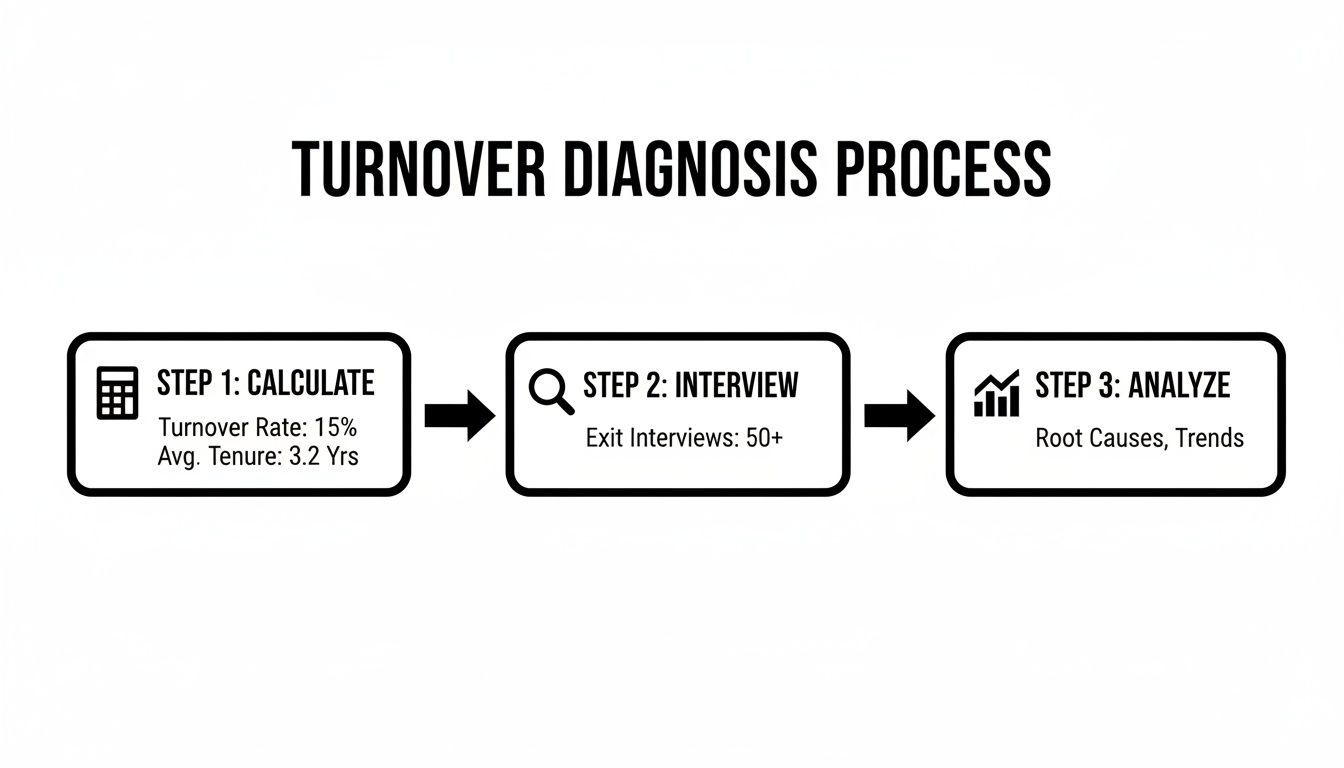
As you can see, it's a logical flow: start with the hard data, add the human element with interviews, and then put it all together to see the full picture.
Calculating Your Turnover Rate
First things first, you need a baseline. Calculating your turnover rate gives you a clear metric on the scale of the problem.
The formula is simple:
(Number of Separations / Average Number of Employees) x 100 = Turnover Rate %
Run this calculation for a specific period, like a quarter or a full year.
But a single, organization-wide number doesn't tell you much. To get insights you can actually use, you have to slice and dice the data.
- Voluntary vs. Involuntary: Are people choosing to leave, or are you letting them go? High voluntary turnover is a big red flag for issues with culture, management, or compensation.
- Regrettable vs. Non-Regrettable: Let’s be honest, not all turnover is bad turnover. Losing a low performer is very different from losing a star player. You need to tag departures as “regrettable” when you lose a high-performing, high-potential employee you really would have fought to keep.
Your regrettable turnover rate is arguably the most important number to watch. If it's creeping up, you're losing the very people who drive your success. Remember, replacing a single employee can cost anywhere from 50% to 200% of their annual salary—a massive financial hit, especially when it’s a key team member.
To truly understand turnover, you need a dashboard of key metrics that give you a 360-degree view. Simply tracking the overall rate isn't enough; you need to dig deeper into the specifics of who is leaving and why.
Key Metrics for Diagnosing Employee Turnover
A breakdown of essential KPIs sports organizations should track to understand and address staff turnover effectively.
| Metric | What It Measures | Why It Matters for Sports Orgs | Target Goal Example |
|---|---|---|---|
| Overall Turnover Rate | The percentage of employees who leave over a specific period. | Provides a high-level benchmark of workforce stability. | Keep below 15% annually. |
| Voluntary Turnover Rate | The rate of employees who leave by their own choice. | A direct indicator of job satisfaction, culture, and engagement. | Keep below 10% annually. |
| Regrettable Turnover Rate | The rate of high-performing employees who voluntarily leave. | The most critical metric; signals the loss of top talent. | Keep below 5% annually. |
| New Hire Turnover Rate | The percentage of new hires who leave within their first year. | Shows potential issues in recruiting, hiring, or onboarding. | Keep below 20% in the first year. |
| Turnover by Department | The turnover rate for specific teams (e.g., Sales, Operations). | Pinpoints problem areas and managers who may need support. | Align with overall company targets. |
| Turnover by Tenure | Tracks when employees leave (e.g., 0-6 months, 1-2 years). | Reveals critical drop-off points in the employee lifecycle. | Reduce turnover at the 2-year mark. |
By tracking these KPIs, you can move from broad assumptions to targeted action plans. A high New Hire Turnover Rate, for instance, tells you to fix your onboarding process, not your compensation plan.
Uncovering the "Why" with Exit and Stay Interviews
Numbers tell you what is happening. Conversations tell you why.
This is where you get the real story. Exit and stay interviews are invaluable tools for any sports organization that’s serious about keeping its people.
An exit interview is your final chance to learn from an employee's experience. A stay interview is your chance to show current employees you’re invested in improving that experience before they even think about leaving.
A good exit interview goes way beyond, "So, why are you leaving?" You need to dig into the specifics. Was the "Scouting Assistant" role sold as one thing, but the reality was nonstop, lonely travel? Did a lack of off-season flexibility cause an "Event Coordinator" to burn out?
Stay interviews are the proactive side of the coin. Sit down with your current top performers and have a real conversation. Ask them what keeps them motivated, what they love about their job, and what might tempt them to look somewhere else. This gives you feedback in real-time—gold you can act on immediately to prevent your best people from even starting to look.
When you combine the hard data from your turnover calculations with the human stories from these interviews, patterns will emerge. Maybe you’ll discover that most of your regrettable turnover comes from the marketing department right around the two-year mark. Now that is an insight you can work with. It transforms your diagnosis from a report that sits on a shelf into a powerful, targeted game plan.
Winning the Talent Game From Day One

So many turnover problems don't start when someone quits—they start the day you hire them. A mismatch from the get-go or a chaotic first few weeks is often the real culprit. If you want to keep good people, you have to get serious about attracting the right people and then actually set them up to succeed.
In the sports world, this means being brutally honest about the demands of the job and incredibly intentional about how you bring someone into the fold. It's about building a foundation of trust and clarity right away. This prevents that all-too-common scenario where a new hire's reality is miles away from the job they were sold, which almost guarantees they'll be gone before the season's over.
Craft Transparent and Realistic Job Descriptions
Your first line of defense against turnover is an honest job description. Vague, glamorized postings attract candidates who simply aren't ready for the grind that defines so many careers with sports teams.
For instance, an "Events Coordinator" role isn't just about "managing game-day logistics." Get specific. Try this instead: "Manage game-day logistics, including 12-hour workdays on weekends during the season and frequent on-call availability for urgent issues." That one sentence does a massive amount of filtering for you. It weeds out people who aren't built for the lifestyle.
To get your job descriptions working harder for you, try adding:
- A "Day in the Life" Section: Give them a real taste of a demanding day or a hectic week.
- The Non-Negotiables: Be upfront about extensive travel, mandatory weekend work, or physical demands.
- Cultural Clues: Is your office a loud, collaborative war room or more of a heads-down, structured environment? Tell them.
This approach doesn't scare away great candidates; it attracts the right ones. The people who truly thrive in this industry are drawn to the challenge, but they deserve to know what they're signing up for.
Architect a Structured and Welcoming Onboarding Experience
The moment a great candidate accepts your offer, the clock starts. You have a limited window to make them feel like they belong. A disorganized, "figure it out yourself" onboarding process makes new hires feel isolated and, frankly, makes them question their decision. The data doesn't lie: organizations with a strong onboarding process improve new hire retention by 82%.
A proper onboarding experience is more than a laptop and a handbook. It's a deliberate plan to integrate a new person into your culture, your workflows, and your team over their first 90 days.
Onboarding isn't just an administrative checklist; it's your first and best opportunity to prove to a new hire that they made the right choice. It reinforces their value and sets a positive tone for their entire tenure.
This isn't a one-day information dump. Think of it as a multi-week journey designed to turn an outsider into a confident, contributing member of the team.
The First 90 Days: A Playbook for Success
Those first three months are everything. A well-thought-out 90-day plan gives a new hire a clear roadmap, which cuts down on their anxiety and ramps up their productivity much faster.
Here’s a practical checklist you can adapt for just about any role, from a scouting assistant to a partnership coordinator:
Week 1: Getting Grounded
- Tech & Systems: All accounts, logins, and hardware must be ready to go on day one. No excuses.
- Team Intros: Schedule actual one-on-one meetings with the people they'll be working with closely.
- Assign a Buddy: Pair them with a seasoned employee—not their direct manager—who can answer the "dumb" questions and show them the ropes.
- Review the Plan: The manager should walk them through their goals for the first three months so they know what "success" looks like.
Weeks 2-4: Learning the Ropes
- Role-Specific Training: This is the time for a deep dive into the core functions of their job.
- Shadowing: Have them shadow a few key colleagues. It’s the fastest way to understand how things really get done.
- A Small First Project: Give them a manageable task they can own from start to finish. An early win is a huge confidence booster.
Weeks 5-12: Starting to Contribute
- Weekly Check-ins: The manager needs to connect with them every week to check progress, offer feedback, and clear roadblocks.
- More Responsibility: As they get more comfortable, start giving them more complex and meaningful work.
- The 90-Day Review: Sit down for a formal meeting to review how they did against their plan and set goals for the next quarter.
This structured approach can transform a stressful, overwhelming experience into a supportive journey, drastically improving the odds that your new hire will stick around for the long haul.
Building Career Paths That Keep Your Best People

Let's be blunt: ambitious, high-performing people will not stick around if they feel like they’ve hit a dead end. In the fast-paced sports world, if you don't show them a future with you, another organization will be more than happy to. Creating clear, compelling career development opportunities isn’t just a nice-to-have; it’s one of the most powerful levers you can pull to reduce turnover.
This is about more than just dangling the possibility of a promotion. It's about demonstrating a real, tangible investment in your people's growth. When an employee can actually see a viable path from their current role to a future they’re excited about, their entire mindset shifts. They become more engaged, more productive, and far more likely to build their career with you.
Map Out Tangible Growth Trajectories
Even if you're a smaller team or have a relatively flat organizational chart, you can still map out meaningful career paths. The trick is to get creative about what "growth" actually looks like. A promotion doesn't always have to come with a new title or direct reports.
Think about a ticket sales rep who feels stuck. How do you show them a future? You could map a path that leads to a senior sales role, and from there, to a corporate partnerships position. This means you first have to identify the skills they need to make that jump—like strategic negotiation or B2B sales techniques—and then give them concrete opportunities to build them.
Consider a few potential growth trajectories:
- Junior Marketer to Digital Strategist: This path requires building deep expertise in analytics, SEO, and paid media campaign management.
- Operations Assistant to Event Manager: This progression is all about developing skills in budget management, vendor relations, and large-scale project coordination.
Clearly defining these pathways transforms a job into a career. Our guide on sports management career paths offers more great examples to help you visualize these journeys for your own team.
Don't let a lack of vertical promotions be an excuse for a lack of development. Growth can be horizontal, skill-based, or project-focused. The goal is to ensure your people are always learning and adding value.
This proactive approach is critical because a stalled career is a primary reason people start looking elsewhere. It’s a well-documented driver of voluntary exits. In fact, some studies show that as many as 61% of employees leave within their first year, and employers who implement clear career ladders and mentorship see early turnover fall by an impressive 20%–40% after launching formal internal mobility programs. You can find more insights in these employee retention statistics and trends.
Implement Regular Development Check-ins
Annual reviews are simply not enough. If you’re only talking about an employee’s career path once a year, you’re already behind. Career development needs to be an ongoing conversation, not a box-checking exercise.
Start implementing quarterly or bi-annual development check-ins. These meetings should be focused entirely on the employee’s future, completely separate from day-to-day performance talk. The agenda should revolve around their long-term aspirations, the skills they want to build, and how the organization can help them get there.
Use these conversations to co-create a personalized development plan. This shouldn't be a static form filed away in HR; it should be a living document that outlines specific, actionable steps for both the employee and their manager.
Invest in Skills Through Training and Certifications
Nothing shows you're serious about an employee's growth like investing real dollars in them. It's a powerful signal that you see them as a long-term asset, not just a line item on a budget.
- Fund Professional Certifications: Offer to cover the cost for relevant certifications. Think a Certified Strength and Conditioning Specialist (CSCS) for a trainer or a Google Analytics certification for a marketer.
- Create Cross-Training Opportunities: Let someone from the communications team shadow the sponsorship sales team for a week. This cross-pollination builds new skills, fosters collaboration, and can even spark an employee's interest in a new internal career path they hadn't considered.
- Bring in Experts: Host workshops on practical skills like public speaking, project management, or leadership. This elevates the entire team and demonstrates a company-wide commitment to professional development.
When you build these opportunities into your culture, you create an environment where your best people feel challenged, valued, and motivated to build their future with you. You stop being just another stepping stone and become a destination.
Developing Managers Who Coach, Not Just Command
In the intense, personality-driven world of sports, an old saying rings truer than ever: people don't leave companies, they leave managers. A brilliant strategist or a top sales director who can't connect with their team is a massive retention risk. To really tackle turnover, you have to transform your leaders—from the head coach to the ticket office director—into people who build up their teams, not just bosses who hand out orders.
This whole shift starts when you treat management as a skill that can be taught, not just some innate talent. Promoting your best player into a leadership role without training them for it is a classic recipe for disaster. They need a completely new playbook, one focused on communication, empathy, and employee growth, to build a place where top talent actually wants to stick around and build a career.
The Foundation of Effective Management
Great managers in sports don't just oversee a to-do list; they cultivate talent and build teams that can handle the pressure. Their biggest job is creating a sense of psychological safety—an environment where people feel trusted enough to take risks, ask questions, and voice concerns without fear.
This really boils down to mastering a few key skills:
Delivering Constructive Feedback: It’s all about learning to give feedback that is specific, actionable, and actually motivating. Instead of saying, "Your reports are sloppy," a coaching-focused manager would say, "Let's walk through this event recap together. The data is solid, but I think we can make it more impactful by adding a section on key learnings for next time."
Running Meaningful One-on-Ones: These meetings should never be just a status update. They are dedicated time to dig into an employee’s career goals, roadblocks, and general well-being. A great manager asks questions like, "What part of your work is most energizing for you right now?" and "What support do you need from me to get things done this week?"
Recognizing Achievements: Real recognition is so much more than a year-end bonus. It’s about acknowledging effort and specific contributions in a timely way. That could be a public shout-out in a team meeting for handling a difficult sponsor or a simple, direct "thank you" for staying late to make sure a project was flawless.
A manager's impact isn't just a "soft skill"; it's a hard metric. A bad manager-employee relationship is one of the most reliable predictors of someone walking out the door. Investing in your leaders is a direct investment in your retention rate.
From Theory to Practice
Let’s look at a real-world scenario. An operations crew is clearly showing signs of burnout after pulling off a massive, month-long tournament. They're disengaged, and one of your key people just put in their notice. A command-style manager might just tell them to push through until the off-season.
A coaching-style manager, however, takes a totally different approach. They’d call a team meeting, not to assign blame, but to listen. Then, they’d work on practical solutions: maybe rotating responsibilities to break up the monotony, scheduling mandatory "no-contact" days off, or budgeting for extra help for the next big event. This doesn't just solve the immediate problem; it rebuilds trust for the long haul.
Strong front-line management is one of the most powerful levers you can pull to reduce turnover. Research from Gallup finds that roughly 50% of employees who quit cite their manager as the main reason. Organizations that invest in proper manager training and structured coaching can see regrettable turnover fall by 10% to 25% within a single year.
Developing these leadership skills takes intentional effort. Investing in formal leadership development programs can be incredibly effective for turning managers into true coaches. Building these skills is also a crucial part of planning for long-term success, a key theme in many fulfilling careers in sports management. When you give your managers the right tools, you empower them to become your organization's most powerful retention asset.
Crafting a Rewards Strategy Beyond the Paycheck

Let's be honest. Competitive pay is just the price of admission these days. It gets you in the game, but it's rarely the reason your best people stay through a grueling season. If you want to build real loyalty and stop the revolving door of talent, you have to think bigger than the bi-weekly direct deposit.
The key is building a total rewards strategy. This is where your team feels genuinely valued for their massive contributions, not just compensated for their time. It’s about recognizing that what keeps someone fired up—especially in the high-octane sports world—is a mix of financial security, personal well-being, and perks that actually mean something.
Benchmarking Salaries for Unique Sports Roles
Before you can get creative, you have to nail the fundamentals. Is your pay competitive? The challenge is that the sports industry has so many unique roles that don't map cleanly to corporate salary surveys. You can't just look up the going rate for a "Director of Player Personnel" on a generic job site.
Getting this right means digging a little deeper.
- Look for industry-specific salary reports. Sports business journals and professional associations often publish data that's far more relevant than a generic national survey.
- Talk to your peers. Don't underestimate the power of trusted, confidential conversations with counterparts at similar organizations. This is where you get the real-time market intelligence that reports can't capture.
- Consider the context. A role with a small college team is going to have a different market rate than the same title in a major professional league. Your organization’s size, location, and revenue all play a huge part.
Once you’ve established a fair and competitive baseline, you can start layering on the high-impact benefits that truly make you stand out.
The Power of High-Impact, Low-Cost Perks
Not every reward needs to blow a hole in your budget. In fact, some of the most valued perks in the sports world are unique to our industry and cost next to nothing to implement. These are the things that make your employees feel like insiders.
Think about what you can offer that no standard corporate office ever could:
- Game Tickets for Family and Friends: This is a classic for a reason. It turns an employee’s job into a shared experience and a source of pride.
- Merchandise Discounts: A simple discount at the team store fosters a tangible sense of belonging. It’s a small thing that goes a long way.
- Exclusive Access: How about access to a closed practice session, a behind-the-scenes stadium tour, or a casual meet-and-greet with a player? These are the "money-can't-buy" experiences that people talk about for years.
These perks are powerful because they connect your team directly to the magic of the game. They’re a constant reminder that their hard work is part of something special.
A total rewards package is your employee value proposition in action. It communicates that you care about your people as whole individuals—recognizing their need for financial stability, work-life balance, and personal well-being.
This isn’t just feel-good advice; the data backs it up. While salary is important, a broader strategy that includes career paths and flexibility is what truly drives retention. Organizations that combine competitive pay with career development and flexible work options often see voluntary turnover drop by 15%–30% compared to those who just throw money at the problem. You can dig deeper into these workforce turnover trends to see the numbers for yourself.
Designing Benefits That Actually Support Well-Being
The relentless pace of the sports calendar is a recipe for burnout. The smartest organizations are tackling this head-on by designing benefits that give people a chance to breathe. It’s all about providing the support and flexibility your team needs to recharge their batteries.
Consider putting programs in place that are specifically aimed at improving work-life balance:
- Off-Season Flexibility: Can you offer compressed four-day workweeks or more remote work options during the quieter months? This is a massive draw for employees who give their all when the season is in full swing.
- Mental Health Resources: Don't just check a box. Partner with a service that provides legitimate, confidential counseling and stress management tools. More importantly, create a culture where it's okay to use them.
- Wellness Stipends: Offer a monthly stipend for gym memberships, fitness classes, or meditation apps. This empowers your people to take charge of their own well-being in a way that works for them.
When you invest in your team’s health, you’re doing more than just reducing burnout. You're building a culture where people feel supported enough to build a real, sustainable career with you.
Common Questions on Employee Turnover in Sports
Let's be honest, navigating employee retention in the fast-paced, high-pressure world of sports can feel like trying to hit a moving target. The challenges are unique, and the answers aren't always cut and dry.
I get asked a lot of specific questions by hiring managers trying to get a handle on this. Here, I'll break down some of the most common ones with practical, no-nonsense advice you can start using today.
What Is a Healthy Employee Turnover Rate in Sports?
This is the million-dollar question, and the honest answer is: it depends. There’s no single number that works for everyone, but a good starting benchmark for overall turnover is somewhere between 10% and 20% annually. But that number without context is almost useless in our industry.
Think about it: an organization with a huge seasonal workforce for game days is going to have a wildly different turnover rate than one with mostly full-time office staff. You have to break it down.
- Full-Time Staff: I always tell clients to aim for a voluntary turnover rate under 15%. If you see it creeping higher than that, it's time to start digging into the "why."
- Seasonal/Part-Time Staff: This rate will naturally be much higher, but don't ignore it. A sudden spike can be a canary in the coal mine, signaling issues with on-site management, scheduling, or even something as simple as how staff are treated during their shifts.
The real metric to obsess over is your regrettable turnover rate—that's the percentage of your top performers who are walking out the door. If this number is above 5%, sound the alarm. You're losing the very people you've built your team around.
How Can We Retain Top Performers on a Tight Budget?
When you can't just throw money at the problem, you have to get smarter. The good news is that some of the stickiest retention tools have nothing to do with salary. It's all about the experience.
Focus on what you can offer that a typical corporate job can't. These are the unique, high-impact perks that come with working in sports.
- Offer Unforgettable Access: Give your key people experiences money can't buy. Let them watch a closed practice, get a real behind-the-scenes tour, or have a casual lunch with a coach or executive. These moments build a deep, personal connection to the organization.
- Prioritize Flexible Scheduling: The sports calendar is unforgiving, but the off-season is your golden opportunity. I've seen teams have great success with compressed four-day workweeks or more remote work options during quieter months. This is a massive perk that costs you nothing.
- Invest in Their Growth: Show them you're invested in their career, not just their current role. Funding a relevant professional certification or sending them to a key industry conference proves you see them as a long-term asset.
When the budget is tight, shift your focus from monetary rewards to experiential and developmental ones. Acknowledgment, flexibility, and a clear path for growth can be more powerful than a small raise.
For a more comprehensive look at retention strategies, you might find a detailed guide on how to reduce employee turnover especially helpful.
What Is the First Step a Small Team Should Take?
If you're a small organization and this all feels overwhelming, take a deep breath. Don't try to fix everything at once. The single most powerful first step you can take is to start conducting stay interviews.
Seriously. Exit interviews tell you why people already left, which is lagging data. Stay interviews tell you why your best people are still showing up every day—and, more importantly, what might make them start looking elsewhere. They are proactive, personal, and incredibly insightful.
Just sit down with your key team members for an informal chat. Ask a few simple but powerful questions:
- What do you look forward to when you come to work?
- What are you learning here, and what do you want to learn next?
- What's one thing that would make your job more satisfying?
- If another team called you tomorrow, what would tempt you to listen?
This process costs nothing but your time. The honest answers you get will give you a crystal-clear, prioritized roadmap for where to focus your retention efforts, straight from the people who matter most.
Ready to build your winning team? GetSportJobs is the premier job board for the sports industry, connecting top talent with the best organizations. Post your job today and find the dedicated professionals who will drive your success. Find your next great hire now!