What Is Sponsorship Activation and How Does It Work
Let’s get one thing straight: sponsorship activation is the moment a partnership stops being a piece of paper and starts delivering real results. It’s the collection of all the marketing activities you plan and execute to bring that sponsorship agreement to life for your target audience.
Think of it this way: just having your company's logo on a race car is the sponsorship deal. Hosting a high-tech racing simulator for fans to try at the track? That's the sponsorship activation. One is passive; the other is an active experience that people will remember long after the race is over.
What Is Sponsorship Activation Beyond The Logo?
Imagine you’ve just signed a major sponsorship deal. It’s like being handed the keys to a high-performance sports car—it looks impressive, but it’s not doing much just sitting in the garage. The sponsorship agreement, which gives you the right to use a team’s name and logo, is the car itself. Sponsorship activation is the fuel, the driver, and the race plan that gets that car on the track to win over the hearts and minds of fans.
This is the critical step that transforms a static logo on a jersey into a dynamic, memorable brand experience. It’s all about moving beyond simple brand exposure and creating genuine connections. The real goal here is to turn casual spectators into loyal customers by making your brand a valuable, integrated part of their event experience.
From Passive Exposure to Active Engagement
In today's world, simply paying for your logo to be seen on a banner just doesn’t cut it anymore. Consumers, especially younger ones, are looking for more meaningful interactions. In fact, research shows that a staggering 77% of consumers trust brands more after they've had a chance to interact with them directly at a live event. That’s precisely what sponsorship activation is designed to do.
To truly connect with an audience, you need to go beyond basic logo placement. This often involves weaving in dynamic strategies like experiential marketing and events to create immersive touchpoints people won't forget.
A few powerful activation ideas include:
- Interactive Fan Zones: Creating dedicated spaces with games, challenges, photo booths, or product sampling stations.
- Digital Campaigns: Running social media contests, creating unique digital content with star athletes, or offering exclusive AR filters.
- Retail Tie-ins: Offering ticket holders special discounts or creating limited-edition co-branded merchandise.
- Community Initiatives: Sponsoring local youth sports clinics or partnering on community-focused events to build goodwill and a positive brand image.
The real magic of activation is its power to make a brand unforgettable. It’s the difference between a fan just seeing your logo and a fan remembering the incredible moment your brand helped create.
To really nail down the difference, let’s look at a side-by-side comparison.
Sponsorship vs Sponsorship Activation at a Glance
This table breaks down the core differences between the sponsorship agreement itself and the activation that brings it to life.
| Element | Sponsorship (The Agreement) | Sponsorship Activation (The Action) |
|---|---|---|
| Primary Goal | Secure official association and rights. | Engage the audience and drive business results. |
| Nature | A legal and financial contract. | A strategic marketing campaign. |
| Key Output | Rights to use logos, marks, and IP. | Memorable brand experiences and interactions. |
| Audience Role | Passive observers (they see your logo). | Active participants (they engage with your brand). |
| Example | Paying to be the "Official Drink of the Team." | Setting up a sampling booth for fans to try the drink. |
Ultimately, understanding what sponsorship activation is means seeing it for what it truly is: the engine of the entire partnership. It’s the strategic effort that drives measurable results—like brand awareness, customer loyalty, and direct sales—ensuring your investment delivers a powerful and undeniable return.
How Activation Fits Into The Sponsorship Lifecycle
It's a common mistake to think of sponsorship activation as the last thing you do. A final flourish after the ink is dry on the contract. But in reality, activation isn't an afterthought—it's the thread that should run through the entire partnership journey.
The smartest brands don't just secure a sponsorship and then ask, "Okay, what now?" They walk into the very first meeting with a clear vision for how they'll bring the partnership to life. This foresight is everything. It ensures the final contract is packed with the specific assets they need, whether that’s player appearances, rights to create digital content, or prime real estate at the venue.
Without planning for activation from day one, even the most brilliant idea is dead in the water.
This simple journey map says it all: the sponsorship deal is just the start. Activation is what comes next, and it’s the bridge to creating a real, lasting connection with the audience.
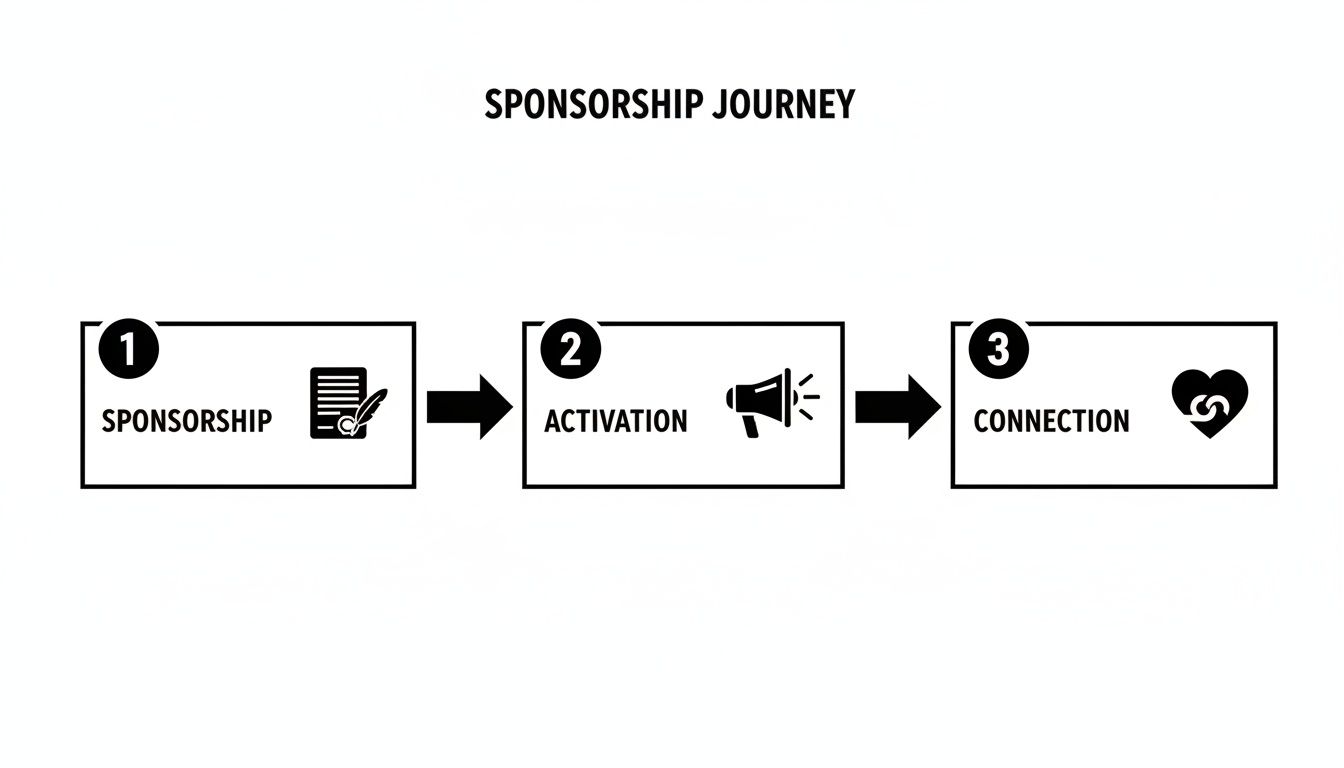
Think of the signed contract as the key to the car. Activation is the engine, the fuel, and the driver all in one, actually getting you to your destination: a genuine bond with fans.
The Four Stages of Sponsorship
To really see where activation fits, it helps to break the entire sponsorship lifecycle down into four distinct phases. You’ll notice that thinking about activation early and often is crucial for success at every step.
Strategy and Identification: This is the ground floor. Here, a brand figures out what it wants to achieve and starts looking for potential partners—be it a team, a league, or an event—that speak to the right audience. The crucial piece? Brands should already be brainstorming activation ideas. This helps them gut-check whether a potential partner can even deliver what's needed for their vision.
Negotiation and Contracting: When you get to the negotiating table, your activation plan is your secret weapon. It’s what helps you argue for the specific rights and assets you need to pull off your campaign. This avoids that all-too-common pitfall: signing a deal that looks great on paper but leaves you with no real tools to market with.
Activation Planning and Execution: Once the deal is done, the real work begins. This is where the big ideas get turned into detailed project plans with budgets, timelines, and assigned roles. Effective execution is what makes the difference between a forgettable sponsorship and a truly memorable fan experience.
Measurement and Renewal: The campaign is over, but the job isn't done. The final stage is all about measurement—tracking performance against the goals and KPIs set in stage one to calculate the return on investment (ROI). This data is absolutely vital for proving the partnership's worth and making a smart, data-backed decision on whether to renew.
Core Strategies For Unforgettable Activations
So, what does it take to turn a sponsorship deal into an activation that fans actually remember? It's not about just slapping a logo on a banner. The best activations are built on solid strategies designed to connect with a specific audience in a way that feels genuine and adds real value to their experience.
Today's most effective activations generally fall into a few key categories. By mixing and matching these approaches, brands can build a campaign that hits all the right notes, engages fans on multiple levels, and ultimately delivers on business goals.
Digital And Social Media Engagement
Let's face it, the conversation doesn't end at the stadium gates anymore. A strong digital strategy is essential, using online platforms to take the sponsorship far beyond the live event. The real goal here is to create interactive content that fans genuinely want to engage with and share.
Imagine a tech sponsor creating a custom augmented reality (AR) filter on Instagram that lets fans "try on" their team's new jersey. Or picture a brand hosting a live Q&A with a star player on X (formerly Twitter) right after a big win. These digital touchpoints create buzz, are highly measurable, and scale incredibly well.
Experiential Marketing At Events
This is all about creating memorable, hands-on moments right at the venue. Experiential marketing aims to build immersive activities that give fans a tangible way to interact with your brand, leaving a lasting impression.
Here are a few classic examples:
- Immersive Fan Zones: Think of a beverage company setting up a branded lounge outside the arena, complete with comfy chairs, phone charging stations, and free samples. It becomes the go-to meeting spot.
- Interactive Games: An auto brand could bring in a high-tech racing simulator, letting fans go head-to-head for prizes and, more importantly, bragging rights.
- Photo Opportunities: Well-designed, "Instagrammable" photo booths or backdrops are a fantastic way to encourage user-generated content, spreading your brand's visibility organically online.
To make sure your on-site presence really pops, it’s worth thinking about how innovative designs can elevate the experience, like some of these creative trade show booth ideas. Pulling off these ground-level activations takes serious coordination, a topic we cover in our guide to event management in sports.
Community Impact and Purpose-Driven Activation
Fans today, especially younger ones, want to support brands that stand for something. This is where purpose-driven activation comes in. It’s about linking your brand with a team or league’s community programs to make a positive social impact.
The industry is waking up to this. With global sponsorship rights fees hovering around $97.5 billion, smart brands are shifting their budgets toward activation. Why? Because 66% of Millennials and Gen Z expect sponsors to demonstrate social values, and activations tied to a good cause can lift engagement by nearly 22%.
This could mean co-hosting a youth sports clinic in a local community or donating a percentage of sales from co-branded gear to a charity partner. This approach builds authentic brand affinity that runs much deeper than the game itself, creating a powerful legacy for the partnership.
Winning Activation Tactics You Can Use Today
Theory is great, but what does sponsorship activation actually look like on the ground? Let's get into the playbook and break down the real-world tactics that are making the biggest impact in sports right now. These are the tangible ideas that create buzz, forge genuine connections, and ultimately, deliver results.
From digital campaigns that meet fans wherever they are to on-site experiences that become the highlight of game day, the best activations add real value. They don't just interrupt the fan experience—they become a welcome part of it.
Digital-First Fan Engagement
Fans follow their teams 24/7 on their phones, so digital activation isn't just an option anymore; it's essential. This is all about using online channels to create interactive, shareable moments that extend far beyond the stadium walls.
This digital-first approach is now the main highway to reaching modern fans. Major studies show sponsors are shifting huge chunks of their activation budgets to digital because it offers massive scale, precise targeting, and measurable results. In fact, industry analysis has shown over 40% growth in digital activation spending year-over-year in leading markets. You can find more details in research about the evolving sports sponsorship market.
Here are a few popular digital tactics that work:
- Athlete-Led Social Content: Imagine a short, authentic TikTok video series with a star player. It's the kind of content that can generate millions of views and open a direct line to younger fans.
- Exclusive Digital Collectibles: Offering unique NFTs or digital badges to fan club members creates a powerful sense of community and rewards your most loyal supporters.
- Interactive Contests and Polls: Running a simple "Predict the Score" contest on social media before a big game is a fantastic way to drive engagement and collect valuable fan data.
On-Site Experiential Activations
While digital is crucial, you can't beat the power of a face-to-face interaction. Experiential marketing at live events creates tangible memories that fans associate directly with your brand. Pulling these off requires meticulous planning and coordination, which is a core skill for anyone interested in working at events.
The goal of on-site activation is simple: become the best part of someone’s day. A memorable, positive interaction at a game can build more brand loyalty than a dozen traditional ads.
Effective on-site tactics often focus on community and exclusivity. For instance, a sponsor could host a youth sports clinic led by professional players. This creates an unforgettable day for kids and parents while building incredible goodwill in the community.
Another powerful idea is the co-branded merchandise drop. Releasing a limited-edition item that's only available at the stadium drives foot traffic and creates a must-have collectible that can sell out in hours. These tactics work because they aren't just ads; they're valuable experiences.
How To Measure Sponsorship Activation ROI
Let's be honest: an activation strategy without clear metrics is just an expensive party. To prove your campaign was worth it, you have to translate all that fan excitement into hard numbers that justify the investment. Measuring return on investment (ROI) isn't about guesswork; it's about tracking the right key performance indicators (KPIs) through every step of the customer journey.

This process has to start by looking past simple vanity metrics. Instead, the real focus should be on tangible outcomes that connect directly back to core business goals. By organizing your KPIs into a few distinct categories, you can build a comprehensive and compelling picture of your activation's performance.
Key Performance Indicator Categories
Measuring ROI effectively requires a balanced approach. When you track metrics across brand perception, audience engagement, and direct business impact, you get a complete view of what your sponsorship activation really achieved.
Think of your KPIs as fitting into three essential buckets:
Brand Metrics: These tell you if you've changed how the audience sees your brand. Things like brand recall, awareness, and purchase intent are crucial here. We often use fan surveys and brand lift studies before and after a campaign to capture this data.
Engagement Metrics: This is all about how fans are actually interacting with your activation. You'll want to track social media mentions, hashtag usage, contest entries, event attendance, and website traffic coming from campaign-specific landing pages. These numbers prove you captured their attention.
Business Metrics: These are the bottom-line numbers that directly tie your activation to revenue. The most important metrics here are lead generation (like email sign-ups at an event booth), sales lift in the event's local area, and the customer acquisition cost calculated for this specific sponsorship channel.
The ultimate goal of measurement is to prove that your sponsorship activation isn't just creating buzz—it's driving meaningful consumer behavior. A great campaign will materially lift both long-term brand metrics and sales.
There's plenty of data to back this up. Multiple industry analyses have shown how well-executed activations boost awareness, consideration, and purchase intent, which is exactly why sponsors invest so heavily in activation teams and measurement.
Proprietary tracking, for example, has shown that fans who are aware of a sponsor are about three times more likely to buy from that brand. They're also about twice as likely to recommend it to a friend, creating a powerful ripple effect you just don't get from conventional advertising. You can dig deeper into the data on the future of sports sponsorships and learn about the full-funnel attribution of these activations.
Tools for Tracking Success
So, how do you capture all these different metrics? Professionals in the field rely on a mix of tools. Social listening platforms like Brandwatch or Sprout Social monitor online conversations, CRM systems like Salesforce track leads and sales, and on-site surveys (both digital and in-person) gather direct feedback from fans.
By combining these different data sources, you can tell a complete, powerful story about your sponsorship activation's success. More importantly, you'll have the evidence you need to secure the budget for your next big campaign.
Building Your Career In Sponsorship Activation
Knowing what sponsorship activation is is one thing. Building a career out of it is the real goal. This field is buzzing with exciting roles dedicated to bringing partnerships to life, blending creativity with sharp, strategic execution.
The entire industry runs on professionals who are masters of juggling multiple moving parts, from coordinating with athletes and influencers to crunching campaign data. As brands continue to pour money into creating authentic fan experiences, the need for skilled activation specialists has never been higher. These are the people who make sure a sponsorship actually delivers a real, measurable return.
Core Roles In The Industry
Job titles can be all over the map, but most activation careers fit into a few main buckets. While each role has a different focus, they all share the same mission: connect a brand with its target audience in a way that feels genuine and memorable.
Partnership Activation Manager: Think of this as the strategic leader. Managers oversee the entire activation playbook for a brand or a team, making sure every campaign hits its business goals and that all the contractual promises are kept.
Sponsorship Coordinator: This is often where people get their start. Coordinators are the ones on the ground, the project managers making things happen. They handle the nitty-gritty logistics—scheduling player appearances, managing the setup for a game-day booth, or tracking marketing materials.
Brand Experience Specialist: This is the creative engine. These specialists are responsible for dreaming up and executing the cool stuff—designing an interactive fan zone, launching a viral social media contest, or creating an unforgettable VIP event.
Must-Have Skills For Success
To really make your mark in any of these roles, you need a pretty diverse toolkit. Hiring managers are looking for people who are equal parts creative visionary and detail-obsessed planner. It's a fantastic path for anyone considering a career in sport marketing because it touches on so many different disciplines.
A great activation professional is part marketer, part project manager, and part storyteller. They need to dream up a big idea, map out how to execute it perfectly, and then have the data to prove it all worked.
Here are the key skills that will get you noticed:
Project Management: Being able to manage timelines, stay on budget, and coordinate with different vendors is absolutely essential. There are no shortcuts here.
Creative Thinking: You have to come up with fresh ideas that don't just add to the noise but actually connect with fans on an emotional level.
Digital Marketing: You must be comfortable with social media campaigns, content creation, and understanding online analytics. This isn't optional anymore.
Data Analysis: The ability to use metrics and KPIs to measure ROI is what separates the pros from the amateurs. Good data helps you prove your worth and make smarter decisions next time.
Common Sponsorship Activation Questions
When you start digging into sponsorship activation, you'll find a few questions that come up time and time again. Getting your head around these is crucial for building a solid understanding and being able to talk about it confidently, whether you're in a job interview or a strategy meeting.
Let’s break down some of the most common ones.
What’s The Difference Between Brand Activation And Sponsorship Activation?
This is a classic, and it's easy to get them mixed up. The simplest way to think about it is that brand activation is the big umbrella term. It covers any campaign or experience designed to bring a brand to life and get consumers to engage directly with it.
Sponsorship activation is a specific, powerful type of brand activation. It's what happens when you use the assets of a property you sponsor—like a football club, a concert venue, or an esports league—to connect with their fans. You're tapping into the passion and excitement that already exists there.
So, all sponsorship activation is a form of brand activation, but not all brand activation relies on a sponsorship.
Think of it like this: setting up a pop-up experience in a busy city square is brand activation. Setting up that same pop-up inside the stadium on game day, as part of your official partnership with the team? That's sponsorship activation.
How Much Should A Company Budget For Activation?
Everyone wants a magic number, but the reality is, it depends. However, there's a well-known rule of thumb in the industry: the 1:1 ratio. This suggests that for every dollar you spend on the sponsorship rights fee, you should budget another dollar to activate it.
But treat that as a starting point, not a hard-and-fast rule. A lean, digitally-led campaign might only need $0.50 for every $1 of rights fees. On the other hand, an ambitious experiential tour with stops in multiple cities could easily require $2 or $3 in activation spend for every sponsorship dollar. It all comes back to your specific goals and the scale of your ideas.
What Are The Most Common Mistakes To Avoid?
The number one mistake, by a country mile, is "logo slapping." This is when a brand pays for a sponsorship, puts its logo on a few things, and then does absolutely nothing to engage the fans. It's a massive waste of potential.
Beyond that, here are a few other pitfalls to watch out for:
- Audience Mismatch: Partnering with a team or league whose fans just aren't your target customer. It's a fundamental error that no amount of clever activation can fix.
- Poor Contracting: Not getting the specific activation rights you need—like access to players for content shoots or rights to run promotions on digital channels—locked down in the initial agreement.
- Ignoring Measurement: Failing to set clear KPIs before the campaign even starts. If you don't know what success looks like, you'll never be able to prove the value of your investment.
Ready to turn your passion for sports into a career? At GetSportJobs, we connect talented professionals with the best opportunities in the industry. Find your next role in sponsorship, marketing, and beyond at https://www.getsportjobs.com.